
European Economic
and Social Committee
Building strong societies for peace, solidarity, and international law: Workers in the face of geopolitical instability
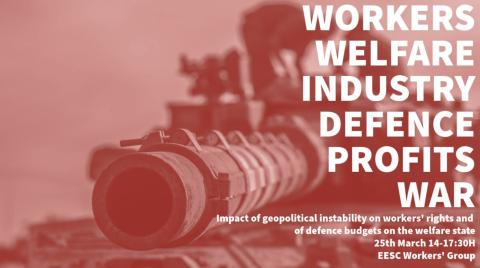
On 25th of March, the EESC Workers’ Group gathered together with a number of guest speakers from academia, trade unions and MEPs from the European Parliament, to discuss the current geopolitical situation, its impact on social and defence expenditure, its spillovers on supply chains and industry, and the consequences for the welfare states and workers’ rights.
The discussion showed the existing tension between the demands of defence, and the opportunity costs vis à vis social investment and civilian research and development. These demands for defence are to be balanced with social cohesion to ensure societies remain strong and democracy is not put further in jeopardy by inequality and popular polarisation, and included in a broader concept of security that must incorporate social and economic dimensions as well.
Important outcomes of the meeting were the need to highlight the peaceful nature of the EU and of any common act in defence terms, the relevance of coordination and rationalisation to ensure efficiency of defence expenditure, and the different paths towards autonomy and sovereignty, including buying EU-made weapon systems and supporting a European defence industry and a strong social Europe.
The question of the impact of defence expenditure on growth and GDP was examined in depth, offering different perspectives of the multiplier effects of defence expenditure depending on how the money is spent and on what, with much more positive impacts if the money is spent on R&D and equipment and it stays in Europe. Nevertheless, the discussion also highlighted the limited benefits of military expenditure compared with social or educational expenditure and the risks of increasing military expenditure while keeping in place stringent fiscal rules for the rest of expenses.
Lucie Studničná, Workers’ Group President, said: “The EU is a project of peace. It must continue to be a project of peace. But we cannot be naive about our environment. The balance between pacifism and defence is not an easy one, but we must find it. The EU needs its own voice for this purpose. We must keep peace at the centre of our efforts: trade unions know well that when they call for war, it is workers who are sent to die, and weapons manufacturers who reap the benefits. We must never forget this”
Work organisation
Related content



Recommended for you
Toghadh Séamus Boland ina Uachtarán ar Choiste Eacnamaíoch agus Sóisialta na hEorpa, agus gheall sé go gcuirfear an tsochaí shibhialta i gcroílár na hEorpa
News
Toghadh Séamus Boland na hÉireann ar an 35ú Uachtarán ar Choiste Eacnamaíoch agus Sóisialta na hEorpa (CESE) le haghaidh an téarma oifige 2025-2028. Is urlabhra riamh anall é do phobail na tuaithe…
CESE, Uachtarántacht na hÉireann agus an fhís choiteann atá acu
News
I ndiaidh na díospóireachta a reáchtáladh le Comhaltaí CESE le linn sheisiún iomlánach mhí Iúil, níl aon dabht faoi ach go bhfuil clár Uachtaránacht reatha an Aontais ag freagairt go mór do na…
#YEYS2022: Ceist na bréagaisnéise pléite ag aos óg na hEorpa agus a dtuairimí ina leith curtha in iúl acu don Leas-Uachtarán Jourová
News
Chuir daltaí meánscoile ó gach cearn den Eoraip ocht gcinn de thograí nithiúla faoi bhráid Leas-Uachtarán an Choimisiúin Eorpaigh um Luachanna agus um Thrédhearcacht, Věra Jourová. Bhí páirt á…
#CivilsocietyforUkraine
News
Cáineann CESE ionradh Rialtas na Rúise ar an Úcráin, ionradh atá gan údar agus gan chúis Rún ó Choiste Eacnamaíoch agus Sóisialta na hEorpa (CESE) maidir leis an gcogadh san Úcráin agus an tionchar…
Eagrán speisialta de CESE info
News
Eagrán speisialta de CESE info atá dírithe ar an Úcráin. Is féidir scéal Tetyana Ogarkova a léamh, bean a chuala fuaim ionradh na Rúise ar dhúiseacht di an 24 Feabhra.