
European Economic
and Social Committee
Building strong societies for peace, solidarity, and international law: Workers in the face of geopolitical instability
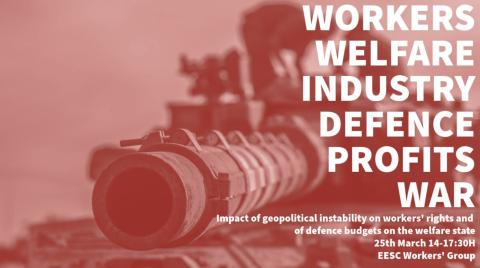
On 25th of March, the EESC Workers’ Group gathered together with a number of guest speakers from academia, trade unions and MEPs from the European Parliament, to discuss the current geopolitical situation, its impact on social and defence expenditure, its spillovers on supply chains and industry, and the consequences for the welfare states and workers’ rights.
The discussion showed the existing tension between the demands of defence, and the opportunity costs vis à vis social investment and civilian research and development. These demands for defence are to be balanced with social cohesion to ensure societies remain strong and democracy is not put further in jeopardy by inequality and popular polarisation, and included in a broader concept of security that must incorporate social and economic dimensions as well.
Important outcomes of the meeting were the need to highlight the peaceful nature of the EU and of any common act in defence terms, the relevance of coordination and rationalisation to ensure efficiency of defence expenditure, and the different paths towards autonomy and sovereignty, including buying EU-made weapon systems and supporting a European defence industry and a strong social Europe.
The question of the impact of defence expenditure on growth and GDP was examined in depth, offering different perspectives of the multiplier effects of defence expenditure depending on how the money is spent and on what, with much more positive impacts if the money is spent on R&D and equipment and it stays in Europe. Nevertheless, the discussion also highlighted the limited benefits of military expenditure compared with social or educational expenditure and the risks of increasing military expenditure while keeping in place stringent fiscal rules for the rest of expenses.
Lucie Studničná, Workers’ Group President, said: “The EU is a project of peace. It must continue to be a project of peace. But we cannot be naive about our environment. The balance between pacifism and defence is not an easy one, but we must find it. The EU needs its own voice for this purpose. We must keep peace at the centre of our efforts: trade unions know well that when they call for war, it is workers who are sent to die, and weapons manufacturers who reap the benefits. We must never forget this”
Work organisation
Related content



Recommended for you
EWSA: Die EU muss die soziale Nachhaltigkeit stärker ins Blickfeld rücken
News
Der Europäische Wirtschafts- und Sozialausschuss (EWSA) fordert die Europäische Kommission auf, einen längst überfälligen Bericht zu veröffentlichen und die Ausweitung des Anwendungsbereichs der EU…
Ko-Kreation von Dienstleistungen von allgemeinem Interesse im Bereich Gesundheit als Beitrag zur Stärkung der partizipativen Demokratie in der EU
News
Bei dieser vom Europäischen Wirtschafts- und Sozialausschuss (EWSA) und der Universität Debrecen organisierten Veranstaltung wurde hervorgehoben, wie wichtig die Ko-Kreation von Dienstleistungen von…
Zur Bekämpfung des Klimawandels werden mehr öffentliche Investitionen in die Energieinfrastruktur in der EU gebraucht
News
In einer auf der Plenartagung im September verabschiedeten Stellungnahme erläutert der Europäische Wirtschafts- und Sozialausschuss (EWSA), dass zur Verwirklichung der Energiewende und der Klimaziele…
Energie – EWSA warnt vor neuen Abhängigkeiten
News
Der Europäische Wirtschafts- und Sozialausschuss (EWSA) bezieht in einer auf seiner September-Plenartagung verabschiedeten Stellungnahme klar Stellung zum Thema Energie: Der Vorschlag der Kommission…
Der EU-US-Handels- und Technologierat muss die Dynamik nutzen, um ein Wegweiser für Handel, Technologie und Innovation zu werden
News
Auf seiner Juli-Plenartagung zeigte sich der Europäische Wirtschafts- und Sozialausschuss (EWSA) optimistisch, dass der neue Handels- und Technologierat (TTC) ein innovatives Instrument für die EU…