European Economic
and Social Committee
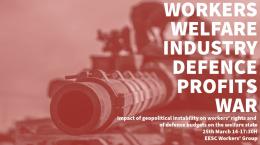
European Defence and Strategic Autonomy: no arbitrary expenditure without a plan, not at the cost of our welfare state

On 25th June 2025, NATO's summit in the Hague reached a decision to invest 5% of GDP in defence. This rather arbitrary number was first proposed by US President Trump at the end of 2024, and was initially deemed unlikely by most allies (the US spends circa 3.1% of its GDP in defence, for instance), as the initial talks considered a new 3% target (over the old 2%). However, in recent months, European leaders have fallen in line, and all have signed the final declaration, with the only differing note of Spain, which, despite signing it, stated that it could reach the defence commitments while spending 2.1% of GDP (Spain currently spends around 1.3% of GDP). On the 26th of June, the European Council acknowledged this meeting and the need for a stronger effort in defence, although it did not make a comment on specific figures.
The Workers' Group is well aware of the different threats that Europe faces, and the need to back our strategic autonomy with the capacity to defend ourselves and to continue supporting Ukraine, particularly with an increasingly erratic United States. Nevertheless, we are also well aware that the combined expenditure of EU member states almost triplicates Russia and surpasses China, that we have more troops than the US, and that, somehow, we have very little to show for it. Around 4% of our forces can actually be deployed, and our national armies use dozens of weapon systems and purchase them without coordination. Moreover, lacking key enablers, our armed forces cannot conduct most autonomous operations without US support.
The Workers' Group is also aware of what 5% of GDP means: in many countries, such as Spain or Italy, it means 70 to 80% of the cost of the whole healthcare system. Most EU countries run budget deficits and have debt levels of sometimes more than 100% of GDP. We are not even certain if this new 5%, if ever reached, will mean that the US will fully endorse Article 5 again. But it will cost dearly to the quality of public healthcare, education, pensions and other services.
We therefore call for workers, civil society at large, political parties and citizens to oppose this arbitrary 5% target. As ETUC said, defence spending must not mean attacks on social budgets.
Europe needs a plan for its defence. And, in some cases, will need more resources, but in most what will need is better coordination and integration, as the White Paper on European Defence and other related files already point out. Without a clear plan on what to buy, and why; without a sufficiently coordinated procurement system; without deep reforms for EU integration in the field of defence; without common logistical and weapons platforms to cover gaps; the result will likely be a lot of money thrown chaotically to satisfy Trump's desire of selling his equipment.
Under heavy indebtment and welfare cuts, we will be left with a bloated version of the current situation in which we have to deal with a very expensive yet scarcely operable army. Europe will still lack strategic autonomy, our dependency on a single supplier (the US) will have probably increased, and we will face deep social and economic consequences.