
European Economic
and Social Committee
Building strong societies for peace, solidarity, and international law: Workers in the face of geopolitical instability
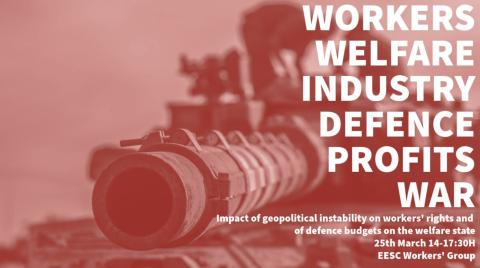
On 25th of March, the EESC Workers’ Group gathered together with a number of guest speakers from academia, trade unions and MEPs from the European Parliament, to discuss the current geopolitical situation, its impact on social and defence expenditure, its spillovers on supply chains and industry, and the consequences for the welfare states and workers’ rights.
The discussion showed the existing tension between the demands of defence, and the opportunity costs vis à vis social investment and civilian research and development. These demands for defence are to be balanced with social cohesion to ensure societies remain strong and democracy is not put further in jeopardy by inequality and popular polarisation, and included in a broader concept of security that must incorporate social and economic dimensions as well.
Important outcomes of the meeting were the need to highlight the peaceful nature of the EU and of any common act in defence terms, the relevance of coordination and rationalisation to ensure efficiency of defence expenditure, and the different paths towards autonomy and sovereignty, including buying EU-made weapon systems and supporting a European defence industry and a strong social Europe.
The question of the impact of defence expenditure on growth and GDP was examined in depth, offering different perspectives of the multiplier effects of defence expenditure depending on how the money is spent and on what, with much more positive impacts if the money is spent on R&D and equipment and it stays in Europe. Nevertheless, the discussion also highlighted the limited benefits of military expenditure compared with social or educational expenditure and the risks of increasing military expenditure while keeping in place stringent fiscal rules for the rest of expenses.
Lucie Studničná, Workers’ Group President, said: “The EU is a project of peace. It must continue to be a project of peace. But we cannot be naive about our environment. The balance between pacifism and defence is not an easy one, but we must find it. The EU needs its own voice for this purpose. We must keep peace at the centre of our efforts: trade unions know well that when they call for war, it is workers who are sent to die, and weapons manufacturers who reap the benefits. We must never forget this”
Work organisation
Related content



Recommended for you
Rolul activ al societății civile organizate este esențial pentru o UE rezilientă
News
CESE a organizat, în sesiune plenară, o dezbatere privind importanța tot mai mare a societății civile organizate și a orașelor în asigurarea capacității Europei de a face față șocurilor asimetrice și…
Crearea în comun a serviciilor publice în sectorul sănătății va contribui la o democrație mai participativă în UE
News
Acest eveniment, organizat de Comitetul Economic și Social European (CESE) și de Universitatea din Debrecen, a evidențiat importanța crucială a creării în comun a serviciilor de interes general în…
Pentru a combate schimbările climatice, UE are nevoie de mai multe investiții publice în infrastructura energetică
News
Într-un aviz adoptat în sesiunea plenară din septembrie, Comitetul Economic și Social European (CESE) consideră că, pentru a realiza tranziția energetică și obiectivele climatice, sunt necesare…
Energie – CESE avertizează cu privire la crearea de noi dependențe
News
Într-un aviz adoptat în sesiunea sa plenară din septembrie Comitetul Economic și Social European (CESE) adoptă o poziție fermă în domeniul energiei: propunerea Comisiei reprezintă un pas în direcția…
Tranziția digitală trebuie să fie echitabilă: drepturile omului și controlul uman asupra mașinii trebuie să rămână valori fundamentale
News
Comitetul Economic și Social European (CESE) subliniază oportunitățile oferite de revoluția digitală, dar avertizează și cu privire la riscuri: implementate prea rapid, soluțiile digitale pot duce la…