
Laajentumismaat

This page is also available in:

ETSK on aktiivisesti mukana EU:n laajentumisprosessissa ja on kehittänyt kaksitahoisen – alueellisen ja kahdenvälisen – lähestymistavan suhteilleen kansalaisyhteiskunnan organisaatioiden kanssa laajentumismaissa.

Alueellisen lähestymistavan yhteydessä Länsi-Balkanin seurantakomitea – joka on ETSK:n pysyvä sisäinen elin – on tärkein ETSK:n toimia tällä alueella koordinoiva väline. Kahden vuoden välein järjestettävä Länsi-Balkanin kansalaisyhteiskuntafoorumi on osa seurantakomitean työtä.

ETSK työskentelee myös kahdenvälisesti Länsi-Balkanin maiden ja Turkin kanssa. ETSK on perustanut näiden maiden ja EU:n välillä tehtyjen assosiaatiosopimusten pohjalta Turkin, Montenegron ja Serbian kanssa kolme yhteiselintä, joissa on mukana kansalaisyhteiskunnan edustajia, jotta kansalaisyhteiskunnan organisaatiot voisivat osallistua liittymistä edeltäviin prosesseihin ja liittymisprosesseihin. Kussakin elimessä on sama määrä jäseniä ETSK:sta ja kumppanimaista, ja ne kokoontuvat kahdesti vuodessa.

ETSK pitää säännöllisesti yhteyttä niiden laajentumismaiden kansalaisyhteiskunnan organisaatioihin, joiden kanssa ei ole vielä perustettu kansalaisyhteiskunnan edustajien yhteiselintä, ja järjestää niiden kanssa yhteistä toimintaa.

Yhteiselinten työtä täydentävät ETSK:n valmistelemat lausunnot yksittäisten maiden liittymistä edeltävistä prosesseista ja liittymisprosesseista sekä alueellisesti kiinnostavista aiheista.
  • Hyväksytyt on 10/07/2024 - Bureau decision date: 12/12/2023
    Viite
    NAT/924-EESC-2024
    Civil Society Organisations - GR III
    Bulgaria
    Plenary session number
    589
    -
    Download — ETSK:n lausunto: How to ensure the social, environmental and economic sustainability of the EU agri-food sector with future enlargement?
    • NAT/924 Record of the proceedings
    • Follow-up from the Commission NAT/924
  • Hyväksytyt on 30/05/2024 - Bureau decision date: 12/12/2023
    Viite
    ECO/639-EESC-2024-00535
    Workers - GR II
    Spain
    Plenary session number
    588
    -

    The European Council of December 2023 discussed the EU enlargement policy, including the stabilisation and association process and next steps in this respect. The enlargement policy will be one of the top priorities for the next coming years. One of the most important aspects of the enlargement process will be the cohesion policy and the structural funds.

    The need for a structural policy to be applied following enlargement is justified both by the external necessity of reducing the gap between the applicant countries and the EU average and by the internal necessity of combating increasing disparities amongst and within accession countries.

    Download — ETSK:n lausunto: The role of cohesion policy in upcoming rounds of EU enlargement
  • Hyväksytyt on 27/04/2021 - Bureau decision date: 01/12/2020
    Viite
    INT/930-EESC-2020
    Workers - GR II
    Malta

    The Communication stresses the EU's commitment to safeguarding an online environment providing the highest possible freedom and security, for the benefit of its citizens.

    Download — ETSK:n lausunto: Communication on cybersecurity strategy
  • Hyväksytyt on 10/07/2014
    Viite
    REX/401-EESC-2014-1609
    Civil Society Organisations - GR III
    Plenary session number
    500
    -

    This own-initiative opinion will draw upon the first-hand experiences of the non-state actors (civil society, business and trade unions) engaged in the accession negotiations between Croatia and the EU over the period 2005-11, as well as experiences of EESC members who have been engaged in the work of Joint Consultative Committees (JCCs) with accession countries over the past seven years (Croatia, the former Yugoslav Republic of Macedonia, Turkey and Montenegro) as well as the Western Balkans Follow-up Committee.

    Download — Enhancing the transparency and inclusiveness of the EU accession process
  • Hyväksytyt on 21/01/2014
    Viite
    ECO/359-EESC-2014-7379
    Employers - GR I
    Greece
    Plenary session number
    495
    -

    The EESC welcomes the special attention devoted to drawing up a European Union Strategy for the Adriatic and Ionian Region (EUSAIR), in order to support cohesion and competitiveness in the light of challenges that cannot be satisfactorily resolved by single regions or countries through the usual means. The EESC believes that EUSAIR must adopt a comprehensive programme with an action-oriented list of projects and schemes, and strongly recommends that better use be made of the private sector's potential to attract investment (both local and international) and to create business opportunities. Simultaneously, the strategy should include a stronger social dimension, in order to better support inclusive growth in the Adriatic and Ionian region.

    Download — EU Strategy for the Adriatic and Ionian Region (EUSAIR)
  • Hyväksytyt on 10/07/2013
    Viite
    REX/381-EESC-2013-1176
    Civil Society Organisations - GR III
    Romania
    Workers - GR II
    Austria
    Plenary session number
    491
    -

    The opinion should take stock of the current situation of civil society in Serbia (legal environment, relations with the authorities, situation of social and civil dialogues) and propose recommendations for possible EU action in this field. The opinion will provide an opportunity to get the views of Serbian civil society organisations in the course of a study visit to Serbia.

    Download — The role of civil society in EU-Serbia relations
  • Hyväksytyt on 12/03/2008
    Viite
    REX/239-EESC-2008-01-01-505
    Plenary session number
    443
    -
    Download — EU-Former Yugoslav Republic of Macedonia
  • Hyväksytyt on 24/10/2007
    Viite
    REX/237-EESC-2007-1468
    Civil Society Organisations - GR III
    Austria
    Plenary session number
    439
    -
    Download — Croatia on the road to accession
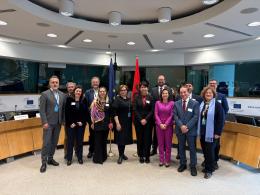
  • Albania remains firmly committed to EU integration, advancing accession negotiations and implementing the growth plan for the Western Balkans, with reforms in the rule of law, digitalisation and the green transition. However, anti-corruption and media freedom require further robust efforts. These topics were at the centre of discussions during the 2nd meeting of the EU-Albania Civil Society Joint Consultative Committee on 21 November 2025.

  • Reference number
    31/2025

    At an Enlargement Forum hosted by the European Economic and Social Committee (EESC), civil society representatives from candidate countries commended the Committee’s Enlargement Candidate Members initiative as a vital tool for shaping their countries’ European integration process and bolstering public support for EU accession.