Pays de l’élargissement

This page is also available in:

Le CESE participe activement au processus d’élargissement de l’Union et a défini une approche double - régionale et bilatérale - dans ses relations avec les organisations de la société civile dans les pays de l’élargissement.

En ce qui concerne l’approche régionale, le comité de suivi «Balkans occidentaux», un organe interne permanent du CESE, constitue le principal instrument pour la coordination des activités du CESE dans cette région. Le forum de la société civile des Balkans occidentaux, qui se tient tous les deux ans, fait partie du travail du comité de suivi.

Le CESE travaille aussi de façon bilatérale avec les pays des Balkans occidentaux et avec la Turquie. Sur la base des accords d’association conclus entre ces pays et l’Union, le CESE a créé, avec le Monténégro, la Serbie et la Turquie, trois organes conjoints incluant des représentants de la société civile afin d’associer les organisations de la société civile aux processus de préadhésion et d’adhésion. Chaque organe se compose d’un nombre identique de membres du CESE et du pays partenaire et se réunit deux fois par an.

Le CESE entretient des contacts réguliers et organise des activités conjointes avec les organisations de la société civile des pays de l’élargissement pour lesquels il n’existe pas encore d’organe conjoint des représentants de la société civile.

Le travail des organes conjoints est complété par la préparation d’avis du CESE sur les processus de préadhésion et d’adhésion de chacun des pays, ainsi que sur des thèmes d’intérêt régional.

  • Building an Inclusive Future in an Enlarged EU: The role of Social Dialogue, Civil Society and Youth Engagement

    As part of its ongoing Enlargement Candidate Members (ECMs) initiative, the EESC hosted a second Enlargement Forum on 17 July 2025 in Brussels. The event gathered ministers for European affairs from candidate countries, senior officials from the European Commission, social partners, and civil society representatives to discuss the role of civil and social dialogue in the EU enlargement process.

  • Reference number
    31/2025

    Lors d’un forum sur l’élargissement organisé par le Comité économique et social européen (CESE), les représentants de la société civile des pays candidats ont salué l’initiative lancée par le Comité en faveur des membres de pays candidats à l’adhésion. Cette initiative constitue un outil essentiel pour façonner le processus d’intégration européenne de leurs pays et pour renforcer le soutien du public à l’adhésion à l’Union européenne (UE).

  • In this opinion the EESC:

    • believes that institutionalising civil and social dialogue accelerates the integration of candidate countries into the European social model, based on the representativeness and diversity of the social partners and civil society organisations, and their involvement in public decision-making;
    • notes that National Economic and Social Councils and other forms of institutionalised civil and social dialogue contribute significantly to strengthening the model of governance and participatory democracy. Hence, in states where they do not exist, the establishment of Economic and Social Councils will strengthen the role and place of social partners and civil society organisations in the consultation and partnership relationship with the governments of candidate and partner countries.
  • Le 25 juin 2025, le Comité économique et social européen (CESE) a organisé une manifestation dans le cadre de la Semaine européenne de la diplomatie publique, lancée pour la première fois par le Service européen pour l’action extérieure (SEAE). Les participants ont mis en évidence une dimension fondamentale de l’action européenne: la contribution de la société civile à la diplomatie publique dans des domaines allant du commerce international à l’eau, en passant par l’élargissement. La société civile est en effet susceptible d’apporter une valeur ajoutée lorsque des questions politiques ou d’autres problèmes restreignent la portée de la diplomatie officielle. 

  • Published in
    13 pages

    Le Comité économique et social européen (CESE) a adopté le 19 juin 2025 une résolution visant à fournir à la Commission européenne une contribution à son programme de travail 2026.

  • Reference number
    20/2025

    The European Economic and Social Committee (EESC) launched its 10th Western Balkans Civil Society Forum today in Budva, Montenegro, gathering over 100 participants to discuss how to accelerate socio-economic convergence with the EU for improved living standards across the region. The two-day Forum, 13-14 May is taking place in Budva, Montenegro, to support Montenegro's ambition to become the next EU Member State by 2028 and to serve as a model for the rest of the region. 

  • Reference number
    16/2025

    The European Economic and Social Committee (EESC), the European Training Foundation (ETF), and Eurofound are joining forces on 3 April in Tirana for a high-level event focused on promoting effective social dialogue and collaboration in the Western Balkans. Titled Enhancing quality of work and life through effective social dialogue in the Western Balkans, the by-invitation-only event will bring together key stakeholders to explore challenges and opportunities in the region’s labour markets and social policies.

  • Published in
    8 pages

    Conclusions de la Semaine de la société civile 2025

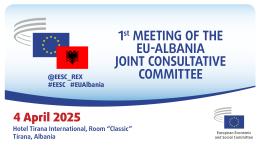
  • The first meeting of the EU-Albania Joint Consultative Committee (JCC) took place on 4 April 2025 in Tirana, Albania. This platform, established within the institutional framework of the EU-Albania Stabilisation and Association Agreement (SAA), will enable representatives from both the EU and Albanian civil society to monitor the country's accession negotiations, discuss issues of common interest, and highlight concerns to be addressed on Albanian's path towards the European Union.

  • Event type
    JCC Meeting

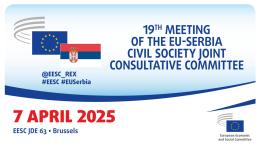
    The EU-Serbia Joint Consultative Committee (JCC) held its 19th meeting on 7 April 2025 at the EESC in Brussels. This platform, established within the institutional framework of the EU-Serbia Stabilisation and Association Agreement (SAA), will enable representatives from both the EU and Serbian civil society to monitor the country's accession negotiations, discuss issues of common interest, and highlight concerns to be addressed on Serbia's path towards the European Union.