
European Economic
and Social Committee
EFNI 2026: Making the Single Market work for SMEs
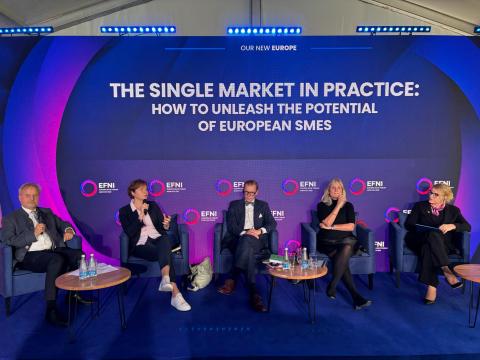
Europe's Single Market is often described as one of the EU's greatest achievements. Yet for many small and medium-sized enterprises (SMEs), its full potential remains out of reach. Regulatory fragmentation, administrative burdens, limited access to finance and difficulties in scaling across borders continue to prevent many businesses from benefiting from a market of 450 million consumers.
These issues were at the heart of a debate at the European Forum for New Ideas (EFNI) in Sopot, where EESC Employers' Group President Sandra Parthie led a delegation of EESC Employers' Group members, which included Alena Mastantuono, Antonio García del Riego, Winand Quaedvlieg and Heiko Willems, that joined policymakers, business representatives and experts to discuss how Europe can unlock the potential of its SMEs and advance the competitiveness agenda.
Together, the delegation reinforced a common message: Europe must create the right conditions for businesses to invest, innovate and grow by strengthening competitiveness, reducing unnecessary burdens and ensuring that the Single Market delivers tangible benefits for companies of all sizes.
SMEs at the centre of Europe's competitiveness
SMEs are the backbone of the European economy, responsible for the majority of private-sector jobs and a significant share of innovation. However, they are also the businesses most exposed to today's multiple pressures: high energy costs, technological disruption, geopolitical uncertainty and increasingly complex regulatory requirements.
As Europe seeks to improve its competitiveness, the challenge is not simply to create new policies for SMEs, but to ensure that existing opportunities can be accessed and used effectively. A Single Market that works well in theory but remains difficult to navigate in practice is not enough.
Simplicity backed by capacity
A key message emerging from the discussion was that SMEs need "simplicity backed by capacity": rules that are easy to understand and apply, combined with the tools and resources needed to comply with them.
Reducing administrative burdens is an important step, but simplification must deliver concrete results on the ground. Businesses operating across borders need consistent implementation of EU rules, fewer reporting obligations and an end to unnecessary national requirements that create additional costs and complexity.
At the same time, Europe must ensure that SMEs can access the support they need to manage the green and digital transitions. This includes affordable energy, access to capital, digital tools and targeted support for innovation.
A changing world of work
The discussion also highlighted how technological and economic change is reshaping the relationship between employers and employees. Flexible forms of work, hybrid working models and growing demand for specialised skills are changing expectations on both sides of the labour market.
For SMEs, the challenge is particularly acute. Skills shortages can have a disproportionate impact on smaller firms, which often lack the resources to organise extensive training programmes or compete with larger employers for talent. As a result, employability and lifelong learning are becoming increasingly important. Workers want opportunities to develop new skills and remain relevant in rapidly changing labour markets, while employers need access to skilled people who can help their businesses adapt and grow.
This is why investment in upskilling, micro-credentials and cross-border learning opportunities should form part of Europe's competitiveness agenda.
Revitalising social dialogue
Another important theme was the need to strengthen social dialogue. Effective cooperation between employers and workers remains essential for managing transitions successfully, particularly in sectors facing major technological and economic change.
For SMEs, social dialogue should not be viewed as an administrative exercise but as a practical tool that helps businesses and workers find solutions together. Sector-based approaches can play an important role in identifying skills needs, supporting adaptation and ensuring that transitions are implemented in a way that works for both companies and employees.
From survivors to drivers of change
To fully unleash the potential of European SMEs, policymakers must focus on three key priorities: skilled people, resilience against economic shocks and easier access to markets. Measures that support investment, facilitate cross-border business activities and strengthen skills development can help SMEs become more competitive and innovative.
The success of Europe's Single Market will ultimately be judged by a simple question: does it work for smaller businesses as well as it works for larger ones? If Europe can reduce barriers, provide the right conditions for growth and ensure consistent implementation of its rules, SMEs will continue to do what they do best: create jobs, drive innovation and support Europe's economic prosperity.
Europe does not need more obstacles for its SMEs. It needs a Single Market that delivers in practice, enabling businesses of all sizes to invest, innovate and grow across borders.
Work organisation
Recommended for you
„Sinu Euroopa, Sinu arvamus“ 2023: noored soovivad läbipaistvamat, digitaalsemat ja lihtsamat ELi
News
23. ja 24. märtsil korraldas Euroopa Majandus- ja Sotsiaalkomitee 14. korda ürituse „Sinu Euroopa, Sinu arvamus“. Üritus tõi Brüsselisse 105 õpilast 35 koolist kõigist 27…
Algab kandideerimine Euroopa Majandus- ja Sotsiaalkomitee kodanikuühiskonna auhinnale, mille teemaks on vaimne tervis
News
Kodanikuühiskonna organisatsioonid, üksikisikud ja eraettevõtted saavad nüüd esitada oma mittetulunduslikke projekte, et konkureerida Euroopa Majandus- ja Sotsiaalkomitee auhinnale, mis on pühendatud…
Valimised 2024. aasta juunis: Euroopa Majandus- ja Sotsiaalkomitee kutsub eurooplasi üles hääletama ühtse ja demokraatliku Euroopa poolt
News
Uue Euroopa Parlamendi valimistel on palju kaalul, sest demokraatia on nõrgenemas kogu maailmas, desinformatsioon on laialt levinud ja rahulolematus kasvab, kuna inflatsioon kiireneb ja sõjaoht…
TENi sektsiooni esimees Baiba Miltoviča ja Euroopa Regioonide Komitee raportöör Andres Jaadla kirjutavad alla elamumajandust käsitlevale deklaratsioonile
News
14. novembril 2024 allkirjastatud ühisavalduses kutsuvad Euroopa Majandus- ja Sotsiaalkomitee transpordi, energeetika, infrastruktuuri ja infoühiskonna sektsiooni (TEN) esimees Baiba…
EL peab transpordisektori CO2 heite vähendamiseks viivitamatult keskenduma saastevabale vesinikule
News
Eestis toimunud konverentsil rõhutati, et vähese CO2 heitega vesinik on energiasüsteemi eduka ümberkujundamise põhielement, mille potentsiaali arendamiseks on aga vaja taristut ja rahastamist.Ürituse…