
European Economic
and Social Committee
Revitalizing Democracy in Europe: Urgent Action Needed to Bridge Gaps and Inspire Change
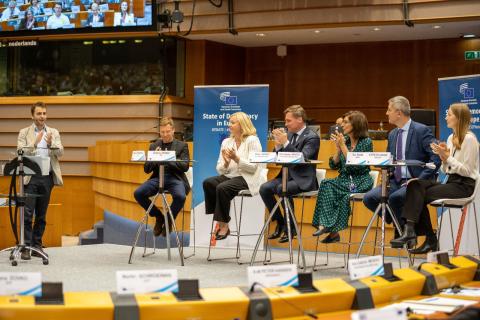
The European elections proved that the pro-European majority still holds, but also showed that voters across the EU demand urgent political and legislative responses to the challenges raised in the electoral campaign. Otherwise, the pro-European majority may risk losing support as citizens may increasingly turn their backs on the mainstream political forces.
At its July plenary session, the European Economic and Social Committee (EESC) hosted a debate on the state of democracy in Europe. This is the first debate to take place since the European elections with the President of the European Parliament, Roberta Metsola and the representatives of the political groups of the newly elected European Parliament.
EESC president Oliver Röpke said that ‘The European elections in June were a wake-up call and it is our duty to reflect on the state of democracy today, after these election results. We are united in our conviction that the European Union is the only answer in this respect: it promotes and defends democracy in Europe by involving all possible actors – from civil society and the social partners, to national authorities, national and European politicians and institutions. Together, we can truly make democracy more open, resilient and inclusive – and deliver a form of democracy that visibly improves lives across Europe.’
The President of the European Parliament, Roberta Metsola said that enthusiasm for Europe was still alive and democracy was vibrant. ‘One thing that I learned during this campaign is that we can really regain that narrative. We can recapture that enthusiasm for Europe that we saw in each of the Member States during the election campaign - particularly with young voters, who were voting for the first time.’
In order to consolidate support for democracy in Europe, the EU, as Ms Metsola pointed out, must prove that politics is still the best agent for positive change in societies and communities. ‘Employers, workers, civil society are essential to European construction - across our European towns, cities and regions. Because that is where Europe starts and where democracy is in action.’ One of the most urgent tasks for the EU is to address the need for more accessible housing across the Union.
In the debate with the representatives of the political groups, Željana Zovko, Vice-Chair of the European People’s Party (EPP), the biggest group in the European Parliament, said that the group expected that the policies begun during the previous mandate would be pursued.
Ana Catarina Mendes, Vice-president of the Socialists & Democrats (S&D) Group, said that it was vital to focus on implementing the European Pillar of Social Rights and combating poverty. Dan Barna, Vice-Chair of the RENEW Group, urged the new European Commission to defend the rule of law using existing tools in a more effective way. Kira-Marie Peter-Hansen, Vice-Chair of the GREENS/EFA Group, spoke about how important it was to keep the Green Deal as a crucial EU policy. Martin Schirdewan, Co-Chair of the LEFT Group, made it clear that they will call on the new Commission to deal with the cost of housing crisis.
The EESC’s Employers’ Group president, Stefano Mallia said that ‘Ringing alarm bells signalling the decline of democracy have become louder and louder. At the last European elections, we witnessed a worrying degree of voter support for the idea of strong leaders. The emergence of antidemocratic attitudes among young people is a major concern. Efforts to undermine democracy by using spyware against journalists, imposing restrictions on civil society organisations, overtly politicising the appointment of judges and disregarding the rule of law show that democracy needs attention and must be reinvented to fit the 21st century. This is the time to act if we want to avoid sleepwalking into disaster.’
The EESC’s Workers’ Group president, Lucie Studničná, said that ‘After the surge of votes for far-right parties in the last European elections, this is the last chance to show that politicians have heard people’s anger, frustration and, in some cases, despair - and have the political will to act. Over the next five years, we need ambitious action to provide hope and address the huge challenges we face regarding climate change, inequality, sustainable growth, demographic change, security and technological change. That is why we, the trade unions, are calling for a new Social Contract, centred around social progress.’
The EESC’s Civil Society Organisations’ Group president, Séamus Boland, stressed the importance of strong political alliances and called for deeper collaboration between the European Parliament and the EESC on civil dialogue. ‘The chasm between the electorate and the elected has become dangerously wide. We have to reach out to citizens and we can do this best working together as partners. Through the EESC, the Parliament can reach civil society organisations, which are the bedrock of European societies and communities.’
Work organisation
Downloads
-
Revitalizing Democracy in Europe: Urgent Action Needed to Bridge Gaps and Inspire Change
Recommended for you
„Sinu Euroopa, Sinu arvamus“ 2023: noored soovivad läbipaistvamat, digitaalsemat ja lihtsamat ELi
News
23. ja 24. märtsil korraldas Euroopa Majandus- ja Sotsiaalkomitee 14. korda ürituse „Sinu Euroopa, Sinu arvamus“. Üritus tõi Brüsselisse 105 õpilast 35 koolist kõigist 27…
Algab kandideerimine Euroopa Majandus- ja Sotsiaalkomitee kodanikuühiskonna auhinnale, mille teemaks on vaimne tervis
News
Kodanikuühiskonna organisatsioonid, üksikisikud ja eraettevõtted saavad nüüd esitada oma mittetulunduslikke projekte, et konkureerida Euroopa Majandus- ja Sotsiaalkomitee auhinnale, mis on pühendatud…
Valimised 2024. aasta juunis: Euroopa Majandus- ja Sotsiaalkomitee kutsub eurooplasi üles hääletama ühtse ja demokraatliku Euroopa poolt
News
Uue Euroopa Parlamendi valimistel on palju kaalul, sest demokraatia on nõrgenemas kogu maailmas, desinformatsioon on laialt levinud ja rahulolematus kasvab, kuna inflatsioon kiireneb ja sõjaoht…
TENi sektsiooni esimees Baiba Miltoviča ja Euroopa Regioonide Komitee raportöör Andres Jaadla kirjutavad alla elamumajandust käsitlevale deklaratsioonile
News
14. novembril 2024 allkirjastatud ühisavalduses kutsuvad Euroopa Majandus- ja Sotsiaalkomitee transpordi, energeetika, infrastruktuuri ja infoühiskonna sektsiooni (TEN) esimees Baiba…
EL peab transpordisektori CO2 heite vähendamiseks viivitamatult keskenduma saastevabale vesinikule
News
Eestis toimunud konverentsil rõhutati, et vähese CO2 heitega vesinik on energiasüsteemi eduka ümberkujundamise põhielement, mille potentsiaali arendamiseks on aga vaja taristut ja rahastamist.Ürituse…