
European Economic
and Social Committee
EESC Jubilee: EU needs even more social dialogue
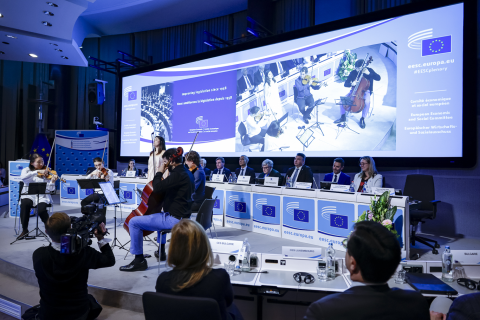
The EESC is a success story, but the European Union needs to make an even stronger effort to uphold its social contract, solidarity, a fair economy and inclusiveness. This is the key to preserving its European values.
The European Economic and Social Committee (EESC) was established by the Treaty of Rome (signed in March 1957), and held its first plenary session in May 1958. Its past experience and lessons for the future were the subject of a debate on the "Celebration of the 65th anniversary of the European Economic and Social Committee: Empowering Civil Society, Defending Democracy", held on 13 December 2023 in Brussels. ''Over the past 65 years, the Committee has built a true platform for civil society to freely express its views to improve the EU's legislation. In the changing geopolitical context, the voice of a strong and independent civil society is now more important than ever. It is civil society, in its role as watchdog, who makes sure nobody switches off the checks and balances, the rule of law or fundamental rights and values – so that nobody 'unplugs democracy'', said EESC President Oliver Röpke.
EESC members represent the variety of civil society organisations across Europe, including business, trade unions and other interest groups. It is an EU consultative body that delivers opinions to the European Commission, the EU Council and the European Parliament, acting as a bridge between the EU's decision-making institutions and EU citizens. "The EESC has turned 65 and you might have thought it was time to retire. But the opposite is true. The EESC is needed now more than ever, when so many Europeans face difficulties. The attempt to ignore the role of organised social dialogue should be resisted. Other EU institutions should listen to us more and more," urged Georges Dassis, former President of the EESC and President of the Association of former members of the EESC.
As highlighted during the debate, the EESC has been a leading partner in the debate on the European Pillar of Social Rights in recent years. The EESC was also an integral part of the Conference on the Future of Europe, whose final recommendations explicitly mentioned the EESC as an instrument for increasing participation and transparency in EU democracy. Recent examples of the EESC's pioneering role include being the first to call for a proper European Health Union and being at the forefront of proposing the "right to repair". Stefano Mallia, President of the Employers' Group, stressed the importance of the impact of the EESC's work, highlighting the improvements made in legislation since 1958: "In recent months, we have accomplished several key goals, including the competitiveness check and an EU Blue Deal. And we will continue to work to bring forward the views of the people we represent."
The energy transition, the fight against the climate crisis and the response to the geopolitical threat posed by Russia are just some of the challenges that reinforce the need for an EESC that helps to build consensus for the common good, to promote the values of European integration and to advance the cause of participatory democracy and civil society organisations. "For 65 years, the EESC has provided a platform for trade union representatives to engage in meaningful discussions with employers, civil society organisations and other institutions of the European Union. The success of the EESC lies in collaboration. By bringing together representatives from many different groups in society, we manage to produce opinions with many different perspectives. This inclusivity ensures that our work stays in line with democratic principles,” said Lucie Studničná, President of the Workers' Group.
Séamus Boland, President of the Civil Society Organisations' Group, called for the EESC to be fully mobilised for next year's European elections. "The EU must bring collective problem-solving to common European challenges. Whether we achieve this will largely depend on the results of next year's European Parliament elections. The EESC and its members have a mandate and a responsibility to reach out to citizens through their networks of civil society organisations to address disinformation, fears and lack of trust. We must also reiterate our call for real measures to implement dialogue with civil society at EU level in all policy areas," said Boland.
Background information
The EESC is a consultative body that gives representatives of Europe's socio-occupational interest groups and others a formal platform to express their points of view on EU issues.
Consultation of the EESC by the Commission or the Council is mandatory in certain cases; in others it is optional – all EESC opinions are addressed to the Council, the European Commission and the European Parliament. Since it was established, the EESC has expanded into a forum for the single market and endeavours through a variety of fora to bring the EU closer to the people.
Find out more about the history of the EESC
For more information, please contact:
EESC Press Unit – Agata Berdys
+32 (0)2 546 9476
@EESC_PRESS
Recommended for you
„Sinu Euroopa, Sinu arvamus“ 2023: noored soovivad läbipaistvamat, digitaalsemat ja lihtsamat ELi
News
23. ja 24. märtsil korraldas Euroopa Majandus- ja Sotsiaalkomitee 14. korda ürituse „Sinu Euroopa, Sinu arvamus“. Üritus tõi Brüsselisse 105 õpilast 35 koolist kõigist 27…
Algab kandideerimine Euroopa Majandus- ja Sotsiaalkomitee kodanikuühiskonna auhinnale, mille teemaks on vaimne tervis
News
Kodanikuühiskonna organisatsioonid, üksikisikud ja eraettevõtted saavad nüüd esitada oma mittetulunduslikke projekte, et konkureerida Euroopa Majandus- ja Sotsiaalkomitee auhinnale, mis on pühendatud…
Valimised 2024. aasta juunis: Euroopa Majandus- ja Sotsiaalkomitee kutsub eurooplasi üles hääletama ühtse ja demokraatliku Euroopa poolt
News
Uue Euroopa Parlamendi valimistel on palju kaalul, sest demokraatia on nõrgenemas kogu maailmas, desinformatsioon on laialt levinud ja rahulolematus kasvab, kuna inflatsioon kiireneb ja sõjaoht…
TENi sektsiooni esimees Baiba Miltoviča ja Euroopa Regioonide Komitee raportöör Andres Jaadla kirjutavad alla elamumajandust käsitlevale deklaratsioonile
News
14. novembril 2024 allkirjastatud ühisavalduses kutsuvad Euroopa Majandus- ja Sotsiaalkomitee transpordi, energeetika, infrastruktuuri ja infoühiskonna sektsiooni (TEN) esimees Baiba…
EL peab transpordisektori CO2 heite vähendamiseks viivitamatult keskenduma saastevabale vesinikule
News
Eestis toimunud konverentsil rõhutati, et vähese CO2 heitega vesinik on energiasüsteemi eduka ümberkujundamise põhielement, mille potentsiaali arendamiseks on aga vaja taristut ja rahastamist.Ürituse…