Room VMA 22, EESC building, rue Van Maerlant 2, 1040 Brussels and Interactio
Brussels
Belgium
This event will feature insights from EU institutions and highlight recommendations from persons with lived experience, civil society and disability organisations. #EndForcedSterilisation #DisabilityRights
The EESC is organising a public hearing to feed into a timely own-initiative opinion which will examine civil society proposals on how to reform climate governance, including decision-making processes, negotiation frameworks, and the participation and impact of civil society organisations at global climate summits. It will also assess how international climate litigation is shaping climate negotiations and may further influence the governance of the UNFCCC, particularly in light of the International Court of Justice’s advisory opinion of 23 July 2025.
The EESC annual communication event for civil society communicators, the Connecting EU Seminar, will this year delve into Europe’s ability to uphold its core values as its economic priorities shift and pressure on democratic trust and civic spaces intensifies – and on how civil society can defend them.
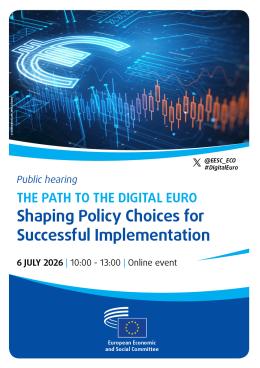
In the context of the work on the own-initiative opinion on the introduction of the digital euro, the ECO section decided to organise a public hearing bringing together experts from European and international institutions and various organised civil society.
The 5th annual All DAGs meeting took place on Monday 2 July 2026 10:00-14:00 at the EESC premises in JDE51 including a networking lunch. Over 80 participants gathered including many EU DAG Members and key EU institution stakeholders as one TSD community, to openly exchange ideas, challenges, and aspirations. The meeting featured, among others, INTA Chair Bernd Lange and Sofia Muñoz, Director at DG Trade and Economic Security, European Commission.
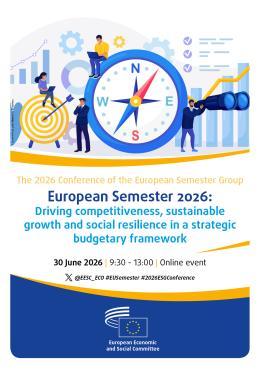
European Semester 2026: Driving competitiveness, sustainable growth and social resilience in a strategic budgetary framework
Location
online event
Belgium
The EESC’s European Semester Group is bringing together speakers from the EU institutions, organised civil society, the Member States and research institutes for its annual conferenceto be held on Tuesday 30 June 2026.
Meeting Venue: The Union of Chambers and Commodity Exchanges of Türkiye (TOBB)
Address: Dumlupınar Bulvarı No:252 (Eskişehir Yolu 9. Km.) 06530 /ANKARA
Ankara
Türkiye
The 43rd meeting of the EU–Türkiye Joint Consultative Committee brings together representatives of organised civil society to reinforce dialogue and cooperation between the EU and Türkiye. The opening session sets the political and institutional context through high-level interventions, including reflections on the role of civil society in a shifting geopolitical environment. The programme then focuses on SMEs, examining their resilience, competitiveness, and inclusive transformation in times of economic and global uncertainty. A second working session addresses digital transformation, innovation, and governance, with particular attention to the social and labour dimensions of technological change. The format combines policy presentations with practical testimonials, ensuring a balanced exchange between institutional perspectives and real-economy experience. Interactive discussions throughout the meeting foster stakeholder engagement and the sharing of diverse views
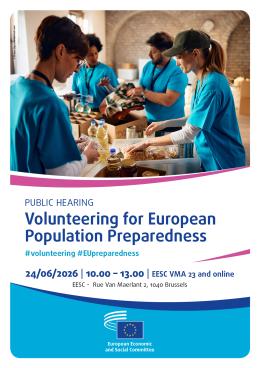
Volunteering plays a central role in building resilient and inclusive societies that are better prepared for existing and future challenges. This public hearing will gather institutional actors, civil society organisations, social partners, and experts to reflect on the role that volunteering can play in the “whole-of-society” approach to preparedness (called for by the European Commission). Discussions will feed into the related EESC Opinion (SOC/864).
Joint events of the Domestic Advisory Groups of the EU and six Central American countries were hosted by the European Unionin Brussels, on 15-16 June 2026.