Exploring the multiple facets of European security
In this issue:
Our members address European security, the focus of the Polish Presidency 2025;
Guest articles by Hans WOLTERS and Eero YRJÖ-KOSKINEN (Institute for European Environmental Policy), Juraj LIZÁK (Slovak Youth Council), and Agnieszka MAJ and Karolina ZUBEL (Center for Social Economic Research (CASE));
Reports on recent group activities;
Interview with rapporteur King JOÓ on the EESC opinion on 'Ensuring a needs-based work-life balance for all: How adequate flexible working conditions can support intergenerational solidarity and the empowerment of women'.
Civil Society Organisations' Bulletin - January 2025
This own-initiative opinion constitutes the contribution of the ECO section to the 2025 EESC transversal own-initiative opinion package on the cost-of-living crisis, looking at specific economic policy measures that can help make the European economy future-proof.
This own-initiative opinion will examine the impact of single market fragmentation on the cost of living and competitiveness and look into successful EU initiatives to tackle such issues. It will aim at proposing possible solutions, with particular attention to consumer protection, to the cost-of-living crisis.
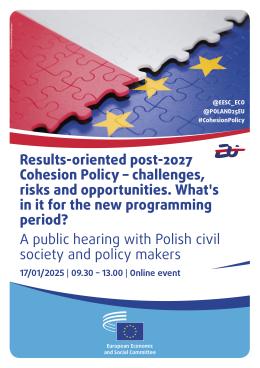
Public hearing with Polish civil society and policy makers
Event type
Public hearing
Location
Online event
ul. Wspólna 2/4
00-926 Warszawa
Warsaw
Poland
In the context of the ongoing exploratory opinion, requested by the Polish Presidency, to examine how civil society actors can make use of a results-orientation approach in cohesion policy in the next programming period, the EESC is organizing a hearing in Warsaw on 17 January 2025. The hearing will be important as the EESC will explore how civil society and local actors understand the concept of a results-orientation approach to cohesion policy, to which degree they are prepared and if they have the administrative capacity to implement it.
The hearing is co-organized with the Polish Presidency of the Council of the EU and it has the patronage of the Polish Presidency. The venue is the premises of the Ministry of Development Funds and Regional Policy of Poland.
The EESC is organising this public debat to discuss how civil society partners can use a results-orientation approach in cohesion policy for the next programming period. The principles of multi-level governance and shared management are contradictory or complementary to the results-focused cohesion policy ?
The Commission is proposing amendments to three EU regulations to ensure that EU funds can be quickly mobilised in support of post-disaster recovery.
The amendments concern theRegulations governing the European Regional Development Fund (ERDF) and the Cohesion Fund (CF), and the European Social FundPlus (ESF+), for the 2021-2027 programming period.
These proposals come as a direct response to the floods affecting Central and Eastern European countries and wildfires in Portugal in September 2024 and include injecting liquidity with increased pre- and co-financing under Cohesion Policy.
Cohesion policy in its current form has had positive impact on the socio-economic development of the EU, individual countries and regions. However, the Polish presidency points out that there is a need to improve the effectiveness of the mechanisms supporting the transformational objectives of cohesion policy. In the discussion of its future, there are ideas aimed at reforming the implementation mechanisms with the approach used in the implementation of the Recovery and Resilience Facility (RRF) implemented since 2021 as a response to the challenges arising from the COVID-19 pandemic and to support the transformation processes of economies.