
European Economic
and Social Committee
COP30 between sustainability and competitiveness: a path we must take
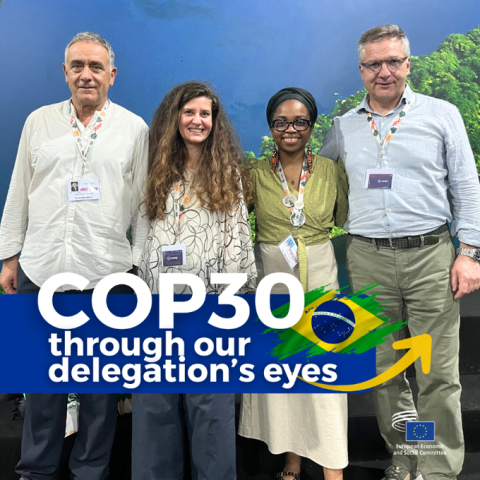
The global situation makes it very difficult to strengthen the commitment to multilateralism; these are not good times to reach consensus and seek long-term solutions. Ten years after the Paris Agreement, the world has changed remarkably, and even the institutions that appeared to be guarantors of progress toward a better quality of life for the inhabitants of our planet—with improvements in health, education, democratic consolidation, rights, and freedoms—appear weakened.
The United Nations demonstrates a clear lack of capacity; a structure largely governed by rules requiring unanimity makes decision-making more difficult than ever. The European Union, which has played a significant leadership role in the Western world, is embroiled in a war on its borders and ongoing conflicts that demand enormous political and budgetary efforts, preventing it from participating in these forums with the same impetus and energy it demonstrated ten years ago.
It is in this context that COP30 was held. What did we expect from it? A minimum of responsibility. Our hope lay in the capacity of Brazilian diplomacy to convince the countries of the so-called Global South, including China and India—major emitters of greenhouse gases, producers of fossil fuels, and committed to the growth necessary for their citizens—to accept, thus giving continuity to the agreements reached at COP28 held in Dubai in 2023, a roadmap for reduction and substitution, ambition and mitigation essential to avoid exceeding the 1.5-degree Celsius threshold, which has practically been surpassed.
Clean energy sources are available, but investment and research are needed to find solutions, and above all, a commitment to sustainability is crucial. This has not been possible, and the search for commitments has been postponed to next year's meeting in Türkiye with the Australian Presidency (COP31), but I cannot but stress that sectors as important as transport, energy or agriculture are showing that it is possible to achieve the proposed objectives without stopping the economy, and quite on the contrary, by reinforcing new lines of clearly competitive investment.
Another important chapter, to follow up on the proposals made at the 2021 Glasgow Summit and the 2022 Egypt Summit, was to strengthen the financial means to address loss and damage caused by climate change with new funding commitments. This would help the countries most affected by rising temperatures. Some consider this mechanism an obligation of wealthier nations to the less fortunate, and once again, in Belém the proposal to triple it by 2030, albeit with good intentions, was presented, although ambiguously. In my view, in just a few years, in the EU we have seen that we ourselves must equip ourselves with compensation mechanisms, insurance systems, and especially specific budget allocations within the Multiannual Financial Framework. Our countries have been suffering from droughts, fires, and floods, with significant economic costs, and even losses in human lives and material damage.
I would not conclude by saying that COP30 was a missed opportunity; it is a snapshot of a complex moment in which we must strive to find solutions. Businesses must demonstrate that achieving these goals is possible, but we need certainty, legal and regulatory security, and this requires maintaining leadership—in our case, that of the European Institutions in the multilateral arena. The EESC must continue working towards achieving these objectives.
Josep Puxeu Rocamora, Vice President of the NAT Section of the EESC.
Work organisation
Recommended for you
Η εργαλειοποίηση των μεταναστών και η προσφυγική κρίση της Ουκρανίας επιβάλλουν ένα νέο ξεκίνημα για τη μεταναστευτική πολιτική
News
Η κρατική εργαλειοποίηση των μεταναστών, που αποσκοπεί στην αποσταθεροποίηση της ΕΕ, και ο τρέχων πόλεμος στην Ουκρανία, που οδηγεί σε πρωτόγνωρη εισροή προσφύγων, επιβάλλουν την επανεξέταση της…
YEYS! 2023: Οι νέοι ζητούν μια πιο διαφανή, ψηφιακή και απλοποιημένη ΕΕ
News
Στις 23 και 24 Μαρτίου, η Ευρωπαϊκή Οικονομική και Κοινωνική Επιτροπή (ΕΟΚΕ) φιλοξένησε την 14η διοργάνωση της εκδήλωσης «Η δική σου Ευρώπη, η δική σου φωνή!» (YEYS!), η οποία προσέλκυσε στις…
Η ΕΕ χρειάζεται αποτελεσματικότερη πολυμέρεια για την αντιμετώπιση των κινδύνων που σχετίζονται με την ασφάλεια στη θάλασσα, επισημαίνει η ΕΟΚΕ
News
Η Ευρωπαϊκή Οικονομική και Κοινωνική Επιτροπή (ΕΟΚΕ) ζητεί περισσότερες κοινές δράσεις σχετικά με τη στρατηγική της ΕΕ για την ασφάλεια στη θάλασσα και το σχετικό σχέδιο δράσης, που αποσκοπούν στη…
Η ΕΟΚΕ δρομολογεί τη διαδικασία υποβολής υποψηφιοτήτων για το Βραβείο της Κοινωνίας των Πολιτών, το οποίο θα αφορά την ψυχική υγεία
News
Οι οργανώσεις της κοινωνίας των πολιτών, οι ιδιώτες και οι ιδιωτικές εταιρείες μπορούν τώρα να υποβάλουν τα μη κερδοσκοπικά έργα τους για το βραβείο της ΕΟΚΕ που είναι αφιερωμένο στη στήριξη της…
#ReskillEU — Το εργατικό δυναμικό της Ευρώπης στους τομείς της ενέργειας και των μεταφορών χρειάζεται νέες δεξιότητες για να κάνει πραγματικότητα την απανθρακοποίηση
News
Για να επιτύχει η απανθρακοποίηση των τομέων της ενέργειας και των μεταφορών της ΕΕ, οι εν λόγω τομείς χρειάζονται εργαζομένους εξοπλισμένους με «νέες» δεξιότητες, προειδοποιεί η Ευρωπαϊκή Οικονομική…