
European Economic
and Social Committee
Tackling Societal Challenges Through Trusted Partnerships
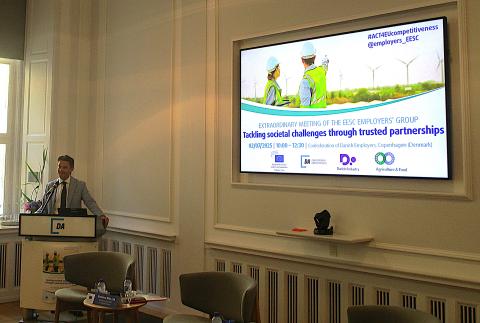
On 2 July 2025, the EESC Employers’ Group held an Extraordinary Meeting in Copenhagen titled "Tackling Societal Challenges Through Trusted Partnerships", in cooperation with the Confederation of Danish Employers, Danish Industry and Danish Agriculture and Food Council and under the Danish Presidency of the Council of the EU. The event offered a timely platform to examine how trust-based cooperation between governments, employers, and social partners can enhance Europe's competitiveness and social resilience in the face of structural transformation.
Set against the backdrop of intensifying geopolitical instability and rapid technological change, the conference sent a clear message: Europe cannot afford to treat competitiveness, security, and sustainability as separate tracks. They are interdependent pillars of a viable future.
Opening the event, Stefano Mallia, President of the Employers’ Group, lauded Denmark’s leadership in reconciling climate ambition with economic dynamism and labour market cohesion. “These are not competing objectives—they are mutually reinforcing,” he stated, pointing to Denmark’s world-leading progress in cutting emissions while growing GDP. But the deeper lesson, he argued, lies in governance: “The Danish model shows what is possible when trust, dialogue, and long-term planning replace fragmentation and short-termism.”
The first panel turned the spotlight on Denmark’s labour market model, widely seen as a benchmark for balancing flexibility and security. Jacob Holbraad, Director General of the Confederation of Danish Employers, explained how peace obligations and strong collective agreements give the Danish system its adaptability, while Morten Skov Christiansen, President of the Danish Trade Union Confederation, stressed that trust between partners is essential: “We renegotiate constantly—but we do it together, with the aim of making the economic pie bigger, not fighting over its division.”
Panelists warned that overly prescriptive EU legislation risks undermining this model by reducing the room for national social dialogue. “Europe needs smart regulation that enables, not replaces, national solutions,” Holbraad added. Echoing this, Employers’ Group members pointed to the Pay Transparency Directive as a test case, stressing the importance of implementation mechanisms that preserve subsidiarity.
A recurring theme was the role of technology and lifelong learning. As AI and automation reshape workplaces, Denmark’s system of autonomous training rights—ten days per year negotiated via collective agreements—was cited as an innovative response. “We’re not afraid of new technologies,” said Christiansen, “but we must ensure workers are prepared for them.”
The second panel examined Denmark’s green transition, with insights from Finn Mortensen, Executive Director of State of Green, and Morten Boje Hviid, CEO of the Danish Agriculture and Food Council. Both underlined how early stakeholder involvement and strong public–private partnerships have allowed Denmark to decouple growth from emissions. “It’s not just about targets,” Mortensen noted, “it’s about governance models that bring industry, government, and civil society into alignment.”
However, participants raised concerns about the uneven burden of transition. Farmers warned that without cost-effective solutions and fair competition rules, they risk being priced out of both the European and global markets. “We need policies that ensure environmental ambition does not become economic attrition,” Hviid cautioned.
There was also scepticism about consumers’ willingness to absorb higher costs associated with sustainable products. While Danish surveys show high support for climate action, “at the supermarket checkout, price still wins,” one participant noted—highlighting the need for supportive policy design and clear communication.
Throughout the conference, Denmark’s experience was presented not as a one-size-fits-all model, but as a source of transferable lessons. Social trust, mutual accountability, and regulatory coherence emerged as essential ingredients for any Member State aiming to navigate the green and digital transitions while remaining competitive.
The event came to an end with a call to strengthen the role of social partners in shaping EU policy. As Mallia summarised: “We must stop asking whether social dialogue and competitiveness are compatible. They are inseparable. If we want a strong Europe in a changing world, we must build it on cooperation, not confrontation.”
Work organisation
Recommended for you
Η εργαλειοποίηση των μεταναστών και η προσφυγική κρίση της Ουκρανίας επιβάλλουν ένα νέο ξεκίνημα για τη μεταναστευτική πολιτική
News
Η κρατική εργαλειοποίηση των μεταναστών, που αποσκοπεί στην αποσταθεροποίηση της ΕΕ, και ο τρέχων πόλεμος στην Ουκρανία, που οδηγεί σε πρωτόγνωρη εισροή προσφύγων, επιβάλλουν την επανεξέταση της…
YEYS! 2023: Οι νέοι ζητούν μια πιο διαφανή, ψηφιακή και απλοποιημένη ΕΕ
News
Στις 23 και 24 Μαρτίου, η Ευρωπαϊκή Οικονομική και Κοινωνική Επιτροπή (ΕΟΚΕ) φιλοξένησε την 14η διοργάνωση της εκδήλωσης «Η δική σου Ευρώπη, η δική σου φωνή!» (YEYS!), η οποία προσέλκυσε στις…
Η ΕΕ χρειάζεται αποτελεσματικότερη πολυμέρεια για την αντιμετώπιση των κινδύνων που σχετίζονται με την ασφάλεια στη θάλασσα, επισημαίνει η ΕΟΚΕ
News
Η Ευρωπαϊκή Οικονομική και Κοινωνική Επιτροπή (ΕΟΚΕ) ζητεί περισσότερες κοινές δράσεις σχετικά με τη στρατηγική της ΕΕ για την ασφάλεια στη θάλασσα και το σχετικό σχέδιο δράσης, που αποσκοπούν στη…
Η ΕΟΚΕ δρομολογεί τη διαδικασία υποβολής υποψηφιοτήτων για το Βραβείο της Κοινωνίας των Πολιτών, το οποίο θα αφορά την ψυχική υγεία
News
Οι οργανώσεις της κοινωνίας των πολιτών, οι ιδιώτες και οι ιδιωτικές εταιρείες μπορούν τώρα να υποβάλουν τα μη κερδοσκοπικά έργα τους για το βραβείο της ΕΟΚΕ που είναι αφιερωμένο στη στήριξη της…
#ReskillEU — Το εργατικό δυναμικό της Ευρώπης στους τομείς της ενέργειας και των μεταφορών χρειάζεται νέες δεξιότητες για να κάνει πραγματικότητα την απανθρακοποίηση
News
Για να επιτύχει η απανθρακοποίηση των τομέων της ενέργειας και των μεταφορών της ΕΕ, οι εν λόγω τομείς χρειάζονται εργαζομένους εξοπλισμένους με «νέες» δεξιότητες, προειδοποιεί η Ευρωπαϊκή Οικονομική…