
European Economic
and Social Committee
EESC July plenary to focus on post-COVID-19 recovery
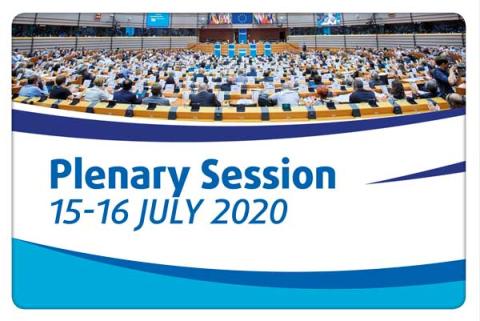
Highlights of the European Economic and Social Committee's July plenary session 15-16 July 2020
- 15 July, 3:00 pm –The EESC plenary will debate the priorities of the German Presidency of the EU with Peter Altmaier, German Federal Minister for Economic Affairs and Energy
- 16 June, 11:00 am – Debate with Paolo Gentiloni, European Commissioner for Economy.
- 16 June, 12:30 am – Debate with Margaritis Schinas, Commissioner for promoting our European Way of Life.
- 16 July, 10:15 am – The assembly will debate and vote on an EESC Resolution on the EESC's contribution to the European Commission's 2021 work programme.
Key opinions to be put to the vote:
Economy
- COVID-19 package (ECO/523 Recovery plan for Europe and MFF 2021-2027, ECO/524 REACT-EU; ECO/527 Recovery and Resilience Facility; ECO/528 Renewed InvestEU)
The EESC points out that the EU must do more for the recovery from the coronavirus pandemic and do it quickly, showing solidarity and an ambitious vision for the future of Europe. The Committee throws its support behind, and calls for a swift approval of, a number of Commission proposals aimed to help Europe recover from the crisis, ease unnecessary administrative burdens at national and EU level, support economic, social and territorial cohesion and, finally, help companies in the recovery stage.
- Enhancing sustainable economic growth across the EU (ECO/513, rapporteur: Philip von BROCKDORFF- Workers, MT)
The Committee highlights that the COVID-19 crisis is an opportunity to change the way the EU does business, without moving away from its long-term objectives for a green, sustainable and social Europe. More
- Taxation mechanics for reducing CO2 emissions (ECO/512, rapporteur: Krister ANDERSSON – Employers, SE)
The EESC addresses global warming and underlines that taxes will not be enough to reduce CO2 emissions: new measures and investments are needed to put in place a symmetric system where whoever emits CO2 is also able to remove it from the atmosphere.
- Taxation of the collaborative economy (ECO/500, rapporteur: Ester VITALE – Workers, IT)
The EESC calls for a European standard for reporting obligations of collaborative economy platforms, highlighting that harmonised rules in taxation could limit administrative burdens and reduce uncertainty in the internal market. More
Climate action
- European Climate package (NAT/784 European Climate Law, rapporteur: Jan DIRX - Diversity Europe, NL, co-rapporteur Tellervo Kylä-Harakka-Ruonala – Employers, FI; NAT/785 European Climate Pact, rapporteur Dimitris Dimitriadis - Employers, EL, co-rapporteur Peter Schmidt – Workers, DE)
After the adoption of the European Green Deal by the European Commission, the Committee provides its input in two opinions on the role of citizens in driving the transformation towards climate neutrality and how to facilitate strong public and social engagement on climate action, towards an EU economy that is sustainable, cleaner, safer and healthier.
Artificial Intelligence/Digitalisation
- White Paper on AI (INT/894, rapporteur: Catelijne MULLER – Workers, NL); Shaping Europe's Digital Future (INT/896, rapporteur: Ulrich Samm – employers, DE); co-rapporteur: Jakob Krištof Počivavšek – Workers, SI)
This report lays out the EESC's stance on the European Commission's White Paper on AI, which has also been the object of a public consultation that has elicited a huge response. The EESC's main focus is on how best to define and regulate high-risk applications to ensure a human-centric AI for Europe More. The EESC also addresses the Commission's umbrella document "Shaping Europe's digital strategy" hailing the Commission's shift towards a digital Europe for all.
Social
- Gender equality strategy (SOC/633, rapporteur: Giulia Barbucci – Workers, IT; co-rapporteur: Indrė Vareikytė – Diversity Europe, LT)
In this opinion, the EESC argues that the new Gender Equality Strategy 2020-2025, launched by the Commission shortly before the start of the pandemic, has to take into account a gender impact produced by the COVID-19 crisis. The EESC underlines that this emergency is exacerbating the already existing gender inequalities, including gender violence, and it recommends that the Commission take prompt action to implement the strategy in tandem with tackling the impact of COVID-19 on women and girls through targeted policy responses. More
Industry and trade
- A New Industrial Strategy for Europe (INT/897, rapporteur: Mihai Ivaşcu - Diversity Europe, RO; co-rapporteur: Dirk Bergrath – Workers, DE)
The new strategy is seen by the EESC as a welcome shift towards a more realistic approach to industry and trade policies in Europe following the dangerous shortfalls exposed by the COVID-19 crisis. Still, the devil is in the (lack of) detail, in the EESC's view. More
- New Circular Economy Action Plan (INT/895, rapporteur Antonello Pezzini – Employers, IT; co-rapporteur: Cillian Lohan, Diversity Europe, IE)
In this opinion the EESC welcomes the Commission's new measures for a Circular Economy capable of supporting the transition to a carbon-free Europe while highlighting the need to couple them with softer measure to bring about a change of culture. More
- Fostering competitiveness, innovation, growth and job creation by reducing market distortion (CCMI/175, rapporteur Georgi Stoev – Employers, BG; co-rapporteur: Thomas Student, CCMI delegate, DE)
This own-initiative opinion looks at the policies and measures the EU should adopt to ensure Europe's industrial competitiveness and value chains, in a context where major international players are returning to unilateralism and subsidised competitors are causing market asymmetries and disruptions.
- Implementation of Free Trade Agreements (REX/525, rapporteur Tania BUZEK - Workers, DE; co-rapporteur: Alberto Mazzola – Employers, IT)
The European Commission has released its 2019 report on the implementation of 35 major trade agreements with 62 partners, including the first full year report on CETA. The EESC welcomes this initiative but regrets that the work and voice of Domestic Advisory Groups (DAGs) remains largely absent from the implementation report and says that the impact of DAG recommendations needs to be considerably strengthened. More
Mobility
- European Year of Rail (2021) (TEN/710, rapporteur: Alberto Mazzola – Employers, IT)
The Committee supports the European Commission's proposal to turn 2021 into the year of travellers by train, stressing that rail is an example of a smart, safe and sustainable mode of transport. More
- Evaluation of the Trans- European Network – Transport (TEN-T) guidelines 2013-2020 (TEN/701, rapporteur: Alberto Mazzola – Employers, IT)
The EESC points out that completing key EU transport corridors is vital but still faces obstacles, especially at national level. An early involvement of civil society organisations could help overcome the issues. More
Jacques Delors building
15 July, 2:30 to 6:30 pm, 16 July, 10:00 am to 7:30 pm
Recommended for you
Pro odolnost EU má zásadní význam aktivní úloha organizované občanské společnosti
News
Na plenárním zasedání EHSV se diskutovalo o tom, jak roste význam organizované občanské společnosti a měst, neboť ovlivňují schopnost Evropy čelit asymetrickým otřesům a neočekávaným…
Mladí lidé coby hybatelé změn a evropské integrace zemí západního Balkánu
News
V rámci konference občanské společnosti na vysoké úrovni na téma Politika v oblasti mládeže v zemích západního Balkánu, kterou uspořádal Evropský hospodářský a sociální výbor (EHSV),…
České předsednictví chce dát Evropě nové pojetí, novou podobu a nový impuls
News
Jedním z bodů červencového plenárního zasedání Evropského hospodářského a sociálního výboru (EHSV) byla diskuse s českým ministrem zahraničních věcí Janem Lipavským o…
Vaše Evropa, váš názor (YEYS!) 2023: Mladí lidé požadují transparentnější, digitálnější a zjednodušenou EU
News
Evropský hospodářský a sociální výbor (EHSV) uspořádal ve dnech 23. a 24. března 14. ročník akce Vaše Evropa, váš názor (YEYS!). V jejím rámci se v Bruselu sešlo 105 studentů z 35 škol ze všech 27…
Spravedlivý přechod na nízkouhlíkovou společnost není možný bez účasti občanské společnosti
News
Dolní Vítkovice v Ostravě jsou bývalou průmyslovou oblastí, kde se dříve těžilo uhlí a vyráběla ocel. 11. října 2022 se zde na konferenci sešli zástupci akademické obce, místních…