
European Economic
and Social Committee
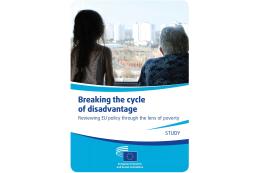
Interview with co-authors of EESC study 'Breaking the cycle of disadvantage - Reviewing EU policy through the lens of poverty'

We spoke with Matthew Geraci, Miia-Mari Paavonaho, Anaëlle Becker, Jennifer McGuinn, Júlia Zomignani Barboza, Fran Gallego Osorio, and Flore Gustave, Millieu Consulting co-authors of the new EESC study, requested by the EESC’s Civil Society Organisations’ Group.
What is this study about and why is the topic relevant?
The study Breaking the cycle of disadvantage - Reviewing EU policy through the lens of poverty looks at poverty with a specific lens, seeing it not as something static, that simply reflects one point in an individual’s life, but as something dynamic, that is transmitted between generations and shaped by the wider family and social environment. That’s what we call intergenerational poverty (IGP). The EU has mostly tended to treat poverty as a snapshot rather than a cycle, however, as disadvantage doesn’t stay still but instead travels across generations, it is important to look at it from an intergenerational perspective to be able to tackle its multiple root causes (or problem drivers, as we refer to them in our study).
What are the study’s main findings?
This study covers a lot of ground, but the findings that really surprised us emerged from the mapping of the EU policy framework. Overall, we found a strong policy focus on education, employment prospects and income, but at the same time a weaker emphasis on health, housing, social protection, gender inequality and access to essential services. What we found particularly striking was that, when viewing the EU policy framework through the lens of the problem drivers of IGP – the factors responsible for perpetuating poverty across generations – ‘low parental education’ was scarcely represented among the EU policies we assessed. This was largely due to the fact that many EU policies frame education in terms of labour market activation, with instruments supporting adult learning and upskilling for employment rather than recognising the role that a parent’s education plays in shaping not only their own but also their children’s life chances (details on page 58 of the study).
How can the study help decision-makers in implementing the EU Anti-Poverty Strategy?
We think that several of the study’s recommendations could meaningfully advance the EU Anti-Poverty Strategy’s objectives, and they can be viewed as working through two channels.
The first is at the level of EU policy. As many of the necessary policy instruments are already in place, what is needed is not fundamentally new policies, but rather a refocusing of existing ones. For instance, we recommend that the European Commission encourage Member States to rebalance education measures under EU funding instruments to better account for the needs of vulnerable parents and young families. We also propose that child rights impact assessments be used in the design of education and social policy to widen the focus towards children and their life chances.
The second channel of recommendations is through research. Our study also presents a framework that EU institutions could use to assess the potential impacts of future policies on IGP at the design stage. While the results would not be immediate, if adopted, it could better integrate IGP considerations across the EU policy framework over the long term.
What should be the focus of future research?
Designing the right policies can only happen if we properly measure and monitor IGP. Decision-makers need a clear picture of how disadvantage is passed from one generation to the next and where action is most needed. Future research should therefore explore how poverty persists across generations in different countries and which indicators are best for tracking it. It should also look beyond income, considering factors such as family instability, stigma, discrimination and psychological impacts, while addressing data gaps concerning groups often missing from poverty statistics, such as Roma people, homeless people and undocumented migrants.
The study can be found on our dedicated website, which also includes an executive summary. Read our press release on the study.

Work organisation
Related content

Recommended for you
Pro odolnost EU má zásadní význam aktivní úloha organizované občanské společnosti
News
Na plenárním zasedání EHSV se diskutovalo o tom, jak roste význam organizované občanské společnosti a měst, neboť ovlivňují schopnost Evropy čelit asymetrickým otřesům a neočekávaným…
Mladí lidé coby hybatelé změn a evropské integrace zemí západního Balkánu
News
V rámci konference občanské společnosti na vysoké úrovni na téma Politika v oblasti mládeže v zemích západního Balkánu, kterou uspořádal Evropský hospodářský a sociální výbor (EHSV),…
České předsednictví chce dát Evropě nové pojetí, novou podobu a nový impuls
News
Jedním z bodů červencového plenárního zasedání Evropského hospodářského a sociálního výboru (EHSV) byla diskuse s českým ministrem zahraničních věcí Janem Lipavským o…
Vaše Evropa, váš názor (YEYS!) 2023: Mladí lidé požadují transparentnější, digitálnější a zjednodušenou EU
News
Evropský hospodářský a sociální výbor (EHSV) uspořádal ve dnech 23. a 24. března 14. ročník akce Vaše Evropa, váš názor (YEYS!). V jejím rámci se v Bruselu sešlo 105 studentů z 35 škol ze všech 27…
Spravedlivý přechod na nízkouhlíkovou společnost není možný bez účasti občanské společnosti
News
Dolní Vítkovice v Ostravě jsou bývalou průmyslovou oblastí, kde se dříve těžilo uhlí a vyráběla ocel. 11. října 2022 se zde na konferenci sešli zástupci akademické obce, místních…