
European Economic
and Social Committee
EU enlargement must be built into Europe’s climate strategy, EESC says
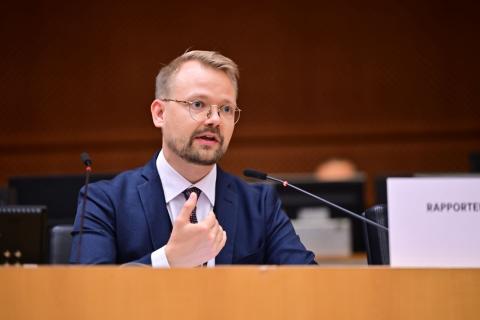
As the EU prepares for a potentially larger Union, enlargement can no longer be treated separately from Europe’s climate ambitions, the European Economic and Social Committee (EESC) has warned. Candidate countries could bring both new challenges and significant opportunities for Europe’s transition to climate neutrality.
The EESC adopted its opinion Enlargement and EU climate policy – Achieving the EU climate targets in a larger Union at its September plenary session, calling for enlargement to be fully integrated into the EU’s climate, energy and industrial strategy.
With Ukraine, Moldova and the Western Balkans among the countries seeking EU membership, a future Union could have more than 30 Member States. These candidate countries currently account for around 10–15% of current EU greenhouse gas emissions, making their transition increasingly relevant as the EU works towards its 2040 climate target and climate neutrality by 2050.
“Enlargement is a geopolitical imperative, but it is also an opportunity to accelerate Europe’s clean energy transition,” said Teppo Säkkinen, rapporteur for the opinion. “If we start aligning candidate countries with EU climate and energy policies now, we can cut emissions, strengthen energy security and create better conditions for investment and competitiveness across Europe.”
The EESC argues that early alignment with EU climate, energy and industrial policies could reduce future compliance costs, give businesses and investors greater certainty and help candidate countries modernise their economies.
It also calls on the European Commission to clarify how EU climate targets and emissions baselines would be calculated in an enlarged Union. Clear rules will be essential for long-term investment decisions and to ensure that climate ambition goes hand in hand with industrial competitiveness.
Ukraine’s reconstruction could accelerate the green transition
Ukraine occupies a particular place in the opinion. The Committee worked with enlargement candidate members from Ukraine to draw in views from Ukrainian employers, trade unions and other civil society organisations. Its post-war reconstruction, EU accession process and need for deep decarbonisation will unfold simultaneously, creating an opportunity to rebuild its energy, industrial and transport infrastructure to modern, low-carbon standards.
Despite Russia’s war of aggression, Ukraine has demonstrated the resilience of its energy system and has at times exported electricity to neighbouring EU countries. Its nuclear capacity and renewable energy potential could make the country an important part of Europe’s future clean-energy system.
“Ukraine’s reconstruction should not simply restore what existed before the war,” said Säkkinen. “It is an opportunity to build a modern, competitive and low-carbon economy that can contribute to Europe’s energy resilience and industrial strength.”
Investing early in candidate countries
The EESC also sees investment and innovation as central to preparing candidate countries for membership. It argues that they should be prioritised in future climate partnerships, including when the EU develops its approach to international carbon credits linked to its 2040 target.
Early investment in decarbonisation could lower the eventual cost of accession, speed up industrial modernisation and help deploy clean technologies where emissions reductions can be achieved cost-effectively.
Closer integration into European energy markets, carbon-pricing mechanisms and stronger emissions monitoring and reporting systems would also help candidate countries prepare for EU membership.
But the transition cannot succeed through investment and regulation alone, the EESC warns. Governments must involve employers, trade unions and civil society at large from the outset, while particular attention should be paid to skills, SMEs, farmers and rural communities.
For the EESC, the message is that enlargement and climate policy should no longer run on parallel tracks. If managed early and strategically, bringing new countries into the EU could become part of the solution to Europe’s climate, energy-security and competitiveness challenges. (ks)
Work organisation
Recommended for you
Pro odolnost EU má zásadní význam aktivní úloha organizované občanské společnosti
News
Na plenárním zasedání EHSV se diskutovalo o tom, jak roste význam organizované občanské společnosti a měst, neboť ovlivňují schopnost Evropy čelit asymetrickým otřesům a neočekávaným…
Mladí lidé coby hybatelé změn a evropské integrace zemí západního Balkánu
News
V rámci konference občanské společnosti na vysoké úrovni na téma Politika v oblasti mládeže v zemích západního Balkánu, kterou uspořádal Evropský hospodářský a sociální výbor (EHSV),…
České předsednictví chce dát Evropě nové pojetí, novou podobu a nový impuls
News
Jedním z bodů červencového plenárního zasedání Evropského hospodářského a sociálního výboru (EHSV) byla diskuse s českým ministrem zahraničních věcí Janem Lipavským o…
Vaše Evropa, váš názor (YEYS!) 2023: Mladí lidé požadují transparentnější, digitálnější a zjednodušenou EU
News
Evropský hospodářský a sociální výbor (EHSV) uspořádal ve dnech 23. a 24. března 14. ročník akce Vaše Evropa, váš názor (YEYS!). V jejím rámci se v Bruselu sešlo 105 studentů z 35 škol ze všech 27…
Spravedlivý přechod na nízkouhlíkovou společnost není možný bez účasti občanské společnosti
News
Dolní Vítkovice v Ostravě jsou bývalou průmyslovou oblastí, kde se dříve těžilo uhlí a vyráběla ocel. 11. října 2022 se zde na konferenci sešli zástupci akademické obce, místních…