
European Economic
and Social Committee
Internal Market: From Ambition to Action
Over a year ago, the Letta and Draghi reports sounded the alarm bell about the state of the European internal market. The findings were clear: our single market — the cornerstone of European integration — is eroding. Fragmented, overregulated, and underutilized, it increasingly holds back rather than drives our collective progress.
And since then? Too little has changed. The urgency has been recognised, but words have not yet been translated into real action.
As President of the INT Section of the EESC, I am convinced it is time to move from diagnosis to delivery. We must breathe coherence and ambition into the internal market.
The watchwords are clear: competitiveness and simplification. But these words must be transformed into concrete, measurable reforms, jointly pursued by the Union and its Member States.
The challenge, above all, is political. Member States must reclaim ownership of the internal market. It is not an abstract technocratic construct, but a concrete lever for shared sovereignty and growth. Respect for the rule of law, the Union’s competences, and the principle of subsidiarity must go hand in hand with deeper strategic cooperation across governance levels.
Competitiveness cannot be proclaimed: it must be built, it must be invested in. The future European Competitiveness Fund must match and live up to the Union’s industrial, green, and digital ambitions. Yet, competitiveness also depends on an enabling economic ecosystem—one that nurtures SMEs, the social economy, and innovation. These actors must be supported, financed, and shielded from excessive administrative burdens.
The idea of a 28th regime represents precisely such a breakthrough. By providing an optional, pan-European framework, it allows economic players wishing to go further to go beyond stalemates of traditional harmonization. It is time to give it a genuine strategic role — one law for one market.
As for simplification, it is no longer optional. For many businesses, survival depends on it. Reducing regulatory complexity, streamlining procedures, and improving transparency are prerequisites if we want to reignite investment and growth.
Equally, the social economy must finally receive the recognition it deserves. As a driver of inclusion and sustainability, it should be embedded in Europe's industrial and innovation strategies.
The EESC, and in particular the INT Section, has a crucial role to play in bridging vision and implementation, the Union and its citizens. We will act as a driving force for proposals, as monitors, and as guardians of ambition. The credibility of the European project depends on it.
The internal market cannot remain a fragile legacy under threat. It must once again become Europe's engine-- a lever for progress and shared sovereignty. The time for action is now.
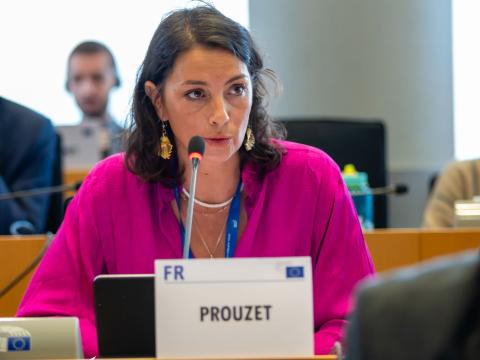
By Emilie Prouzet, President of the INT Section of the EESC
___________________
An article from Marcin Nowacki, President of the TEN section, will be published in the next edition of the newsletter.
Work organisation
Recommended for you
Pro odolnost EU má zásadní význam aktivní úloha organizované občanské společnosti
News
Na plenárním zasedání EHSV se diskutovalo o tom, jak roste význam organizované občanské společnosti a měst, neboť ovlivňují schopnost Evropy čelit asymetrickým otřesům a neočekávaným…
Mladí lidé coby hybatelé změn a evropské integrace zemí západního Balkánu
News
V rámci konference občanské společnosti na vysoké úrovni na téma Politika v oblasti mládeže v zemích západního Balkánu, kterou uspořádal Evropský hospodářský a sociální výbor (EHSV),…
České předsednictví chce dát Evropě nové pojetí, novou podobu a nový impuls
News
Jedním z bodů červencového plenárního zasedání Evropského hospodářského a sociálního výboru (EHSV) byla diskuse s českým ministrem zahraničních věcí Janem Lipavským o…
Vaše Evropa, váš názor (YEYS!) 2023: Mladí lidé požadují transparentnější, digitálnější a zjednodušenou EU
News
Evropský hospodářský a sociální výbor (EHSV) uspořádal ve dnech 23. a 24. března 14. ročník akce Vaše Evropa, váš názor (YEYS!). V jejím rámci se v Bruselu sešlo 105 studentů z 35 škol ze všech 27…
Spravedlivý přechod na nízkouhlíkovou společnost není možný bez účasti občanské společnosti
News
Dolní Vítkovice v Ostravě jsou bývalou průmyslovou oblastí, kde se dříve těžilo uhlí a vyráběla ocel. 11. října 2022 se zde na konferenci sešli zástupci akademické obce, místních…