
European Economic
and Social Committee
Internal Market: From Ambition to Action
Over a year ago, the Letta and Draghi reports sounded the alarm bell about the state of the European internal market. The findings were clear: our single market — the cornerstone of European integration — is eroding. Fragmented, overregulated, and underutilized, it increasingly holds back rather than drives our collective progress.
And since then? Too little has changed. The urgency has been recognised, but words have not yet been translated into real action.
As President of the INT Section of the EESC, I am convinced it is time to move from diagnosis to delivery. We must breathe coherence and ambition into the internal market.
The watchwords are clear: competitiveness and simplification. But these words must be transformed into concrete, measurable reforms, jointly pursued by the Union and its Member States.
The challenge, above all, is political. Member States must reclaim ownership of the internal market. It is not an abstract technocratic construct, but a concrete lever for shared sovereignty and growth. Respect for the rule of law, the Union’s competences, and the principle of subsidiarity must go hand in hand with deeper strategic cooperation across governance levels.
Competitiveness cannot be proclaimed: it must be built, it must be invested in. The future European Competitiveness Fund must match and live up to the Union’s industrial, green, and digital ambitions. Yet, competitiveness also depends on an enabling economic ecosystem—one that nurtures SMEs, the social economy, and innovation. These actors must be supported, financed, and shielded from excessive administrative burdens.
The idea of a 28th regime represents precisely such a breakthrough. By providing an optional, pan-European framework, it allows economic players wishing to go further to go beyond stalemates of traditional harmonization. It is time to give it a genuine strategic role — one law for one market.
As for simplification, it is no longer optional. For many businesses, survival depends on it. Reducing regulatory complexity, streamlining procedures, and improving transparency are prerequisites if we want to reignite investment and growth.
Equally, the social economy must finally receive the recognition it deserves. As a driver of inclusion and sustainability, it should be embedded in Europe's industrial and innovation strategies.
The EESC, and in particular the INT Section, has a crucial role to play in bridging vision and implementation, the Union and its citizens. We will act as a driving force for proposals, as monitors, and as guardians of ambition. The credibility of the European project depends on it.
The internal market cannot remain a fragile legacy under threat. It must once again become Europe's engine-- a lever for progress and shared sovereignty. The time for action is now.
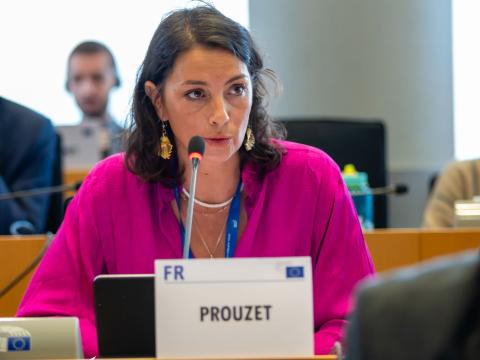
By Emilie Prouzet, President of the INT Section of the EESC
___________________
An article from Marcin Nowacki, President of the TEN section, will be published in the next edition of the newsletter.
Work organisation
Recommended for you
La UE necesita más inversión pública en infraestructuras energéticas para luchar contra el cambio climático
News
En un Dictamen aprobado en el pleno de septiembre, el Comité Económico y Social Europeo (CESE) afirma que se necesita una inversión pública masiva para lograr la transición energética y cumplir los…
Energía: el CESE advierte contra la creación de nuevas dependencias
News
El Comité Económico y Social Europeo (CESE) se pronuncia con firmeza sobre la energía en un Dictamen aprobado en su pleno de septiembre: la propuesta de la Comisión es un paso en la dirección…
La transición digital debe ser justa: los derechos humanos y el control humano deben seguir teniendo una importancia fundamental
News
El Comité Económico y Social Europeo (CESE) señala las oportunidades que presenta la revolución digital, pero también advierte de sus peligros: si se implantan con demasiada rapidez, las soluciones…
La UE necesita ya un plan de acción para ofrecer una vivienda asequible y digna
News
En la conferencia de alto nivel que el Comité Económico y Social Europeo (CESE) celebró en Riga los participantes dieron la voz de alarma por la crisis de la vivienda asequible y advirtieron que ya…
La Presidencia checa de la UE replanteará, reconstruirá y reactivará Europa
News
En el pleno de julio del Comité Económico y Social Europeo (CESE) se celebró un debate con el ministro checo de Asuntos Exteriores, Jan Lipavský, para debatir las prioridades de la Presidencia checa…