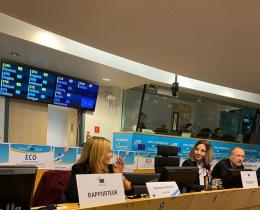
The EESC's Section for Economic and Monetary Union and Economic and Social Cohesion (ECO) held a debate on 15 November addressing gender disparities in access to financial markets. Studies highlight these gaps, sparking ongoing debates as to their causes. Women-led EU businesses receive only 2% of venture capital, apply for fewer loans and invest cautiously. The talks explored how these disparities affected society and the economy and searched for policy solutions.
The European Economic and Social Committee (EESC) recently addressed migrant integration at a public hearing with experts and social partners, highlighting the need for comprehensive approaches that go beyond economic participation. Key recommendations include investing in language training, supporting migrant women, and fostering a culture of tolerance to create more inclusive societies.
Young people's mental health is being increasingly compromised by the excessive use of social media, concerns about climate change and a sense of powerlessness. This is a "political" issue for the EU because it can often be linked to the labour market and housing situation facing young people
The Recovery and Resilience Facility has increased the capacity for social investment in the EU. However, National Recovery and Resilience Plans, funded by the facility, are still plagued by shortcomings such as uneven investing in social programmes in different Member States, insufficient consultation with social partners and a gender dimension that is too weak
In a world striving for sustainable progress, it is evident that significant challenges loom large halfway through the timeline of the United Nations' Sustainable Development Goals (SDGs). The European Economic and Social Committee (EESC), in its opinion adopted in October plenary stresses the necessity ...
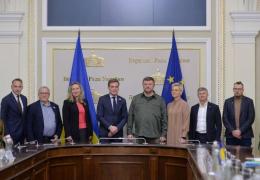
On 2 and 3 November, President Oliver Röpke led a Delegation of the European Economic and Social Committee (EESC) during the Committee's first visit to Ukraine, reaffirming unwavering support for Ukraine's reconstruction efforts and European aspirations. The visit, which took place ahead of the European Commission's Enlargement Package, provided an opportunity for President Röpke to discuss Ukraine's progressive integration into EU and the recent EESC initiative to involve "Enlargement Candidate Members" from Ukraine in its work, starting in 2024. The EESC emphasised that the Ukraine's reconstruction must take place in full respect of human and labour rights, rule of law, transparency, equality and through a genuine social dialogue.
The First Deputy Chairman of the Verkhovna Rada of Ukraine Oleksandr Korniienko held a working meeting with the President of the European Economic and Social Committee Oliver Roepke. “We highly appreciate the Committee’s cooperation with Ukraine and welcome the adoption of three resolutions on the Russian war in Ukraine,” the First Deputy Speaker said, noting that this is a clear signal of support for the Ukrainian people, including civil society: “Our country is not alone in its fight against the aggressor and is part of the European family.”
The European Economic and Social Committee (EESC) has weighed in on the EU's proposal to regulate environmental, social and governance (ESG) ratings. In an opinion adopted in October 2023, the EESC emphasises the need for quality standards to combat greenwashing and advocates the mandatory inclusion of the principle of double materiality. The definitions of "ESG ratings" and "ESG rating providers" need to be refined to exclude certain non-commercial activities from the regulation's scope. Additionally, the Committee recommends establishing an EU sustainability agency.
Despite many recent breakthroughs and the fact that the EU gender equality index reached record levels this year, much still needs to be done for women to achieve equal rights as men in many domains