The pandemic has made it even more urgent to address the new challenges for health and safety at work. Enhanced social dialogue is required to guarantee better standards in teleworking and, more generally, in the digital environment
This research report has been produced in the context of a project entitled ‘The definition of worker in the platform economy’ (CES/FSA/09/2020), which was commissioned by the workers’ group of the European Economic and Social Committee. The report aims to contribute to the debates on platform workers’ risks and regulatory solutions.
The EESC broadly supports the new EU Strategy against trafficking in human beings 2021-2025, but also calls attention to the need of the social dimension to be incorporated into the policy.
The speech delivered by von derLeyen in the 2021 State of the Union Address has to be critically received, mainly for what it lacks in terms of ambition and clarity, despite naming virtually all the key challenges Europe faces.
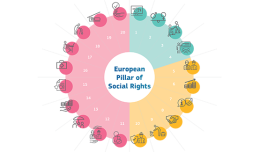
According to the EESC, the Commission's Action Plan on the European Pillar of Social Rights is both timely and necessary to thwart the threat of inequalities deepening across Europe in the aftermath of the pandemic.
Building a resilient Europe - Civil society and the National Recovery and Resilience Plans
Event type
Conference
Location
Brussels
Belgium
The Recovery and Resilience Facility is moving into its next phase, and the European Semester Group of the EESC is following the process. In this high-level conference we will discuss whether the national recovery and resilience plans will deliver as regards the aim of achieving fair, inclusive, competitive and sustainable growth and cohesion through the new growth strategy – the European Green Deal. Focus will be on the implementation of the national recovery and resilience plans, with particular attention on the implementation of the European Pillar of Social Rights and the just transition towards a green, digital and sustainable European economy. The conclusions of this event will be forwarded to EU institutions and the "EU Recovery Summit" conference in Lisbon on 28 June 2021.
Europe needs to make sure that workers benefit from adequate minimum wages, that poverty wages end and that wage setting systems through collective bargaining are strengthened again after years of stagnation and decline.
The European Economic and Social Committee (EESC) intends to play an active part in joint European efforts to translate the principles of the European Pillar of Social Rights (EPSR) into action and to build a fairer and more prosperous Europe for everyone.