
European Economic
and Social Committee
Frans Timmermans at the EESC: "The European Green Deal will be just, or will just not be"
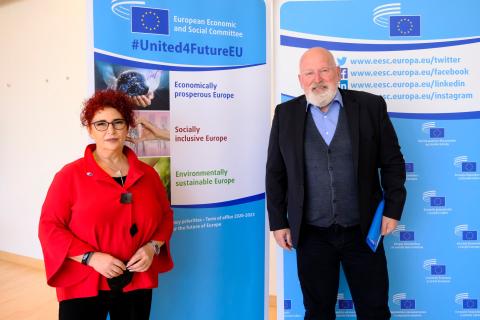
Frans Timmermans has announced measures to shield the most vulnerable from the possible extension of the emission trading system to heating and transport fuels, and heard the EESC's proposals to improve corporate decision-making on the green transition through social dialogue.
Welcoming the European Commission Executive Vice-President, Frans Timmermans, to the EESC plenary session on Wednesday, EESC President Christa Schweng said that the EESC had been a staunch ally of the Commission in its climate action. It had backed the Commission's proposals for bolder emission cuts by 2030 than originally planned. It had also been its active partner in the efforts to support the fledgling circular economy in Europe, with the two institutions launching the European Circular Economy Stakeholder Platform in 2017 as a go-to resource for trailblazing businesses across Europe.
Now, as Europe reflected on how to build back better after the COVID-19 pandemic, a social deal was needed more than ever to ensure a just green transition.
"The Green Deal is an ambitious growth strategy for the EU to achieve climate neutrality by 2050 and provide economic impetus," said Ms Schweng, "but the social, labour, health and equity dimensions should be strengthened to ensure that no person, community, worker, sector or region is left behind."
Mr Timmermans stressed that the social dimension of the green transition was the Commission's prime concern, as the pandemic had blown social disparities out of proportion, putting society "on edge". He described the main elements of the Fit for 55 package to be released on 14 July.
Hardwiring social fairness into climate measures
The package would "hardwire social fairness into the new proposals", said Mr Timmermans, by:
- sharing the burden of climate action fairly between industries, governments and individuals, and
- introducing a social mechanism to help soften the impact on the most vulnerable of measures such as the possible extension of emissions trading to heating and transport fuels.
"Rest assured", said Mr Timmermans, "if we do take this step and if households face growing costs as a result, we will ensure that a social mechanism, a climate action social fund, is in place that can compensate for any possible adverse effects."
"We must protect vulnerable households against potential price increases for heating and transport fuels, especially in regions where clean options aren’t readily available," said Mr Timmermans. " So if we were to introduce emissions trading for these fuels, that means we must also take our commitment to social fairness a step further. Any proposal on emissions trading in these new sectors must come with a proposal for the social impact at the same time."
Bringing the workers' voice into the equation
As part of the debate, Mr Timmermans heard the EESC's contribution to shaping a social deal integral to the Green Deal. The proposals, set out by rapporteur Norbert Kluge, focus on stronger worker participation in corporate decision-making and on corporate social responsibility.
"Social dialogue is of paramount importance to guarantee a close link between the Green Deal and social justice," said Mr Kluge. "We believe that by bringing in the workers' voice we can improve the quality of economic decisions that companies make in transitioning to a green model."
"Worker information, consultation and board-level participation tend to favour a more long-term approach and improve the quality of decision-making in an economic reform agenda." said Mr Kluge.
A report by the Hans Böckler Foundation on how companies in Europe weathered the 2008-2009 financial crisis found that companies with employee-inclusive supervisory boards were not only more robust, but also recovered more quickly from its consequences. They laid off fewer employees, maintained higher levels of investments in R&D, registered higher profits and exhibited less capital market volatility. Overall, they were also more oriented towards the company's long-term interests.
However, the EESC stresses that a social deal as an essential part of a green deal is not just related to work. It is about income, social security and fiscal support for all who need it, including those without any access to work at all.
Active labour market policies are needed, together with effective public employment services, social security systems adapted to changing patterns of labour markets and appropriate safety nets in terms of minimum income and social services for the most vulnerable groups.
Read the full text of Mr Timmermans' speech
Watch the debate with Frans Timmermans on the EESC's twitter account @EU_EESC
Work organisation
Recommended for you
Energi – EESK varnar för nya beroendeförhållanden
News
Europeiska ekonomiska och sociala kommittén (EESK) intar en fast hållning i energifrågan i ett yttrande som antogs vid dess plenarsession i september: kommissionens förslag är ett steg i rätt…
Svenska rådsordförandeskapet 2023: Ukraina står fortfarande högst upp på dagordningen
News
Vid Europeiska ekonomiska och sociala kommitténs (EESK) plenarsession i januari hölls en debatt under vilken Sveriges EU-minister Jessika Roswall redogjorde för prioriteringarna för det nya…
Ditt Europa, din mening! 2023: Ungdomar efterlyser ett mer transparent, digitalt och förenklat EU
News
Den 23–24 mars stod Europeiska ekonomiska och sociala kommittén (EESK) för 14:e gången värd för ”Ditt Europa, din mening!” (YEYS!) i Bryssel, med 105 elever från 35 skolor från alla 27 EU-länder och…
EESK diskuterar agendan för det svenska EU-ordförandeskapet 2023
News
Vid sammanträdet i Europeiska ekonomiska och sociala kommittén (EESK) i Stockholm redogjorde Sveriges statssekreterare med ansvar för EU-frågor, Christian Danielsson, för den politiska inriktningen…
EU–Ukraina: driftskompatibilitet och solidaritet – nyckelfaktorer för transportförbindelserna
News
Vid en debatt som Europeiska ekonomiska och sociala kommittén (EESK) höll i Bryssel framhöll deltagarna vikten av infrastruktur och harmoniserade standarder för att sammanlänka EU med dess…