
European Economic
and Social Committee
Challenges are immense but so is the power of civil society
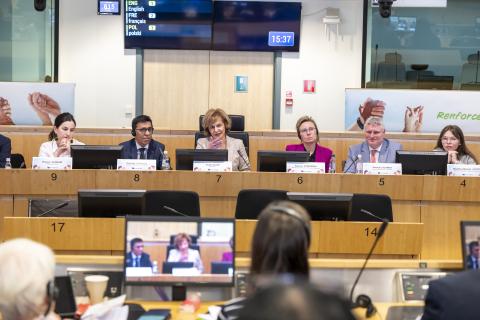
More than 800 participants from citizens' organisations and stakeholders across Europe, including youth organisations, NGOs and journalists, are joining the Civil Society Week, held by the European Economic and Social Committee from 17-20 March 2025. The opening session signalled the protection of the civic space through legal action, reaffirming the key role of civil societies: hold power accountable, build bridges, support social resilience and give a voice to those who are too often ignored.
The 2025 edition of Civil Society Week on the theme of Strengthening cohesion and participation in polarised societies, with its three major initiatives Liaison Group panels, European Citizens' Initiative and the Civil Society Prize, aims to:
- Address the growing polarisation that has been fuelled in recent years by the impact of the financial crisis, climate change and growing income inequality
- Flag the key role that civil society can play in this context
- Gather civil society's solutions and demands for EU policy makers to help depolarise Europe by strengthening societal cohesion and democratic participation in key areas for society.
EESC president Oliver Röpke stressed the challenging times when societies face growing polarisation and trust in democratic institutions is waning. And added: "Civil society must rise to the challenge. Participation, dialogue and solidarity are not just ideals—they are the foundation of a resilient and united Europe. Civil society has the power to bridge divides, to empower voices that feel unheard, and to rebuild trust in democratic processes. As we gather for Civil Society Week, let us reaffirm our commitment to inclusion and active citizenship. A strong democracy depends not just on institutions, but on the engagement of all its people."
Albena Azmanova, Professor of Political and Social Science at City Saint George’s, University of London, talked in her keynote address about the growing economic insecurity faced by the majority of people - what she called an 'epidemic of precarity'. She explained why civil society holds the key to a breakthrough in times of massive insecurity.
"Massive economic insecurity has drained most people of the will to fight. Civil society has the will to fight. In crises civil society can sound a warning that governments cannot take people's tacit support for granted. Civil society activists are driven by a sense of purpose defined by a specific grievance. They are the visible legs and arms of democracy".
As Younous Omarjee, Vice-President of the European Parliament, put it "We need civil society as a glue between citizens, in this context of rising individualism, and as a rampart against the far-right ideas that are spreading".
The crucial role of NGOs in social resilience and their support for vulnerable and remote groups was raised by Adriana Porowska, Minister for Civil Society, from the Polish EU Presidency. She shared the Polish experience with civil society ensuring national resilience. Ms Porowska also highlighted the true power of small communities through the launch of a new governmental programme which prioritises the needs of smaller communities in Poland. "Shaping more resilient and cooperative communities is essential for long-term recovery".
As we are currently witnessing polarisation and confrontational debates which spread hatred and scapegoating, Szabolcs Schmidt, from the European Commission's Directorate General for Justice and Consumers, underscored that a credible, strong and clear civil society is needed in the public debate more than ever. "There is a clear political mandate to support and strengthen civil society and the Commission remains committed to successfully delivering".
Brikena Xhomaqi, Co-chair of the EESC Liaison Group with European civil society networks, stressed that unity in diversity, the EU's proud mantra, is cultivated at grassroots level. However, Ms Xhomaqi mentioned that civil society organisations and NGOs are under attack, questioning their funding and role. "Without resources, Civil Society Organisations cannot function. We need the institutions to protect civil society, we need legal protection for the civic space to keep our society together and united in diversity".
The responsibility of citizens in contributing to polarisation was raised by Petros Fasoulas, Secretary General of European Movement International, who encouraged the promotion of positive narratives, offering hope and engaging in dialogue to foster open and participatory democracy.
The youth representative from the National Youth Council of Moldova Mădălina-Mihaela Antoci reaffirmed that Moldova's European path proves that unity goes beyond borders. "The EU's support for our reforms and resilience shows that Europe's unity is about shared aspirations, not just geography".
Civil Society Week continues with the European Citizens' Initiative on Tuesday 18 March 2025. Debates on Wednesday 19 March will focus on technology for the common good, affordable housing, financing civil society organisations and on how to address the concerns of a green and just transition. On the last day, 20 March, debates will focus on the European Strategy for Civil Society and the Award Ceremony of the Civil Society Prize, which is also dedicated to combating the harmful polarisation of European society. You can follow here
Work organisation
Downloads
-
Challenges are immense but so is the power of civil society
Recommended for you
Energi – EESK varnar för nya beroendeförhållanden
News
Europeiska ekonomiska och sociala kommittén (EESK) intar en fast hållning i energifrågan i ett yttrande som antogs vid dess plenarsession i september: kommissionens förslag är ett steg i rätt…
Svenska rådsordförandeskapet 2023: Ukraina står fortfarande högst upp på dagordningen
News
Vid Europeiska ekonomiska och sociala kommitténs (EESK) plenarsession i januari hölls en debatt under vilken Sveriges EU-minister Jessika Roswall redogjorde för prioriteringarna för det nya…
Ditt Europa, din mening! 2023: Ungdomar efterlyser ett mer transparent, digitalt och förenklat EU
News
Den 23–24 mars stod Europeiska ekonomiska och sociala kommittén (EESK) för 14:e gången värd för ”Ditt Europa, din mening!” (YEYS!) i Bryssel, med 105 elever från 35 skolor från alla 27 EU-länder och…
EESK diskuterar agendan för det svenska EU-ordförandeskapet 2023
News
Vid sammanträdet i Europeiska ekonomiska och sociala kommittén (EESK) i Stockholm redogjorde Sveriges statssekreterare med ansvar för EU-frågor, Christian Danielsson, för den politiska inriktningen…
EU–Ukraina: driftskompatibilitet och solidaritet – nyckelfaktorer för transportförbindelserna
News
Vid en debatt som Europeiska ekonomiska och sociala kommittén (EESK) höll i Bryssel framhöll deltagarna vikten av infrastruktur och harmoniserade standarder för att sammanlänka EU med dess…