
European Economic
and Social Committee
EESC President Oliver Röpke Calls for EU-Action on Ethical AI Governance at AI Action Summit

Artificial Intelligence is reshaping governance, democracy, and the workplace, bringing both vast opportunities and significant challenges. On 10 February, the European Economic and Social Committee (EESC) participated in the AI Action Summit in Paris, a global gathering of policymakers, business leaders, social partners and civil society representatives to discuss AI’s impact on fundamental rights, economic justice, and international regulatory frameworks. EESC President Oliver Röpke took centre stage to advocate for ethical AI governance, international regulatory cooperation, and a human-centric approach to AI policy.
AI Must Work for People, Not Against Them
President Röpke participated in three key discussions during the Summit. In the morning, he spoke at the High-Level Roundtable on AI in the Workplace. “AI should be a tool for empowerment, not control. Workers must have a say in how AI is integrated into their jobs,” he stated. President Röpke also warned against the risks of algorithmic management, job displacement, and AI-driven surveillance, calling for strong legal safeguards and meaningful social dialogue.
Later in the day, at the EESC Side Event “AI in the World of Work”, co-hosted with the French Economic, Social, and Environmental Council (CESE), he was joined by French Minister for Labour Astrid Panosyan-Bouvet, CESE-President Thierry Beaudet and other European policymakers. President Röpke reinforced the importance of worker protections, responsible AI deployment, and inclusive policymaking. He also stressed that AI governance must be rooted in European values of democracy, fairness, and transparency.
In the evening, during the AI Summit Welcoming Event, President Röpke joined global leaders—including Sviatlana Tsikhanouskaya, Henna Virkkunen, and Audrey Tang—to discuss AI’s role in democratic governance. He emphasized that civil society must be actively involved in AI policymaking, warning that "without democratic oversight, AI risks becoming a tool for surveillance and unchecked corporate control".
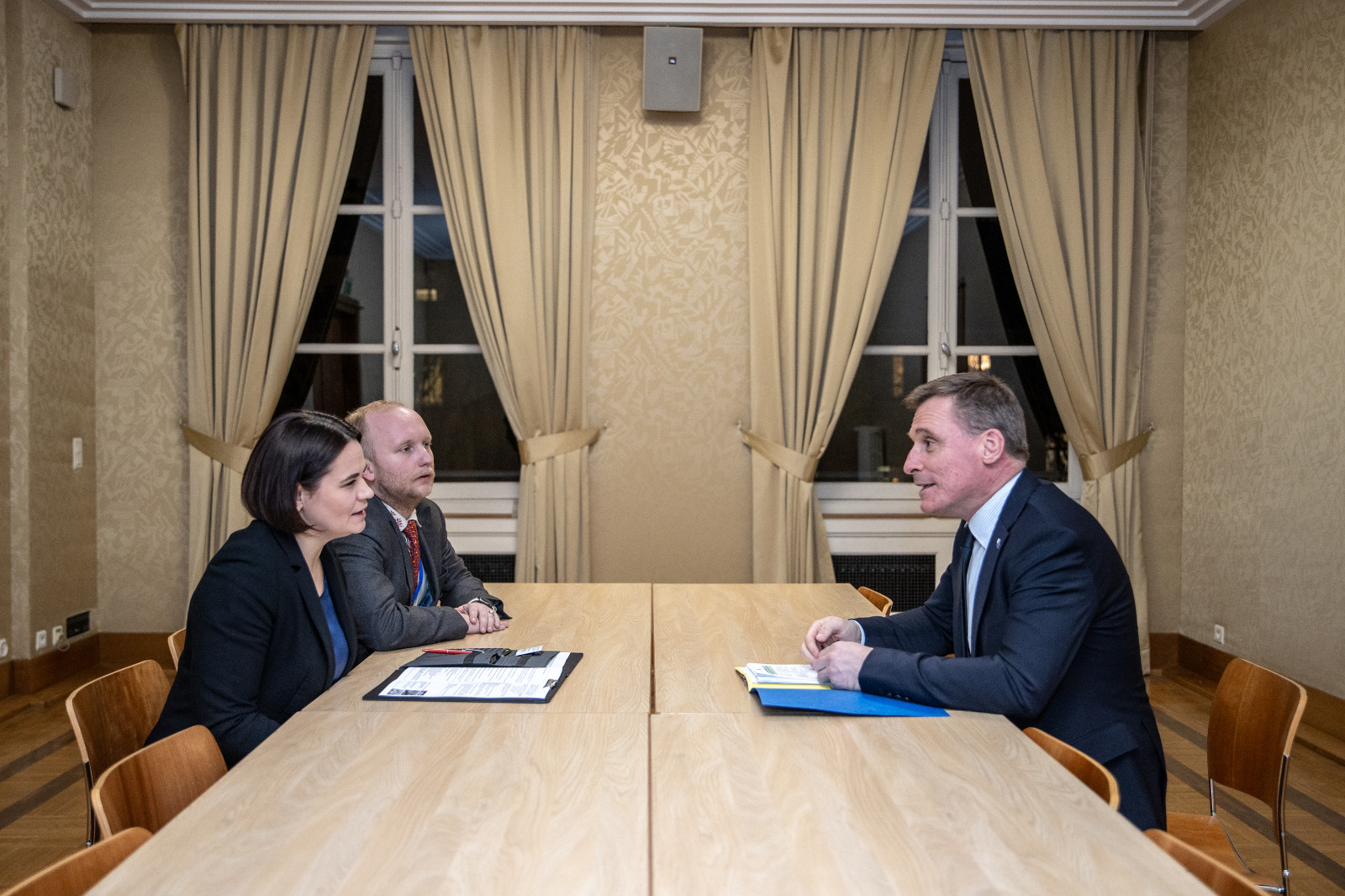
Bilateral Meeting with Sviatlana Tsikhanouskaya
In the margin of the Summit, President Röpke held a bilateral meeting with Sviatlana Tsikhanouskaya, leader of the Belarusian democratic forces. Their discussion focused on supporting civil society, independent media, and fundamental rights in Belarus. President Röpke reiterated the EESC’s unwavering support for democratic forces in Belarus and emphasized the importance of strengthening cooperation between Belarusian civil society and European institutions. They also discussed ways to implement the 'Luxembourg Solutions', aimed at facilitating dialogue between Belarusian democratic forces and European trade unions, employers' organizations, and civil society groups.
EU-Action is needed to champion “AI made in Europe”
The EESC President highlighted that Europe is setting global standards with the EU AI Act, which serves as a model for responsible AI governance. However, he stressed the importance of greater international cooperation. “AI governance cannot be fragmented. We need a global approach that upholds transparency, accountability, and fairness across borders,” he urged. We must to champion “AI made in Europe” by not only providing and attracting public and private funding for scaling-up entrepreneurial efforts but also investing in critical digital infrastructure ensuring fair competition by countering market concentration.
Looking Ahead
The AI Action Summit underscored the urgency of aligning AI regulations to protect workers and democratic institutions. President Röpke’s participation reaffirmed the EESC’s commitment to shaping AI as a force for social justice, fairness, and economic prosperity. As AI continues to evolve, the EESC will push for stronger cooperation between policymakers, industry, and civil society to ensure that AI works for everyone—not just a privileged few.
Recommended for you
Energi – EESK varnar för nya beroendeförhållanden
News
Europeiska ekonomiska och sociala kommittén (EESK) intar en fast hållning i energifrågan i ett yttrande som antogs vid dess plenarsession i september: kommissionens förslag är ett steg i rätt…
Svenska rådsordförandeskapet 2023: Ukraina står fortfarande högst upp på dagordningen
News
Vid Europeiska ekonomiska och sociala kommitténs (EESK) plenarsession i januari hölls en debatt under vilken Sveriges EU-minister Jessika Roswall redogjorde för prioriteringarna för det nya…
Ditt Europa, din mening! 2023: Ungdomar efterlyser ett mer transparent, digitalt och förenklat EU
News
Den 23–24 mars stod Europeiska ekonomiska och sociala kommittén (EESK) för 14:e gången värd för ”Ditt Europa, din mening!” (YEYS!) i Bryssel, med 105 elever från 35 skolor från alla 27 EU-länder och…
EESK diskuterar agendan för det svenska EU-ordförandeskapet 2023
News
Vid sammanträdet i Europeiska ekonomiska och sociala kommittén (EESK) i Stockholm redogjorde Sveriges statssekreterare med ansvar för EU-frågor, Christian Danielsson, för den politiska inriktningen…
EU–Ukraina: driftskompatibilitet och solidaritet – nyckelfaktorer för transportförbindelserna
News
Vid en debatt som Europeiska ekonomiska och sociala kommittén (EESK) höll i Bryssel framhöll deltagarna vikten av infrastruktur och harmoniserade standarder för att sammanlänka EU med dess…