
European Economic
and Social Committee
EESC President Oliver Röpke Calls for EU-Action on Ethical AI Governance at AI Action Summit

Artificial Intelligence is reshaping governance, democracy, and the workplace, bringing both vast opportunities and significant challenges. On 10 February, the European Economic and Social Committee (EESC) participated in the AI Action Summit in Paris, a global gathering of policymakers, business leaders, social partners and civil society representatives to discuss AI’s impact on fundamental rights, economic justice, and international regulatory frameworks. EESC President Oliver Röpke took centre stage to advocate for ethical AI governance, international regulatory cooperation, and a human-centric approach to AI policy.
AI Must Work for People, Not Against Them
President Röpke participated in three key discussions during the Summit. In the morning, he spoke at the High-Level Roundtable on AI in the Workplace. “AI should be a tool for empowerment, not control. Workers must have a say in how AI is integrated into their jobs,” he stated. President Röpke also warned against the risks of algorithmic management, job displacement, and AI-driven surveillance, calling for strong legal safeguards and meaningful social dialogue.
Later in the day, at the EESC Side Event “AI in the World of Work”, co-hosted with the French Economic, Social, and Environmental Council (CESE), he was joined by French Minister for Labour Astrid Panosyan-Bouvet, CESE-President Thierry Beaudet and other European policymakers. President Röpke reinforced the importance of worker protections, responsible AI deployment, and inclusive policymaking. He also stressed that AI governance must be rooted in European values of democracy, fairness, and transparency.
In the evening, during the AI Summit Welcoming Event, President Röpke joined global leaders—including Sviatlana Tsikhanouskaya, Henna Virkkunen, and Audrey Tang—to discuss AI’s role in democratic governance. He emphasized that civil society must be actively involved in AI policymaking, warning that "without democratic oversight, AI risks becoming a tool for surveillance and unchecked corporate control".
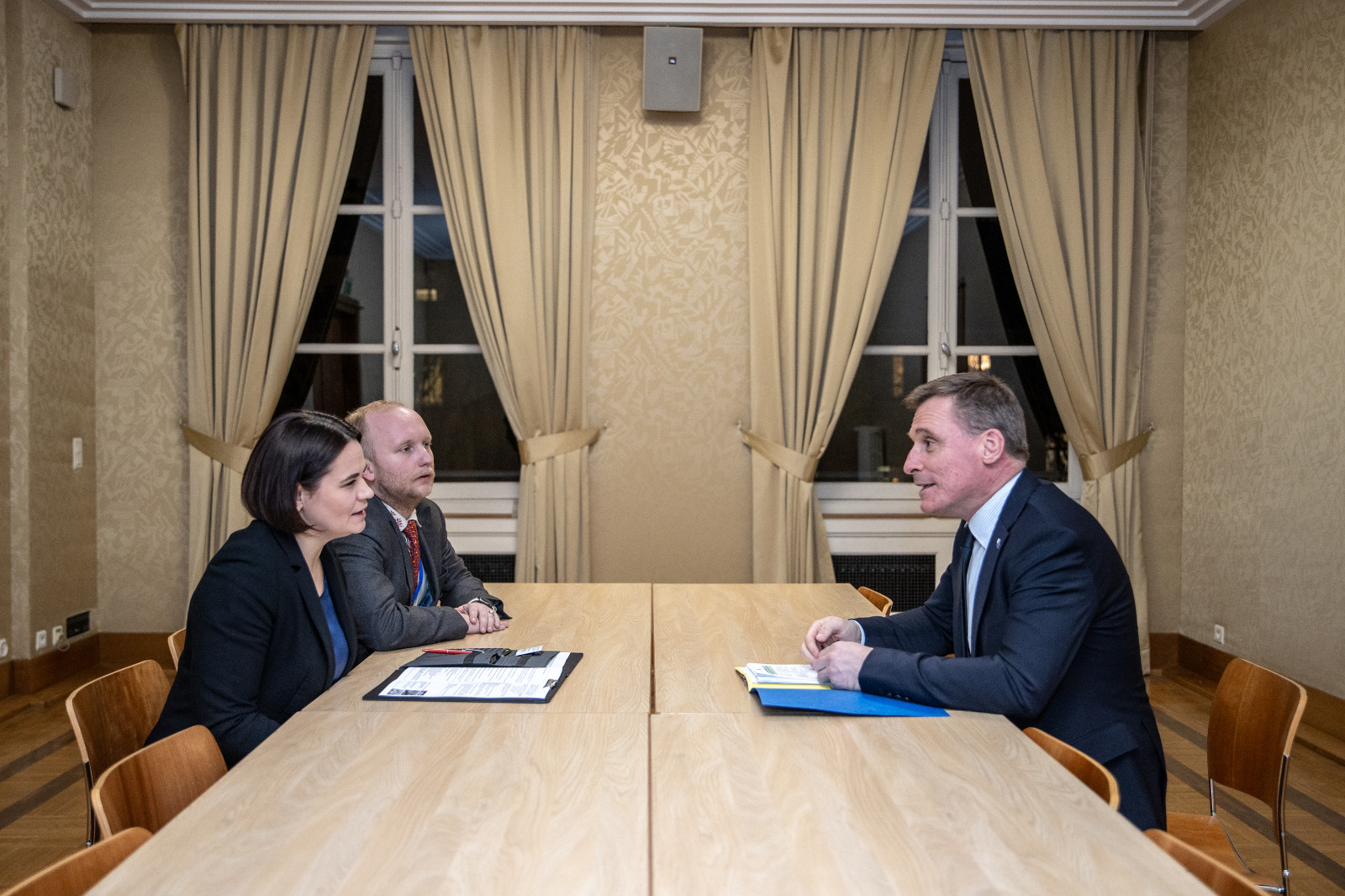
Bilateral Meeting with Sviatlana Tsikhanouskaya
In the margin of the Summit, President Röpke held a bilateral meeting with Sviatlana Tsikhanouskaya, leader of the Belarusian democratic forces. Their discussion focused on supporting civil society, independent media, and fundamental rights in Belarus. President Röpke reiterated the EESC’s unwavering support for democratic forces in Belarus and emphasized the importance of strengthening cooperation between Belarusian civil society and European institutions. They also discussed ways to implement the 'Luxembourg Solutions', aimed at facilitating dialogue between Belarusian democratic forces and European trade unions, employers' organizations, and civil society groups.
EU-Action is needed to champion “AI made in Europe”
The EESC President highlighted that Europe is setting global standards with the EU AI Act, which serves as a model for responsible AI governance. However, he stressed the importance of greater international cooperation. “AI governance cannot be fragmented. We need a global approach that upholds transparency, accountability, and fairness across borders,” he urged. We must to champion “AI made in Europe” by not only providing and attracting public and private funding for scaling-up entrepreneurial efforts but also investing in critical digital infrastructure ensuring fair competition by countering market concentration.
Looking Ahead
The AI Action Summit underscored the urgency of aligning AI regulations to protect workers and democratic institutions. President Röpke’s participation reaffirmed the EESC’s commitment to shaping AI as a force for social justice, fairness, and economic prosperity. As AI continues to evolve, the EESC will push for stronger cooperation between policymakers, industry, and civil society to ensure that AI works for everyone—not just a privileged few.
Recommended for you
Skrajni čas za vlaganje v mlade na Zahodnem Balkanu
News
Da bi vlade držav Zahodnega Balkana svojim državljanom zagotovile boljšo prihodnost, se morajo lotiti reševanja težav, s katerimi se srečujejo mladi, ki imajo ključno vlogo pri njenem ustvarjanju.…
Vaša Evropa, vaš glas! v letu 2023: Mladi si želijo, da bi bila EU preglednejša, bolj digitalna in enostavnejša
News
Evropski ekonomsko-socialni odbor (EESO) je 23. in 24. marca gostil dogodek Vaša Evropa, vaš glas! Potekal je v Bruslju, udeležilo pa se ga je 105 dijakov 35 šol iz vseh 27 držav članic EU in sedem…
Začetek zbiranja prijav za nagrade za civilno družbo EESO na temo duševnega zdravja
News
Organizacije civilne družbe, posamezniki in zasebna podjetja lahko svoje nepridobitne projekte prijavijo za nagrado EESO, namenjeno spodbujanju duševnega zdravja Evropejcev Evropski ekonomsko…
Oddajte svoj glas junija 2024: EESO poziva Evropejce, naj volijo za enotno in demokratično Evropo
News
Demokracija po vsem svetu nazaduje, širijo se dezinformacije in vse več je nezadovoljstva zaradi naraščajoče inflacije ter preteče nevarnosti vojne, zato so letošnje evropske volitve, na katerih bodo…
Ohranjanje zagona širitve EU: prizadevanje civilne družbe, da bi s postopnim vključevanjem prinesla koristi Zahodnemu Balkanu
News
Evropski ekonomsko-socialni odbor (EESO) je 20 let po pristopu Slovenije k EU v Ljubljani zbral politične voditelje in voditelje civilne družbe, da bi obeležili to simbolično obletnico in poudarili…