
European Economic
and Social Committee
European Economic and Social Committee proposes concrete actions to counter threats to EU democracy
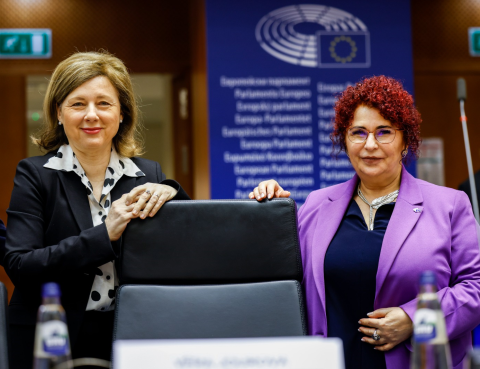
On 23 March, the European Economic and Social Committee (EESC) held a plenary debate and adopted a resolution entitled "United for Democracy" with concrete proposals to strengthen democracies and democratic values across the European Union. Policymakers, experts, and organised civil society representatives agreed that civic education, better funding to social partners and a focus on the local dimension, are key to democracy in Europe.
The Democracy Index 2022 shows that global democracy is declining, reinforced by the consequences of the pandemic, inflation, energy shortages and risks of a worldwide economic crisis. In the EU, 10 Member States are witnessing authoritarian shifts that threaten European fundamental rights. Civic space is shrinking, and the ability of these countries to provide critical public goods to their citizens is under threat. The current protests inFrance have highlighted this.
The European elections in 2024 will be a test of political will, and youth organisations will play a key role in mobilising first-time and young voters,
said EESC President Christa Schweng, But we must go beyond the elections. We need to better support our youth, re-connect with them in the democratic process and empower them for a fully-fledged active citizenship.
European Commission Vice-President for Values and Transparency, Věra Jourová, is currently working on the Defence of Democracy package, announced by European Commission President von der Leyen in September 2022. The package includes a legislative proposal for a directive on transparency to protect the EU democratic sphere from covert foreign interference, a recommendation on secure and resilient elections and a recommendation to increase support and engagement for civil society organisations.
Jourová recognised the crucial role played by civil society organisations in defending and promoting democracy, often working in spaces where states have failed. Active participation of people is not only desired but highly necessary. Democracy is under a stress test and we need to do much more to protect it and regain the trust of our people.
Participants highlighted the need for civil society organisations, including youth organisations, the social economy and voluntary sector, to have better access to funding and to be involved in defining where these resources should be used. They also agreed that transversal competences are the true backbone of a participatory and deliberative democracy. In particular, we should invest more in civic education as a key tool in promoting European values and combating anti-democratic trends.
Following the debate, the EESC adopted a resolution entitled "United for Democracy: employers', workers' and civil society's organisations working for a sustainable democratic future", which builds on the recommendations of this year's Civil Society Days. The resolution aims to strengthen democracy by increasing citizens' participation, and reinforce the structures for participatory democracy. It also calls for the effective implementation of Article 11 of the Treaty on the European Union on citizen participation, including a European strategy for civil society and a European Statute of Associations.
Rapporteur of the resolution, and President of the EESC Employers' Group, Stefano Mallia, highlighted that At the base of every thriving democracy lies a strong and resilient economy. This resolution shows how civil society is contributing to the common good, and by doing so ensures democracy in Europe.
Rapporteur of the resolution and President of the EESC Workers' Group, Oliver Röpke, said: Democracy in Europe is not only threatened from the outside, but also from within. Organised civil society has come under increasing pressure in recent years. The EESC firmly believes that democracy can only be strengthened by reinforcing and expanding democratic participation at all levels.
Rapporteur of the resolution, and President of the EESC Civil Society Organisations' Group, Séamus Boland, said: Our democracy cannot be taken for granted. It has to be nurtured and protected every day. Independent civil society organisations have a crucial role to play. They act as positive agents of change and are crucial in communicating the benefits of democracy. They must be given the necessary means to carry out their work.
European Parliament President, Roberta Metsola, in a video message, reiterated the importance of strengthening participatory democracy in the EU: With the European elections just 14 months away, this topic is very present in my mind. Europe matters. Participatory democracy matters. We are stronger when we work together.
Work organisation
Downloads
-
EESC proposes concrete actions to counter threats to EU democracy
Recommended for you
Energi – EESK varnar för nya beroendeförhållanden
News
Europeiska ekonomiska och sociala kommittén (EESK) intar en fast hållning i energifrågan i ett yttrande som antogs vid dess plenarsession i september: kommissionens förslag är ett steg i rätt…
Svenska rådsordförandeskapet 2023: Ukraina står fortfarande högst upp på dagordningen
News
Vid Europeiska ekonomiska och sociala kommitténs (EESK) plenarsession i januari hölls en debatt under vilken Sveriges EU-minister Jessika Roswall redogjorde för prioriteringarna för det nya…
Ditt Europa, din mening! 2023: Ungdomar efterlyser ett mer transparent, digitalt och förenklat EU
News
Den 23–24 mars stod Europeiska ekonomiska och sociala kommittén (EESK) för 14:e gången värd för ”Ditt Europa, din mening!” (YEYS!) i Bryssel, med 105 elever från 35 skolor från alla 27 EU-länder och…
EESK diskuterar agendan för det svenska EU-ordförandeskapet 2023
News
Vid sammanträdet i Europeiska ekonomiska och sociala kommittén (EESK) i Stockholm redogjorde Sveriges statssekreterare med ansvar för EU-frågor, Christian Danielsson, för den politiska inriktningen…
EU–Ukraina: driftskompatibilitet och solidaritet – nyckelfaktorer för transportförbindelserna
News
Vid en debatt som Europeiska ekonomiska och sociala kommittén (EESK) höll i Bryssel framhöll deltagarna vikten av infrastruktur och harmoniserade standarder för att sammanlänka EU med dess…