
European Economic
and Social Committee
Workers Group nominates Oliver Röpke for EESC President 2023-2025
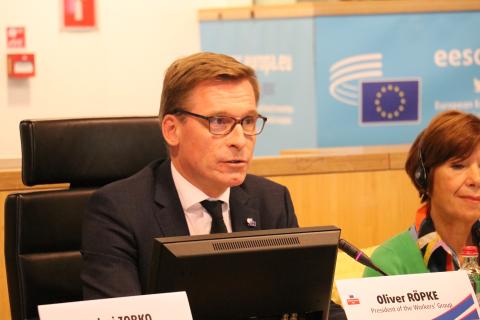
Workers Group President Oliver Röpke was nominated today by his Group to take over as President of the European Economic and Social Committee. As part of his nomination speech, he called for sweeping reforms to make the EESC fit for the challenges the EU is facing. The new EESC President will be elected in a vote by all 329 EESC Members in April 2023.
In today’s meeting, the Workers Group unanimously endorsed Oliver Röpke for the upcoming Presidency of the EESC. During his three terms at the EESC, Austrian trade unionist Oliver Röpke held a variety of positions of responsibility. In March 2019, he became President of the 113-Member Workers' Group.
Mr. Röpke said: “I'm honoured by the confidence my Group has shown in me today. All of us agreed that the EU has many challenges to overcome. That's why we need trust from citizens and strong EU institutions. As EESC President, I will work hard to achieve wide-ranging reforms in our Committee.”
The Workers Group has identified the following key challenges the EU faces:
- The war of aggression of Russia against Ukraine and its consequences for the EU;
- The threats to democracy and the freedom of expression and of association in the EU and around the world;
- Rising prices and the resulting cost of living crisis;
- Climate change and climate justice;
- The necessity of a greener, fairer and more sustainable EU trade policy to accompany the beginning of a new globalisation;
- The need to strengthen trade unions, social dialogue, and collective bargaining systems across the EU;
Oliver Röpke presented a number of proposed reforms to the workings of the Committee today, including:
- To highlight the profile of the EESC as reliable and competent partner for the EU institutions;
- To boost the transparency of the work of the EESC;
- To further improve the legislative and advisory work of the EESC;
- To build stronger alliances with business, trade unions, and civil society;
- To position the EESC as 21st century forum for democracy and citizen participation;
- To push for gender equality and diversity in the workplace and the EESC;
- To open up opportunities for young people to engage in EU decision-making
- To strengthen partnerships with all EESC stakeholders and beyond.
“In the debate today, we discussed the huge challenges that lie ahead of us. It is my firm belief that there is only one way to overcome them: strong unity among all of the EESC Groups.”, Mr. Röpke concluded.
Background information
Whereas EESC Committee Members are appointed for a five-year term of office, key posts, such as the EESC President and two Vice-Presidents, are filled every two and a half years (the so-called ‘mid-term renewal’). The current term will expire in April 2023 and the reappointment process, referred to as ‘the mid-term Renewal’, will then take place.
Work organisation
Downloads
-
CV Oliver Röpke
Recommended for you
Energi – EESK varnar för nya beroendeförhållanden
News
Europeiska ekonomiska och sociala kommittén (EESK) intar en fast hållning i energifrågan i ett yttrande som antogs vid dess plenarsession i september: kommissionens förslag är ett steg i rätt…
Svenska rådsordförandeskapet 2023: Ukraina står fortfarande högst upp på dagordningen
News
Vid Europeiska ekonomiska och sociala kommitténs (EESK) plenarsession i januari hölls en debatt under vilken Sveriges EU-minister Jessika Roswall redogjorde för prioriteringarna för det nya…
Ditt Europa, din mening! 2023: Ungdomar efterlyser ett mer transparent, digitalt och förenklat EU
News
Den 23–24 mars stod Europeiska ekonomiska och sociala kommittén (EESK) för 14:e gången värd för ”Ditt Europa, din mening!” (YEYS!) i Bryssel, med 105 elever från 35 skolor från alla 27 EU-länder och…
EESK diskuterar agendan för det svenska EU-ordförandeskapet 2023
News
Vid sammanträdet i Europeiska ekonomiska och sociala kommittén (EESK) i Stockholm redogjorde Sveriges statssekreterare med ansvar för EU-frågor, Christian Danielsson, för den politiska inriktningen…
EU–Ukraina: driftskompatibilitet och solidaritet – nyckelfaktorer för transportförbindelserna
News
Vid en debatt som Europeiska ekonomiska och sociala kommittén (EESK) höll i Bryssel framhöll deltagarna vikten av infrastruktur och harmoniserade standarder för att sammanlänka EU med dess…