
European Economic
and Social Committee
Workers Group nominates Oliver Röpke for EESC President 2023-2025
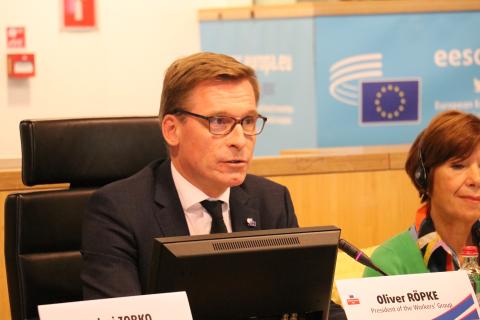
Workers Group President Oliver Röpke was nominated today by his Group to take over as President of the European Economic and Social Committee. As part of his nomination speech, he called for sweeping reforms to make the EESC fit for the challenges the EU is facing. The new EESC President will be elected in a vote by all 329 EESC Members in April 2023.
In today’s meeting, the Workers Group unanimously endorsed Oliver Röpke for the upcoming Presidency of the EESC. During his three terms at the EESC, Austrian trade unionist Oliver Röpke held a variety of positions of responsibility. In March 2019, he became President of the 113-Member Workers' Group.
Mr. Röpke said: “I'm honoured by the confidence my Group has shown in me today. All of us agreed that the EU has many challenges to overcome. That's why we need trust from citizens and strong EU institutions. As EESC President, I will work hard to achieve wide-ranging reforms in our Committee.”
The Workers Group has identified the following key challenges the EU faces:
- The war of aggression of Russia against Ukraine and its consequences for the EU;
- The threats to democracy and the freedom of expression and of association in the EU and around the world;
- Rising prices and the resulting cost of living crisis;
- Climate change and climate justice;
- The necessity of a greener, fairer and more sustainable EU trade policy to accompany the beginning of a new globalisation;
- The need to strengthen trade unions, social dialogue, and collective bargaining systems across the EU;
Oliver Röpke presented a number of proposed reforms to the workings of the Committee today, including:
- To highlight the profile of the EESC as reliable and competent partner for the EU institutions;
- To boost the transparency of the work of the EESC;
- To further improve the legislative and advisory work of the EESC;
- To build stronger alliances with business, trade unions, and civil society;
- To position the EESC as 21st century forum for democracy and citizen participation;
- To push for gender equality and diversity in the workplace and the EESC;
- To open up opportunities for young people to engage in EU decision-making
- To strengthen partnerships with all EESC stakeholders and beyond.
“In the debate today, we discussed the huge challenges that lie ahead of us. It is my firm belief that there is only one way to overcome them: strong unity among all of the EESC Groups.”, Mr. Röpke concluded.
Background information
Whereas EESC Committee Members are appointed for a five-year term of office, key posts, such as the EESC President and two Vice-Presidents, are filled every two and a half years (the so-called ‘mid-term renewal’). The current term will expire in April 2023 and the reappointment process, referred to as ‘the mid-term Renewal’, will then take place.
Work organisation
Downloads
-
CV Oliver Röpke
Recommended for you
Tetyana Ogarkova: "The day of victory will come but it will not bring normality back"
Agenda
On 24 February 2022, the lives of millions of Ukrainians were turned upside down. Now, when we say the word "victory", we expect that day to be the way things used to be. A normal day, a day of peace…
Lutte contre la précarité énergétique: garantir un approvisionnement énergétique abordable devrait figurer au premier rang des priorités politiques des pays de l’UE
News
Alors que le nombre de ménages qui sont dans l’incapacité de chauffer leur logement va vraisemblablement augmenter dans l’Union, avec une inflation annuelle de l’énergie qui dépasse 40 %, il y a…
Les zones rurales ont le potentiel pour produire davantage de résultats
News
Si l’attrait de la vie à la campagne s’est accru ces toutes dernières années, de nombreuses zones rurales de l’Union restent confrontées à un certain nombre de problèmes qui dissuadent les personnes…
Pour lutter contre le sans-abrisme, il faut une approche globale et une action collective
News
Le 7 octobre dernier, le Comité économique et social européen (CESE) a tenu une conférence sur le sans-abrisme et les moyens d’éradiquer ce phénomène d’ici à 2030, en appliquant le principe du…
Un rôle actif pour la société civile organisée est essentiel à la résilience de l’Union européenne
News
Le CESE a tenu un débat en session plénière sur l’importance croissante de la société civile organisée et des villes pour mettre l’Europe en capacité de faire face aux chocs asymétriques et aux…