European Economic
and Social Committee
European Economic
and Social Committee
The European Economic and Social Committee (EESC) is the voice of organised civil society in Europe.
Find out more about its role and structure at http://www.eesc.europa.eu/en/about
The EESC issues between 160 and 190 opinions, evaluation and information reports a year.
It also organises several annual initiatives and events with a focus on civil society and citizens’ participation such as the Civil Society Prize, the Civil Society Days, the Your Europe, Your Say youth plenary and the ECI Day.
Find the latest EESC opinions and publications at http://www.eesc.europa.eu/en/our-work/opinions-information-reports/opinions and http://www.eesc.europa.eu/en/our-work/publications-other-work/publications respectively.
The EESC is active in a wide range of areas, from social affairs to economy, energy and sustainability.
Learn more about our policy areas and policy highlights at http://www.eesc.europa.eu/en/policies
The EESC holds nine plenary sessions per year. It also organises many conferences, public hearings and high-level debates related to its work.
Find out more about our upcoming events at http://www.eesc.europa.eu/en/agenda/our-events/upcoming-events
Here you can find news and information about the EESC'swork, including its social media accounts, the EESC Info newsletter, photo galleries and videos.
Read the latest EESC news http://www.eesc.europa.eu/en/news-media/news and press releases http://www.eesc.europa.eu/en/news-media/press-releases
The EESC brings together representatives from all areas of organised civil society, who give their independent advice on EU policies and legislation. The EESC's326 Members are organised into three groups: Employers, Workers and Various Interests.
Find out more about our Members and groups at http://www.eesc.europa.eu/en/members-groups
The EESC has six sections, specialising in concrete topics of relevance to the citizens of the European Union, ranging from social to economic affairs, energy, environment, external relations or the internal market.
Find out more at http://www.eesc.europa.eu/en/sections-other-bodies
EESO je v mnenju, sprejetem 23. februarja, komentiral sporočilo Evropske komisije o letnem pregledu trajnostne rasti za leto 2023 ter Komisijo pozval, naj vlaga v komuniciranje o izzivih, s katerimi se sooča EU, in o tem, kaj je treba storiti, da bi jih premagali.
Cilj letne strategije za trajnostno rast za leto 2023, v kateri so opisane prednostne naloge gospodarske politike in politike zaposlovanja za EU v prihodnjih 12 do 18 mesecih, je kratkoročno ublažiti negativne učinke energetskih šokov, spodbuditi trajnostno in vključujočo rast ter srednjeročno povečati gospodarsko in socialno odpornost EU.
EESO je v mnenju pozdravil prednostne naloge v zvezi s konkurenčno trajnostjo ter pozornost, namenjeno krepitvi socialnega dialoga v EU. Poleg tega je EESO poudaril pomen dobrega komuniciranja in Komisijo pozval, naj vlaga vanj. EESO je, da bi izboljšali delovanja enotnega trga, pozval k poštenim delovnim pogojem, učinkoviti konkurenci in večjemu upoštevanju pomislekov civilne družbe. Države članice je tudi spodbudil k realističnemu, zmernemu in uravnoteženemu pristopu k obravnavi inflacije.
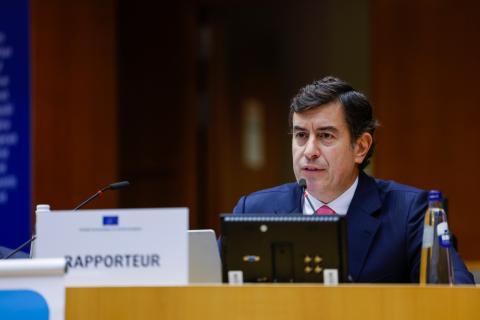
Poročevalec EESO Gonçalo Lobo Xavier je dejal: „Odločno, zanesljivo in skupno govorjenje o naših izzivih in o tem, kako se je EU mobilizirala, da bi jih premagala, je bistvenega pomena za državljane in bo preprečilo nesporazume o evropskem projektu ter okrepilo idejo o Evropi za vse. (tk)