
European Economic
and Social Committee
The Draghi Report, two years on: delivery or delay on EU competitiveness?
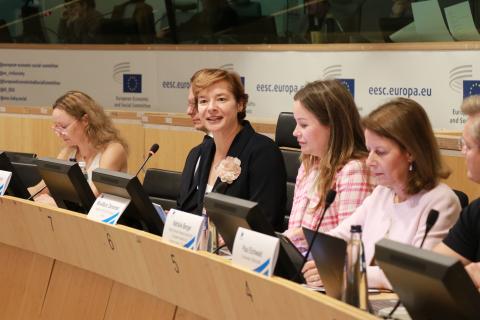
On 23 September 2026, the EESC Employers' Group organised a debate on "The Draghi Report, Two Years On: Delivery or Delay on EU Competitiveness?" to take stock of what has been achieved and what still needs to be done to turn that diagnosis into concrete actions.
The panel brought together Mr Samuel Laurinkari, Vice-President and Head of International Public Policy of Wolt; Dr. Paul Eichwald, Co-founder of Barricadix; Ms Asta Mikalauskaitė, Attaché for Economic Affairs, Permanent Representation of Lithuania to the EU; and Ms Nathalie Berger, Deputy Director-General (acting) at DG GROW.
Two years after the Draghi Report, EU companies still need to see tangible improvements on the ground. Excessive regulatory complexity, fragmented rules and burdensome compliance requirements are still diverting resources away from innovation, investment and growth.
A recurring theme throughout the discussion was the gap between political ambition and practical delivery. Speakers acknowledged that the European Commission has launched several initiatives aimed at strengthening competitiveness, including work on a Competitiveness Compass, investment instruments and new legislative proposals. However, turning commitments into concrete results remains a challenge.
Reducing the burden on businesses
Business representatives highlighted the significant cost of regulatory complexity. Fragmented rules, overlapping legislation and administrative requirements continue to absorb resources that could otherwise be spent on innovation, research and business expansion. The discussion illustrated how companies operating across Europe must devote substantial time and financial resources to compliance, often facing regulatory uncertainty and inconsistent application of rules.
Participants also stressed that the cumulative effect of multiple regulations can undermine competitiveness. Better coordination, more predictable rules and a stronger focus on business realities were identified as essential for Europe's ability to compete globally.
Strengthening the Single Market
The debate also examined the long-standing obstacles that continue to fragment the Single Market. Speakers argued that competing national interests and the tendency of some Member States to add additional requirements when implementing EU legislation create unnecessary complexity for businesses operating across borders.
In response, the European Commission is increasingly favouring directly applicable regulations over directives in certain areas to ensure a more consistent rulebook across the EU. Participants agreed that a fully functioning Single Market remains one of Europe's greatest untapped competitive advantages.
Helping innovative companies scale up
The discussion highlighted the challenges faced by startups and SMEs seeking to grow in Europe. While Europe continues to generate innovative ideas and technologies, many young companies struggle to secure their first customers and access growth opportunities. Public procurement was identified as a particularly important lever to address this challenge.
With public procurement representing around €2.6 trillion annually, speakers argued that modernising procurement rules, simplifying access and creating more opportunities for SMEs could help innovative companies scale more rapidly and compete on equal terms with larger market players. Proposals such as breaking large contracts into smaller lots and reserving opportunities for SMEs were cited as practical ways forward.
Unlocking investment and embracing risk
Another key issue was access to capital. Participants noted that Europe still lacks the depth and scale of capital markets seen in other major economies. Advancing the Capital Markets Union and mobilising private savings were identified as crucial steps to finance innovation and support business growth.
Beyond legislative reforms, speakers called for a broader cultural shift. Europe must become more willing to embrace calculated risk, support entrepreneurship and create conditions that allow businesses to innovate and grow. A stronger Competitiveness Fund and a better combination of public and private financing were highlighted as important elements of this effort.
From diagnosis to delivery
The debate concluded on a shared understanding that Europe's competitiveness challenge is no longer about identifying the problems. The Draghi Report has already provided a clear diagnosis. The real test now lies in delivery.
To secure Europe's future prosperity, policymakers and businesses must work together to reduce regulatory burdens, strengthen the Single Market, improve access to finance and create an environment where innovation can flourish. As participants repeatedly stressed, competitiveness will depend not on the number of strategies produced, but on Europe's ability to implement them effectively and at speed.
Work organisation
Recommended for you
YEYS! 2023: Mládež žiada transparentnejšiu, digitálnejšiu a jednoduchšiu EÚ
News
Európsky hospodársky a sociálny výbor (EHSV) usporiadal 23. a 24. marca 14. ročník podujatia Vaša Európa, váš názor (YEYS), ktoré priviedlo do Bruselu 105…
Slovenská organizácia Integra získava Cenu EHSV pre občiansku spoločnosť za boj proti stereotypom spájaným s duševnými poruchami
News
Európsky hospodársky a sociálny výbor (EHSV) sa tohto roku rozhodol udeliť Cenu pre občiansku spoločnosť projektom na podporu duševného zdravia. Víťazom sa stala írska charitatívna organizácia…
EHSV otvára nový ročník Ceny pre občiansku spoločnosť, ktorej ústrednou témou je duševné zdravie
News
Organizácie občianskej spoločnosti, jednotlivci a súkromné spoločnosti môžu odteraz predkladať svoje neziskové projekty a uchádzať sa o cenu EHSV venovanú podpore duševnej pohody…
Odovzdajte svoj hlas v európskych voľbách v júni 2024: EHSV vyzýva Európanov, aby hlasovali za zjednotenú a demokratickú Európu
News
Vzhľadom na celosvetový trend ústupu demokracie, rýchle šírenie dezinformácií a zvyšujúcu sa nespokojnosť v dôsledku nárastu inflácie a hrozby vojny, pôjde pri hlasovaní o novom…
Dezinformácie a nedostatok záujmu sú hlavnými príčinami vysokej neúčasti voličov vo voľbách do Európskeho parlamentu
News
Európania musia poznať konkrétny vplyv rozhodnutí EÚ na ich životy, čo ich pomôže mobilizovať sa k účasti na voľbách. Rôznym krajinám EÚ je potrebné prispôsobiť rôzne posolstvá. Je potrebné preto…