
European Economic
and Social Committee
Meet our members | Nicoletta Merlo: The EESC demonstrated that youth participation can and must be a structural element of the decision-making process
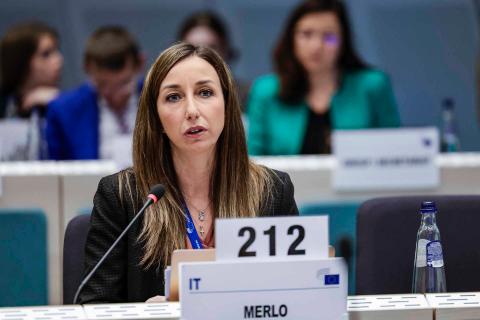
Nicoletta MERLO is the head of Youth Policies at CISL (Italian Confederation of Workers' Unions) and has been an EESC member since October 2020. She is the vice-president of the EESC Youth group and actively participates in the SOC and NAT sections where she seeks to strengthen the voice of the younger generations in the world of work and in sustainability policies.
How was your first mandate as a young EESC and NAT section member? Which key outcomes have been most relevant for you?
My first mandate at the EESC, and particularly in the NAT section, was an extraordinary experience, but not without its challenges. The beginning was marked by the pandemic crisis, which made working remotely a necessity and limited the possibility of building the interpersonal relationships that are at the heart of our role at the Committee. However, with the return to face-to-face meetings, I was finally able to fully enjoy this unique experience, which enriched me both professionally and as a human being.
Working in NAT has been particularly rewarding, especially in the second half of my term, when I had the honour of joining the section’s bureau. Here I found an inclusive and stimulating environment, where I was able to explore crucial topics such as rural development, the green transition, sustainable agriculture and food security. One of the highlights of my mandate was my role as rapporteur for two key opinions on the role of young people in the green transition and rural development. In the opinion on rural development, I stressed the importance of ensuring that young people in rural areas have fair access to essential services, such as education, as well as employment and access to land, in order to combat depopulation and promote sustainable communities. I also highlighted the need to actively involve young people in decision-making processes at local, national and European level, ensuring that they play a central role in the development of policies that affect them.
In the opinion on the green transition, I emphasised the crucial role of young people in promoting environmental sustainability. I proposed the introduction of educational programmes focused on green skills and the implementation of employment policies that facilitate young people’s access to sustainable jobs. Furthermore, I recommended providing financial and educational support to young entrepreneurs, recognising their innovative potential in driving the transition to a green economy.
These opinions represented an opportunity to promote youth involvement in key areas for Europe’s future, helping to build a more inclusive and sustainable society.
However, the achievement I consider most significant is undoubtedly the creation of the EESC Youth Group. I am convinced that this would not have been possible without the pioneering work of the NAT section, led by its president, Peter Schmidt, who strongly believed in the importance of giving space to young people in the European debate, when this issue was not yet so central on the political agenda. It did so, for instance, through the ‘Youth Climate and Sustainability Roundtables’ and through the appointment of a young delegate in the EESC delegation to the COP. This vision was also a decisive boost for my trade union commitment, where I have been fighting for years to strengthen the voice of the younger generations in the world of work and in sustainability policies.
As vice-president of the EESC Youth Group, what is your take on the progress achieved so far?
The creation of the EESC Youth Group was a great achievement in itself, but what we have achieved so far shows how necessary this project was. Thanks to the cooperation with the European Youth Forum, we have introduced a concrete change in the way young people can contribute to the work of the Committee: the adoption of a methodology for implementing the Youth Test. This tool allows youth organisations to actively participate in drafting opinions that are of interest to them, and the EESC was the first European institution to adopt this approach. An achievement of which we can be very proud.
Another key step was the study conducted by the NAT section on the structured and meaningful participation of young people in political and decision-making processes. By mapping good practices at local, national, European and international level, we were able to formulate recommendations applicable to all contexts, with the aim of making youth involvement more incisive and truly effective.
But this is only the beginning. The real challenge now is to turn these results into concrete action: implementing the recommendations of the study, supervising and improving the implementation of the Youth Test, promoting a structured dialogue with youth organisations, working with the sections and the CCMI to integrate youth priorities into the work of the EESC, better coordinating all the Committee's youth activities and maintaining dialogue with the European institutions to strengthen youth participation.
Moreover, our role as members goes beyond the EESC: we need to valorise and disseminate our experience so that it can inspire other institutions, including at national and local level, and contribute to a systemic change in the way new generations are involved in decision-making processes.
Which role can the EESC play in strengthening meaningful youth participation in the EU institutions and how is this perceived by youth organisations?
The EESC has been an example for other European institutions, demonstrating that youth participation can and must be a structural element of the decision-making process. Through in-depth studies, concrete recommendations and the adoption of innovative practices, the Committee has helped to redefine the way in which the younger generation is involved in European policies. A key example is the NAT section’s work on mapping good practices, which has provided operational tools that can be replicated at all levels – local, national and European – facilitating a more systemic and structured approach to youth involvement.
This development has not passed unobserved: youth organisations increasingly recognise the EESC as a reliable interlocutor, an institutional point of reference capable of listening to, taking on board and translating into action the demands of the younger generations. However, our commitment cannot stop here. We must consolidate this trust by turning principles into concrete results, ensure that the initiatives launched have continuity and strengthen the link between the EESC and young people, making it even more solid and structured.
The ultimate goal must be clear: youth participation cannot be an accessory or symbolic element, but an essential pillar of European democracy, fully integrated in decision-making processes at all levels.