
European Economic
and Social Committee
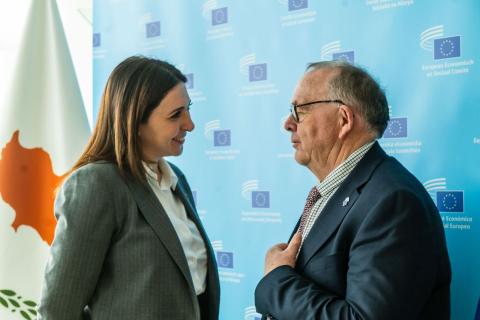
Debates at the European Economic and Social Committee (EESC) plenary revealed strong alignment between the Cyprus Presidency’s five priorities and the Committee’s own work programme: security and preparedness, competitiveness, openness to the world, a Union of values that leaves no one behind and a robust long-term EU budget.
Following a presentation by Marilena Raouna, Cyprus’s Deputy Minister for European Affairs, EESC members discussed the presidency’s priorities under the motto An Autonomous Union. Open to the World. The Cyprus Presidency invited the EESC to contribute expertise through 14 exploratory opinions, providing recommendations on EU legislative proposals and strategic issues while reflecting the views of social partners and organised civil society.
The Committee will focus on tackling energy poverty through affordable and sustainable housing, boosting Europe’s water resilience via the Water Resilience Strategy and promoting social inclusion and independent living for people with disabilities. The EESC provides valuable policy experience that reflects civil society’s perspectives.
EESC President Séamus Boland noted that ‘The priorities of the Cyprus Presidency resonate closely with my programme, which focuses on opportunity, security and resilience, with the fight against poverty at its core.’ Ms Raouna underscored early cooperation with organised civil society: ‘Employers, workers and civil society organisations must remain at the heart of EU policymaking.’
Participants highlighted the challenging context of geopolitical uncertainty, climate pressures and rapid technological change. The presidency reaffirmed its commitment to comprehensive security, including water security and resilience against hybrid threats. The EESC’s EU Blue Deal initiative complements this by promoting sustainable water management.
The presidency aims to strengthen the single market, reduce administrative burdens, support SMEs and advance the green and digital transitions. Affordable energy, modern infrastructure and strong interconnections were highlighted as essential for strategic autonomy.
Affordable housing was also identified as a pressing challenge, alongside gender equality, disability rights and social inclusion. Cyprus also aims to advance discussions on the 2028-2034 multiannual financial framework. The EESC warns that underfunding would undermine cohesion, agriculture and social investment, calling for a stronger budget that ensures no region is left behind. (tk/fb)