
European Economic
and Social Committee
EESC PLENARY: Four Years On: Ensuring Recovery and Hope for Ukraine’s Younger Generation
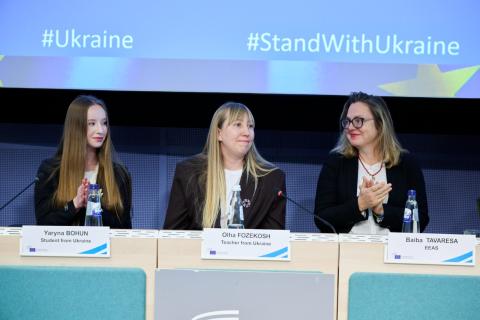
Ahead of the fourth anniversary of Russia’s full-scale invasion of Ukraine, the European Economic and Social Committee (EESC) placed a strong focus on the war’s lasting and complex impact on children and young people. On 18 February, the Committee organised a plenary debate with Yaryna Bohun (Ukrainian student), Olha Fozekosh (Ukrainian teacher), Baiba Tavaresa (EEAS) and Maryna Domushkina (GLOBSEC Kyiv Office). The debate was joined remotely by Munir Mammadzade (UNICEF), Danielle Bell (UN Human Rights Monitoring Mission), Rachel Watkins (Save the Children), Mariia Sulialina (Centre of civil education ‘Almenda’) and Kateryna Rashevska (Regional Centre for Human Rights). Olena Zelenska, the first lady of Ukraine, contributed with a video message.
The debate concluded with a call for coordinated European action, with strong involvement from civil society and international partners, to help young Ukrainians recover and look to the future with hope.
'We will stand by Ukraine and its future for as long as it takes,' said EESC President Séamus Boland, reaffirming the Committee’s unwavering support for Ukraine. 'We must do everything possible to ensure that Ukrainian children receive the support they need. They deserve to grow up in safe and dignified conditions. They will be essential to Ukraine’s recovery and reconstruction.'
Members of the Civil Society Organisations' Group engaged in the debate:
Lidija Pavić-Rogošić, Vice-President of the Civil Society Organisations’ Group, shared her experience from the impact of the Croatian War of Independence on children. 'War leaves lasting wounds on children. The EU must ensure that Ukrainian children do not just survive but thrive. It must invest in psychosocial support, safe schools and local civil society organisations that help restore stability.'
Andris Gobiņš, member of the EESC's EU-Ukraine Civil Society Platform, began his intervention with an apology to Ukrainian children and young people. Speaking about the situation in the occupied territories of Ukraine and the impact on children and young people, he urged: 'This terrible Russian aggression has to stop, and we have to do much more. Industry should stop delivering parts of drones and buying Russian oil'.
Ewa Kulik-Bielińska, also a member of the EU-Ukraine Civil Society Platform, condemned Russia's deliberate acts of war against the Ukrainian people and warned against succumbing to support fatigue. 'We have to do everything not to engulf in this sentiment and we have to resist this, well-intentioned rush of some politicians to end the war quickly, even on Russian terms and at the cost of Ukrainian territory. The decision to end the war should be made by Ukrainians and Ukrainians alone.'
Luca Jahier reported on his recent mission to Ukraine and three lessons learned from it: 'First, we have to go there to see, to listen, to be close to our Ukrainian fellows, to tell with our bodies we are with you. Second, we should engage directly to support in any concrete way, for instance schools, kindergartens, and cultural centres working for rehabilitation. Third, prosecution of crimes must be relentless.'
Pavel Trantina said: 'Ukrainians are not alone. Civil society organisations have been playing a crucial role in supporting Ukrainian children. Czech scouts, for instance, have been welcoming and integrating them in their activities and run a community centre to support families in the city of Prague.'