Turning the Covid pandemic into a powerful lesson for the future
Event type
Webinar
Location
Online
Belgium
The integrity of the Single Market came under heavy pressure during the pandemic. The vast restrictions that Member States imposed at their borders lead to a patchwork of rules, the disruption of value chains and ultimately added to the severe challenges businesses were facing in the COVID19 pandemic. Now that the vaccination rollout is picking up speed, it is time to take a step back to evaluate how the crisis impacted the Single Market and how it can be a powerful resource for a stable economic recovery. The need for a coordinated EU approach will be discussed as well as the impact initiatives, such as the Digital Green Certificate, can have on the economic recovery.
Seminar organized by the European Economic and social Committee (EESC) and the Project Consortium Co-creation of service Innovation in Europe (CoSIE)
Event type
Webinar
Location
Brussels
Belgium
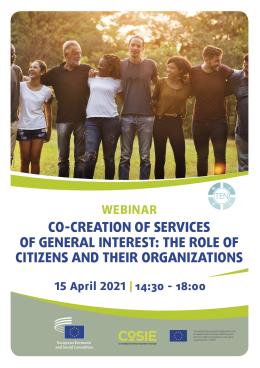
The Thematic Study Group on Services of General Interest of the TEN Section co-organises with the Project Consortium Co-creation of Service Innovation in Europe (CoSIE) a Webinar onCo-creation of Services of General Interest: the Role of Citizens and their Organizations on 15 April at 2.30 p.m.
Europe is facing the greatest crisis in decades, in terms of public health, but also in economic and social ones. Overcoming it will only be possible with a strong social agenda.
The input session will bring together stakeholders and EESC Members to discuss fundamental rights, democracy and rule of law aspects of the COVID-19 crisis.
A first session will cover the ongoing impact of the crisis on the fundamental rights of employers, workers and civil society organisations. A second session will discuss how fundamental rights, democracy and the rule of law can play a key role in the design of a crisis exit strategy and in a post-COVID-19 recovery phase.
As Europe embarks on its ambitious green and digital transitions in a more unsettled and unpredictable world, it is essential that the right strategies and means to maintaining and improving the EU's competitiveness are duly reasoned and substantiated. De-carbonisation and digitalisation are two mutually reinforcing and intertwined processes that represent an unparalleled opportunity to move out of the fragility of the COVID-19 crisis and – strengthen the position of the EU in key strategic value chains while preserving the benefits of an open economy.
The EESC is organising a virtual hearing on the New Pact on Migration and Asylum on 26 November 2020. The aim of the hearing is to provide an understanding of the key elements of the Pact and evaluate its impact on the European migration and asylum framework. By including perspectives from relevant institutional stakeholders, think tanks, social partners and civil society organisations, it will explore whether the Pact brings about the systemic change necessary to overcome the current deadlock and develop a sustainable, rational and rights-based EU asylum and migration policy.
The challenges of contemporary participatory democracy in a Europe that is rebuilding itself: an initial contribution from the Economic and Social Councils and similar institutions to the Conference on the Future of Europe.
In an exploratory opinion requested by the German Presidency of the Council, the EESC sets out "diversity management" measures for ensuring that migrants and ethnic minorities are better included in and integrated into the workplace and society.
Joint side event by the EESC and the Government of Slovenia at the High Level Political Forum (HLPF)
Event type
Webinar
Location
2.00-3.00 p.m. | Live on Twitter @EESC_SDO
The world is facing a climate emergency causing unprecedented economic, social and environmental challenges. Ambitious policy and action are necessary at all levels to accelerate a just transition to a sustainable future, while leaving no one behind. This is particularly relevant in the context of the COVID-19 pandemic, which has exposed the fragility of the current system. ► Watch again