
European Economic
and Social Committee
Commissioner Johansson calls for the European Economic and Social Committee's support for a team Europe approach on labour migration
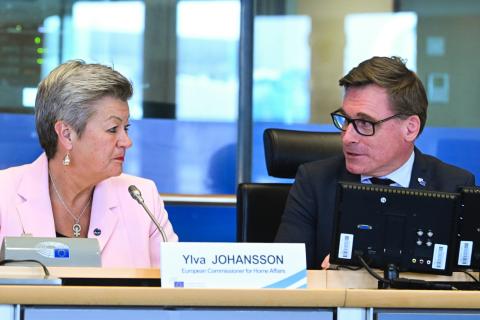
At its April plenary session, the European Economic and Social Committee (EESC) discussed the Talent Mobility Package. This initiative comprises a series of new measures designed to make the Union more attractive to talent from outside the EU, and to facilitate mobility within it.
Guest speaker Commissioner for Home Affairs Ylva Johansson called for the EESC's support by bringing together the Member States and civil society organisations to embrace this innovation and ensure that there is an effective policy on labour migration.
One of the basic measures in the Talent Mobility Package is the "Talent Pool" initiative, the first EU-level voluntary matching pool, where interested Member States can bring together employers in the EU and jobseekers in third countries.
It is estimated that the Talent Pool initiative will have a positive impact on EU GDP, with up to EUR 4.2 billion generated by additional wages and 20 Member States participating until 2030. However, as EESC stressed in its opinion on the Talent Mobility Package adopted in this plenary, the EU Talent Pool needs to be practical, easy-to-use and trusted tool that is attractive for workers and employers. At the same time, it has to support fair and ethical legal labour migration.
EESC president Oliver Röpke stressed that “The EU faces severe labour and skills shortages due to transition to a green and digital economy, and demographic challenges. The talent mobility package can be one instrument among others to alleviate these challenges. At the same time, skilling and reskilling as well as adequate protection of workers and companies against exploitation and unfair competition are necessary."
This initiative aims to provide a comprehensive policy framework to address labour and skills shortages across Europe. These shortages are triggered by a variety of factors which have caused serious obstacles to the operational levels of European companies, with 75% of SMEs reporting difficulties in finding skilled workers.
The European Commissioner for Home Affairs, Ylva Johansson called for a team Europe approach to labour migration with a broader European dimension. “Labour migration is mainly a national competence and it will continue to be so, with one Member State after another increasing quotas for labour migration. But we need to create a team Europe approach, with EU institutions, Member States and civil society organisations working together to bring new initiatives and facilitate the implementation of labour mobility policies.”
EESC members also spoke about exploitation, proper salaries and decent conditions, and labour security, which would guarantee attractive work opportunities for migrant and refugee workers.
EESC member Tatjana Babrauskienė, rapporteur for the opinion, said that “Transparent and trustworthy information on accessing jobs in EU Member States and on requirements, including the recognition of qualifications, needs to be provided via one single EU website for workers and employers.”
When it comes to helping third-country nationals to find good jobs in the EU and employers to recruit these workers, Ms Babrauskienė added that “The skills and competences of workers from third countries should be assessed and swiftly validated to ensure that their skills are certified and they can obtain their qualifications when necessary”.
EESC member and co-rapporteur Mariya Mincheva pointed out that “The EU Talent Pool should not result in an increased administrative burden for employers. It should be straightforward to transfer vacancies from national public employment services to the EU Talent Pool.”
Work organisation
Downloads
-
Commissioner Johansson calls for the European Economic and Social Committee's support for a team Europe approach on labour migration
Recommended for you
Decision repealing Directive 89/629/EEC
Opinion
HOOFDPUNTEN Het EESC: stemt in met het voorstel, heeft er geen commentaar op en heeft daarom besloten er een positief advies over uit te brengen.
RePowerEU Plan
Opinion
HOOFDPUNTEN Het EESC: beschouwt het REPowerEU-plan van de Europese Commissie als een stap in de goede richting om de EU onafhankelijk te maken van de Russische gas- en olielevering; wijst erop…
Individual and collective energy self-consumption as a factor in the fight for the green and energy transition, and for economic and social balance
Opinion
Individueel en collectief zelfverbruik van energie als factor in de strijd voor de groene en energietransitie en voor economisch en sociaal evenwicht Hoofdpunten Het EESC: is van mening dat de…
Equity and efficiency considerations for maritime transportation
Opinion
Rechtvaardigheid en efficiëntie in het zeevervoer Hoofdpunten Het EESC: onderstreept dat de groene transitie van de scheepvaartsector rekening moet houden met landspecifieke, sectorspecifieke en…
Open Dag van de Europese instellingen
Event
Op zaterdag 6 mei kon het Europees Economisch en Sociaal Comité (EESC) samen met de andere EU-instellingen in Brussel voor het eerst sinds de COVID-19-crisis zijn deuren weer openen ter gelegenheid…