
European Economic
and Social Committee
Cultural diplomacy as a key vector of EU foreign policy
At a time when war has returned to the European continent, culture needs, more than ever, to become a core strategic vehicle of the EU's foreign policy. To unlock its full potential, the EESC calls for the establishment of a fully-fledged multiannual strategic action plan on cultural diplomacy.
Culture as an instrument of the European Union's foreign policy has been on the agenda for the last 17 years, starting with the adoption of a European Agenda for Culture in a Globalising World, back in 2007, aimed at giving culture a more substantial role in the EU's foreign policy. After being repeatedly called for in many documents and initiatives over the years, cultural diplomacy now needs to become a real priority.
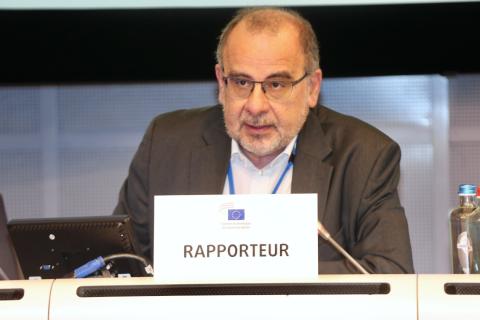
Culture could be a core asset in Europe's internal path, but also in the external image that the EU projects, said the rapporteur and EESC member Luca Jahier. This is particularly true today, with a war on Europe's doorstep and millions of forcibly displaced people.
The own-initiative opinion on the role of cultural diplomacy, adopted at the EESC's October plenary session, highlights the significance of the cultural dimension in the current geopolitical context, something fully in line with the implementation of the 2030 Agenda for Sustainable Development.
The strong multiannual strategic action plan on cultural diplomacy should cover the protection, restoration and reconstruction of heritage in areas hit by natural disasters, crises and conflicts. Another element of this strategy concerns an exercise to map existing initiatives leading to a creation of an EU platform for international cultural relations and the creation of a significant dedicated structure within the EU's External Action Service (EEAS), centred around an "EU Special Envoy for Cultural Relations".
Realising the true potential of cultural diplomacy
Culture is at the very core of the European project, whose full potential hasn't been sufficiently exploited due to fragmented action and the absence of overall visibility and a tangible strategic vision. Mr Jahier therefore stresses the need for a fully-fledged action plan for culture in the EU's external relations, with a clear and coherent strategy involving all relevant actors.
Mr Jahier particularly emphasises the importance of cultural heritage as an inherently politically sensitive and highly complex subject, and hence a powerful and complementary diplomatic component of the EU's approach to peace, security and sustainable development.
The protection, restoration and reconstruction of heritage in areas hit by natural disasters, crises and conflict, such as Ukraine, Afghanistan, Kosovo and Libya, should therefore be a major priority of EU action.
In addition, the EESC points out the importance of stepping up the fight against the illicit trafficking in cultural goods. The Committee also suggests developing a specific initiative on creative industries, especially with regard to contemporary art and new technologies, with a particular focus on the younger generations.
The EESC recommends launching pilot projects in certain areas where coordinated EU action can make a difference, linked to the political priorities already identified in these regions, for example the Western Balkans, the Mediterranean, the Middle East, Africa and Ukraine.
Emphasis should also be put on boosting the capacity of civil society active in the cultural sector in each country and on developing independent grassroots organisations.
Furthermore, the EESC recommends undertaking an exercise to map all actions and initiatives already in place led by the European institutions and organisations, individual States and civil society organisations, as well as those established by the various international partnerships, with a view to creating an EU platform for international cultural relations.
Finally, the EESC suggests creating a dedicated structure within the EEAS centred around an "EU Special Envoy for Cultural Relations", which would have overall responsibility for steering this plan.
Work organisation
Downloads
-
Cultural diplomacy as a key vector of EU foreign policy
Recommended for you
YEYS! 2023: Jongeren vragen een EU die transparanter, digitaler en eenvoudiger is
News
Op 23 en 24 maart is bij het Europees Economisch en Sociaal Comité (EESC) de veertiende editie van Jouw Europa, jouw mening! (YEYS!) gehouden. Voor dat evenement kwamen 105 leerlingen van 35 scholen…
De elektriciteitsmarkt van de EU moet worden hervormd
News
Uit een door het Europees Economisch en Sociaal Comité (EESC) georganiseerd debat kwam naar voren dat het van cruciaal belang is de Europese elektriciteitsmarkt aan te passen om de zwakke punten…
Kandidaten kunnen zich nu aanmelden voor de EESC-prijs voor het maatschappelijk middenveld, die dit jaar geestelijke gezondheid als thema heeft
News
Maatschappelijke organisaties, individuen en particuliere ondernemingen kunnen nu met hun non-profitprojecten meedingen naar de EESC-prijs voor het maatschappelijk middenveld, die deze keer in het…
EESC roept de EU-burgers op om in juni 2024 te stemmen voor een verenigd en democratisch Europa
News
Tegen de achtergrond van een wereldwijde achteruitgang van de democratie, welig tierende desinformatie, groeiende ontevredenheid, stijgende inflatie en oorlogsdreiging, staat er veel op het spel bij…
De sociale en burgerdialoog kunnen de EU helpen duurzaam te groeien
News
Slechts enkele dagen na de Europese verkiezingen van 2024 kwamen het Europees Economisch en Sociaal Comité (EESC) en de nationale sociaal-economische raden van de EU bijeen om de stand van zaken van…