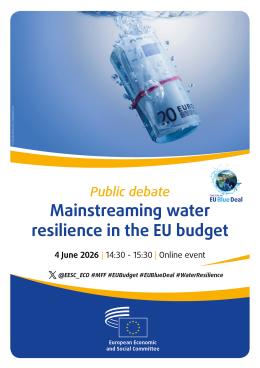
Mainstreaming Water Resilience in the EU Budget is a timely discussion on securing Europe’s water future. Discover how smarter EU investments can strengthen water resilience, sustainability, and preparedness, and how we should shape tomorrow’s funding priorities across programmes in the context of the EU´s next Multiannual Financial Framework.
On 30 March 2026, the EESC Permanent Group on Sustainable Food Systems (PG) will hold a public debate “Towards a sustainable EU Livestock Strategy”, with the aim to contribute to the European Commission’s upcoming EU Livestock Strategy.
Event in the framework of the Cyprus Presidency of the Council of the EU
Event type
Conference
Location
Centre for Social Activities and Welfare of the Municipality of Larnaca, Faneromenis 62
Larnaca
Cyprus
Registration for in-person participation is now closed. Streaming will be available on this page on the day of the event. Prior registration for the streaming is not required.
"Cohesion policy 2028–2034: A new fund, a new framework, a new role for civil society?" brings together EU institutions, social partners and civil society representatives to reflect on the future of cohesion policy in the next Multiannual Financial Framework. The hearing explores proposals for reforming cohesion funding and governance, assesses the implications of the new framework through the National and Regional Partnership Plans and examines how civil society organisations can play a stronger role in the design, implementation and monitoring of cohesion policy. The discussion aims to identify how cohesion policy can continue to deliver territorial, social and economic cohesion while responding to new challenges and transitions facing the European Union.
Public debate in the ECO Section on the Latest twists and turns on the road to the next Multiannual Financial Framework in the framework of the opinion ECO/682 Multiannual financial framework 2028-2034.
The public hearing will examine how national, local and civil society actors will work together to foster collaboration through partnership principle and multi-level governance in order to deliver more inclusive, sustainable, and resilient outcomes across all regions.
On 16 April 2025, the EESC will hold an online event on the role that regenerative agriculture can play in revitalising rural areas, improving soil health, and enhancing carbon sequestration to ensure long-term productivity and food security.