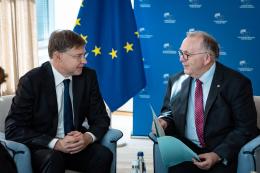
At a high-level debate with European Commissioner Valdis Dombrovskis on 23 September, the European Economic and Social Committee (EESC) backed simpler EU rules but called for stronger evidence, clearer safeguards and greater democratic scrutiny of the Commission’s better regulation plans.
The European Semester increasingly relies on Member States’ ability to implement reforms and investments. Delays often stem not from a lack of funding or policy guidance, but from administrative bottlenecks, limited technical expertise, excessive red tape, complex procedures or insufficient coordination across different levels of national government. The thematic debate will therefore examine how the European Semester could better assess and monitor administrative capacity at national level, as well as whether administrative reform should become a more prominent element in the country-specific recommendations. It will also examine what lessons can be drawn from the implementation of the national recovery and resilience plans, whether instruments such as the Technical Support Instrument could play a stronger role in supporting reforms. Finally, the aim will be to understand how these instruments can contribute, in the long term, to strengthening the capacity building of national administrations and stakeholders.
Public debate in the ECO Section on the The international role of the euro: A European safe asset for a new geopolitical era?. This public debate will explore the opportunities and challenges associated with strengthening the international role of the euro and discuss the economic, financial and geopolitical arguments for and against the creation of a European safe asset.
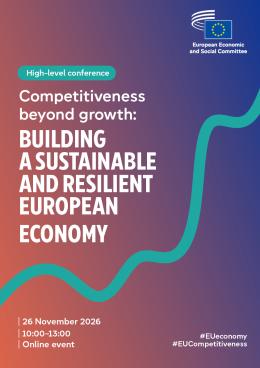
As Europe seeks to strengthen its competitiveness in an increasingly fragmented global economy, the challenge is not only to boost productivity and innovation, but also to preserve the foundations of its social market economy. This high-level conference will examine how the EU can mobilise savings and investment, maintain sustainable public finances, and deepen Economic and Monetary Union to support long-term growth, resilience and convergence.
The European Economic and Social Committee (EESC) invites you to attend our public hearing on how using artificial intelligence and digitalisation in tax administration can strengthen legal clarity, cross-border comparability, economic development and tax certainty.
The public hearing will focus on the capacity to reduce fragmentation and compliance burdens, while facilitating compliance and collection across Member States. The hearing will bring together policymakers, stakeholders and experts from across countries and organisations to discuss on digitizing the EU tax system.
This opinion examines the Commission’s plans to make EU rules simpler, clearer and better enforced, focusing on better regulation, digital tools, legislative simplification and stronger enforcement across the single market.
Download — EESRK nuomonė: Communication on a Simpler, Clearer and Better Enforced EU Rulebook
This debate will bring representatives from public actors and civil society to discuss on their views on the Commission proposal to further integrate capital markets and how to make it fit for purpose.
The Commission proposal is a key element of the Savings and Investments Union agenda. The EESC considers the Commission proposal a step in the good direction, and stresses that more ambition is needed. In particular, to remove remaining duplicative reporting obligations, maintain a level-playing field, increase transparency of systematic internalisers, create a category of 'covered cross-border bonds', and to ensure that supervision leads to identical outcomes all across the EU.