At its July 2025 plenary session, the European Economic and Social Committee (EESC) adopted an own-initiative opinion calling for urgent action to address growing inequalities in access to healthcare across the EU. The opinion highlights how inflation, poverty, and systemic barriers are deepening health disparities, and urges both Member States and the European Commission to act decisively.
At its June plenary session, the European Economic and Social Committee (EESC) adopted two opinions calling for bold EU steps to protect public health by boosting cybersecurity in hospitals and securing supplies of critical medicines. These challenges demand concrete investment, smarter cooperation, and a rights-based approach that puts people’s well-being first.
The topic of the conference was the mental and physical condition of young Europeans and the role of civil society organisations in supporting it. The event was organised as part of the Polish presidency of the EU Council on the initiative of the Minister for Civil Society, Adriana Porowska, and the Civil Society Organisations' Group of the EESC.
Conference on 'The role of civil society organisations in ensuring the health security of children and young people within the EU' co-organised by the European Economic and Social Committee's Civil Society Organisations' Group and the Minister for Civil Society of the Republic of Poland,on 15 May in Warsaw, Poland
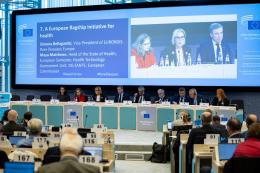
The European Economic and Social Committee (EESC) calls for a European flagship initiative for health, aiming to build a cross-cutting health architecture within the European Union. It also calls on the European Commission to publish an Action Plan on Rare Diseases with clearly achievable targets.
launch the proposal for a comprehensive European Action Plan on Rare Diseases (APRD) with SMART targets that can be achieved by 2030 to enable the diagnosis of rare disease patients within one year;
set up a Steering Group for the European APRD composed of experts from Member States, EURORDIS members and the EESC to ensure coordination and cooperation, monitoring and supervision of the APRD;
encourage agreements with Member States on the content, updating, application and monitoring of national plans for RD.
believes that mental health literacy for the whole of society is needed, both to fight stigma and to facilitate an early intervention and diagnosis of mental health conditions;
considers that relevant policies should aim for an integrated mental health system based on cooperation among the sectors of education, employment, social care and mental health care;
believes empowerment and support for self-representation are key to ensuring the full participation of people in what concerns them and to co-producing strategies and programmes. This involves the planning, design, provision and evaluation of care. It should be accompanied by technical and financial support for forms of self-management.