The meeting will address AI-related issues with a focus on a just digital transition in the morning. In the afternoon session participants will explore ways in which sustainable competitiveness and investment can be achieved for the well-being of EU citizens.
Rue Van Maerlant/Van Maerlantstraat 2, 1040 Bruxelles, Room VMA 23
Brussels
Belgium
The Workers' Group upcoming category meeting "Workers' voice for more democratic participation" will focus on the digital and green just transition from a trade union perspective.
The EESC is convinced that islands, mountainous regions and sparsely populated areas face significant challenges and that there is a solid legal basis that obliges the EU to take action in order to tackle these challenges. In this context, the organised civil society has an important role to play and through this debate, the aim is to find the best practices and solutions so that these regions can perform better and recover from the multiple crises. Therefore the EESC- ECO section has decided to organise this public debate in the framework of the EESC own-intiative opinion on "Main challenges that EU islands, mountain and sparsely populated areas face.
An exhibition organised by the Civil Society Organisations' Group of the EESC in the context of its conference 'EU food sovereignty: the role of agriculture, fisheries and consumers'
-
Location
CINC building, City of Culture of Galicia, Monte Gaiás
Insularity is considered to be a permanent and unchangeable geographical feature which involves additional costs (transport, energy, waste management, public services, necessity goods and services) that hamper the development and competitiveness of the islands, while particularly exposing them to biodiversity loss and climate change. The organised civil society has an important role to play and tackle all these challenges and through this debate. The aim is to find the best practices and solutions so that EU islands can preform better and recover from the multiple crises.
How can these regions become drivers for growth and development?
Event type
Public hearing
Location
Umeå Folkets hus,
Skolgatan 59
Umeå
Sweden
The European Economic and Social Committee (EESC) will be producing an own-initiative opinion on the main challenges faced by EU islands and mountainous and sparsely populated areas, which is scheduled for adoption at the EESC's September plenary session. In this context, the EESC, along with the Conference of Peripheral Maritime Regions (CPMR) and the North Sweden European Office (NSEO), will be holding a public hearing in Umeå (Sweden) on 4 May 2023 entitled "Challenges and opportunities that the digital and energy transitions present to the northern sparsely populated areas and islands. How can these regions become drivers for growth and development?". The hearing is an event under the Swedish Presidency of the Council of the EU.
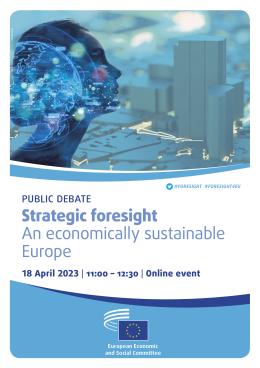
With this debate, the ECO section is providing ex-ante input to the European Commission, in preparation for the upcoming 2023 strategic foresight cycle that wants to shed light on the strategic decisions needed to ensure a socially and economically sustainable Europe with a stronger role in the world in the coming decades.
Extraordinary meeting of the Civil Society Organisations' Group in the framework of the Czech Presidency
Location
Science and Technology Centre, the lower area of Vítkovice, zs Vítkovice 3004, 703 00 Ostrava-Vítkovice
Vítkovice
Czechia
On 11 October 2022, the Civil Society Organisations' Group of the European Economic and Social Committee will hold a conference under the Czech Presidency of the Council of the EU in Ostrava, Czech Republic, on Reinventing the Moravian-Silesian Region in search of a socially just transition. This is an in-person event that will be streamed online.