The Workers' Group is organizing an extraordinary meeting in Prague focusing on the programme and priorities of the Czech EU Presidency and on the role of the social dialogue within the green transition.
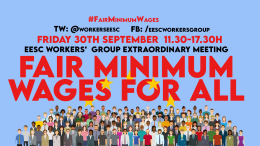
The Workers' Group is organising an extraordinary meeting focusing on the need for fair minimum wages and strong collective bargaining to guarantee decent living conditions for all.
The EU as a driver of shared prosperity – civil society for an economy that works for people & the planet
-
Location
HYBRID EVENT • EESC
Brussels
Belgium
While Europe and its societies are still in the grip of the COVID-19 pandemic and with the Conference on the Future of Europe in its closing stages, the EESC will be holding its annual Civil Society Days in March 2022.
On 14 March, the EESC NAT and INT Sections, the Fair Trade Advocacy Office and the Global Competition Law Centre of the College of Europe organise an online conference to continue the debate on how joint sustainability initiatives can be competition law compliant.
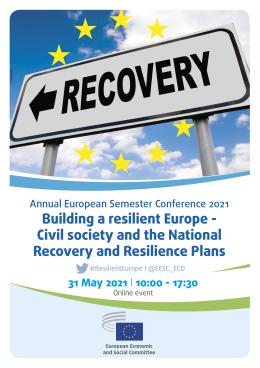
Building a resilient Europe - Civil society and the National Recovery and Resilience Plans
Event type
Conference
Location
Brussels
Belgium
The Recovery and Resilience Facility is moving into its next phase, and the European Semester Group of the EESC is following the process. In this high-level conference we will discuss whether the national recovery and resilience plans will deliver as regards the aim of achieving fair, inclusive, competitive and sustainable growth and cohesion through the new growth strategy – the European Green Deal. Focus will be on the implementation of the national recovery and resilience plans, with particular attention on the implementation of the European Pillar of Social Rights and the just transition towards a green, digital and sustainable European economy. The conclusions of this event will be forwarded to EU institutions and the "EU Recovery Summit" conference in Lisbon on 28 June 2021.
Europe needs to make sure that workers benefit from adequate minimum wages, that poverty wages end and that wage setting systems through collective bargaining are strengthened again after years of stagnation and decline.
The Conference on the Future of Europe offers a unique opportunity to improve the Union's ability to deal with these issues, not least by involving social partners and EU citizens who can offer concrete insights into their actual needs and expectations.
Europe is facing the greatest crisis in decades, in terms of public health, but also in economic and social ones. Overcoming it will only be possible with a strong social agenda.
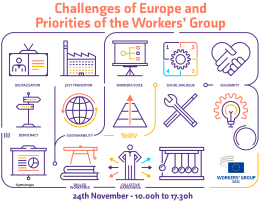
The Workers' Group is organising an extraordinary meeting on the current challenges for Europe and the priorities of the Workers' Group in this framework.
In an exploratory opinion requested by the German Presidency of the Council, the EESC sets out "diversity management" measures for ensuring that migrants and ethnic minorities are better included in and integrated into the workplace and society.