On 11 February, the European Commission published its 2025 work programme. Several initiatives in the work programme – initiatives to enhance competitiveness through the promotion of reforms and investments, both private and public, the new the Savings and Investment Union, as well as the next Multiannual Financial Framework, just to name a few – fall in the remit of the Section for Economic and Monetary Union and Economic and Social Cohesion (ECO) of the European Economic and Social Committee (EESC). We organise this debate to discuss with representatives of the Commission and the members of the EESC the conditions and actions needed for the EU and its Member States to successfully implement what is outlined in the Commission and achieve the shared goals of the Union.
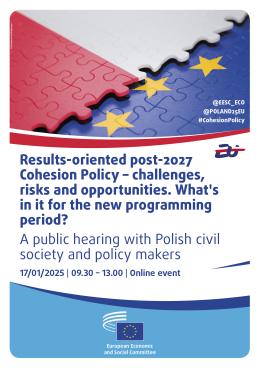
Public hearing with Polish civil society and policy makers
Event type
Public hearing
Location
Online event
ul. Wspólna 2/4
00-926 Warszawa
Warsaw
Poland
In the context of the ongoing exploratory opinion, requested by the Polish Presidency, to examine how civil society actors can make use of a results-orientation approach in cohesion policy in the next programming period, the EESC is organizing a hearing in Warsaw on 17 January 2025. The hearing will be important as the EESC will explore how civil society and local actors understand the concept of a results-orientation approach to cohesion policy, to which degree they are prepared and if they have the administrative capacity to implement it.
The hearing is co-organized with the Polish Presidency of the Council of the EU and it has the patronage of the Polish Presidency. The venue is the premises of the Ministry of Development Funds and Regional Policy of Poland.
The EESC is organising this public debat to discuss how civil society partners can use a results-orientation approach in cohesion policy for the next programming period. The principles of multi-level governance and shared management are contradictory or complementary to the results-focused cohesion policy ?
Conference organised by the EESC's Consumers and Environment Category
Location
Van Maerlant street 2, room VMA 22
Brussels and online
Belgium
Join us on 3 July 2024 for a morning discussion forum in the Consumers and Environment category, with the aim of anticipating and influencing the upcoming decisions that will follow the renewal in the European Parliament and the European Commission. This is an in-person conference that will be live streamed on our website. Registration closed on 1 July 2024.
Lessons learned from the first years of the implementation of the programming period 2021-2027
Event type
Debate
Location
Online event
Belgium
Public debate on 9th Cohesion report: Lessons learned from the first years of the implementation of the programming period 2021-2027, in the framework of the ECO section meeting.
This public hearing is being organised as part of the preparation of the exploratory opinion ECO/630 on "Boosting long-term inclusive growth through reforms and investment" requested by the Belgian Presidency of the Council of the EU. It focuses on how to foster upwards social convergence and cohesion, in an economic governance framework defined around debt sustainability, productive investments and reforms. It also looks at the implications of such a framework for the European Semester and the strengthening of the European Pillar of Social Rights.
The EESC is convinced that islands, mountainous regions and sparsely populated areas face significant challenges and that there is a solid legal basis that obliges the EU to take action in order to tackle these challenges. In this context, the organised civil society has an important role to play and through this debate, the aim is to find the best practices and solutions so that these regions can perform better and recover from the multiple crises. Therefore the EESC- ECO section has decided to organise this public debate in the framework of the EESC own-intiative opinion on "Main challenges that EU islands, mountain and sparsely populated areas face.
Insularity is considered to be a permanent and unchangeable geographical feature which involves additional costs (transport, energy, waste management, public services, necessity goods and services) that hamper the development and competitiveness of the islands, while particularly exposing them to biodiversity loss and climate change. The organised civil society has an important role to play and tackle all these challenges and through this debate. The aim is to find the best practices and solutions so that EU islands can preform better and recover from the multiple crises.