
European Economic
and Social Committee
Defending human rights in Europe - a high-stakes conversation with UN High Commissioner Volker Türk at the EESC
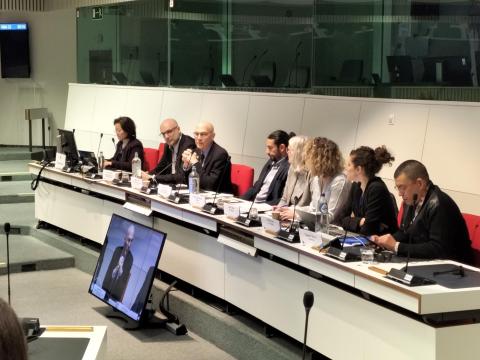
On Tuesday 28 January, the European Economic and Social Committee (EESC) and the UN Human Rights Regional Office for Europe, in partnership with the Human Rights and Democracy Network (HRDN), hosted an interactive dialogue between civil society representatives and the UN High Commissioner for Human Rights, Volker TÜRK. The discussions highlighted concerns over shrinking civic space, disinformation, threats to democracy, the need for stronger protections for human rights defenders, migration policies, international justice and corporate accountability.
Christian Moos, Rapporteur for the EESC opinion on the Defence of Democracy Package and Vice-President of the EESC Fundamental Rights and Rule of Law (FRRL) Group, opened the dialogue with a stark warning about the pressing need for civil society to defend human rights. Moos observed that similar past event would have focused on how to support civic space in other parts of the world, but today such focus was also on Europe.
His remarks set the stage for a discussion that underscored the mounting pressures on civil society, independent media, and human rights defenders across Europe - concerns that were echoed by civil society representatives. The proposed Defence of Democracy Package, designed to counter foreign interference through greater transparency, was highlighted as a potential risk to civic spaces with concerns that the attacks that civil society organisations are already facing from politicians and certain media could further increase. Participants called for general transparency rules rather than singling out specific actors, and increased support for CSOs and independent media to promote democracy both within and outside Europe’s borders.
The politics of division and polarisation
The UN High Commissioner for Human Rights, Volker Türk, highlighted the dangers of the politics of division and polarisation, their dire impact on human rights particularly for minorities and vulnerable groups, such as migrants, Roma, women and girls or the LGBTQ+ community, as well as on our society as a whole.
Civil society representatives echoed these concerns, pointing to disinformation campaigns that fuel anti-democratic narratives and target civil society actors exposing conflicts of interest, corruption, environmental scandals, and human rights abuses.
Fighting impunity and strengthening accountability
Civil society representatives pointed to the recently adopted EU Corporate Sustainability Due Diligence Directive, which sets out obligations for large companies to identify and address adverse human rights and environmental impacts, as a key milestone in efforts to ensure corporate accountability. At the same time, they expressed concerns over the risk that the new legislative simplification agenda is used to weaken this key directive, a move that could undermine corporate accountability and embolden human rights violations.
Participants also condemned the erosion of support for the role and work of the International Criminal Court (ICC). Some EU Member States’ double standards in the treatment of ICC arrest warrants, they warned, threaten the credibility of the EU as a key supporter of international justice and human rights.
Addressing human rights protection gaps in EU Migration Policy
Migration policies also came under scrutiny during discussions, with civil society representatives sharing strong criticism of the human rights risks which the EU Pact on Migration and Asylum carries. Concerns centred on screening and border procedures, which are said could increase the use of immigration detention, including of children, despite international commitments to end such practices. Participants also criticised the general trend towards the externalisation of migration governance, and its adverse impact on human rights of migrants and the human rights situation in countries of origin and transit more generally, especially in the absence of human rights risk assessments and adequate mitigation and due diligence measures.
Supporting and protecting human rights defenders
In Europe, according to a 2023 EU Fundamental Rights Agency (FRA) report more than 50% of human rights defenders have faced threats to their freedom of expression and obstacles to accessing justice. Meanwhile, human rights defenders from non-European countries face significant challenges in gaining access and stay rights in the EU. Participants called for stronger protection mechanisms for human rights defenders within the EU and for dedicated pathways for human rights defenders at risk to be more easily relocated to the EU.
Investing in human rights and engaging with civil society is key to safeguard democracy
In his closing remarks, Volker Türk emphasised the urgent need for sustained support and funding for international organisations defending human rights, CSOs, human rights defenders, and independent media to counter rising authoritarianism and safeguard human rights.
This dialogue reaffirmed the EESC’s commitment to defending democratic values and human rights. As Europe faces rising polarisation, shrinking civic space, and threats to justice, the role of civil society in holding power to account has never been more critical.
The exchange was part of the UN High Commissioner’s strategic engagement with EU partners and stakeholders which took place on 27-28 January in Brussels.
Work organisation
Recommended for you
Η εργαλειοποίηση των μεταναστών και η προσφυγική κρίση της Ουκρανίας επιβάλλουν ένα νέο ξεκίνημα για τη μεταναστευτική πολιτική
News
Η κρατική εργαλειοποίηση των μεταναστών, που αποσκοπεί στην αποσταθεροποίηση της ΕΕ, και ο τρέχων πόλεμος στην Ουκρανία, που οδηγεί σε πρωτόγνωρη εισροή προσφύγων, επιβάλλουν την επανεξέταση της…
YEYS! 2023: Οι νέοι ζητούν μια πιο διαφανή, ψηφιακή και απλοποιημένη ΕΕ
News
Στις 23 και 24 Μαρτίου, η Ευρωπαϊκή Οικονομική και Κοινωνική Επιτροπή (ΕΟΚΕ) φιλοξένησε την 14η διοργάνωση της εκδήλωσης «Η δική σου Ευρώπη, η δική σου φωνή!» (YEYS!), η οποία προσέλκυσε στις…
Η ΕΕ χρειάζεται αποτελεσματικότερη πολυμέρεια για την αντιμετώπιση των κινδύνων που σχετίζονται με την ασφάλεια στη θάλασσα, επισημαίνει η ΕΟΚΕ
News
Η Ευρωπαϊκή Οικονομική και Κοινωνική Επιτροπή (ΕΟΚΕ) ζητεί περισσότερες κοινές δράσεις σχετικά με τη στρατηγική της ΕΕ για την ασφάλεια στη θάλασσα και το σχετικό σχέδιο δράσης, που αποσκοπούν στη…
Η ΕΟΚΕ δρομολογεί τη διαδικασία υποβολής υποψηφιοτήτων για το Βραβείο της Κοινωνίας των Πολιτών, το οποίο θα αφορά την ψυχική υγεία
News
Οι οργανώσεις της κοινωνίας των πολιτών, οι ιδιώτες και οι ιδιωτικές εταιρείες μπορούν τώρα να υποβάλουν τα μη κερδοσκοπικά έργα τους για το βραβείο της ΕΟΚΕ που είναι αφιερωμένο στη στήριξη της…
#ReskillEU — Το εργατικό δυναμικό της Ευρώπης στους τομείς της ενέργειας και των μεταφορών χρειάζεται νέες δεξιότητες για να κάνει πραγματικότητα την απανθρακοποίηση
News
Για να επιτύχει η απανθρακοποίηση των τομέων της ενέργειας και των μεταφορών της ΕΕ, οι εν λόγω τομείς χρειάζονται εργαζομένους εξοπλισμένους με «νέες» δεξιότητες, προειδοποιεί η Ευρωπαϊκή Οικονομική…