
European Economic
and Social Committee
One million voices, one European space
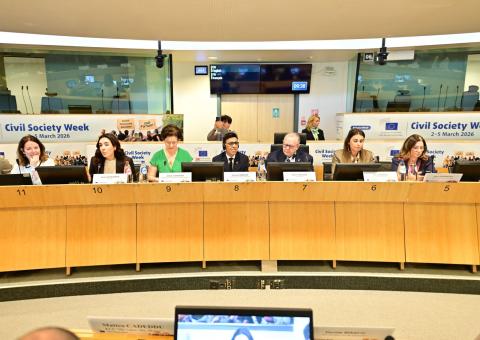
After 14 successful years, the European Citizens' Initiative (ECI) has proven that it is no longer an experiment. With four initiatives surpassing the one-million-signature threshold in 2025, the ECI carries institutional responsibility. The key question, however, is how the political system can translate one million signatures into concrete EU legislation.
The European Citizens’ Initiative (ECI) took centre stage on the second day of the European Economic and Social Committee’s (EESC) Civil Society Week on 3 March. The ECI is an EU participatory mechanism designed to strengthen participatory democracy by allowing at least one million EU citizens to ask the European Commission to propose an act in an area where Member States have transferred powers to EU level. More than 24 million signatures have been collected since the ECI entered into force in 2012.
The European Commission’s November 2025 communication on the European Democracy Shield highlights the ECI as a pivotal instrument for fostering citizen participation, underscoring its significance in safeguarding European democracy and civil society. In few months, four ECIs surpassed the one-million-signature threshold, demonstrating great mobilisation at scale. It proves that citizens can and should get involved, ensuring that voices of minority groups and those who suffer persecution are heard.
‘What was once an ambitious and novel idea has since evolved into a unique cross-border tool for participatory democracy. It gives Europeans a say in setting the political agenda at European level’, said EESC member Maria del Carmen Barrera Chamorro, Chair of the EESC’s Group on the European Citizens’ Initiative.
Participants, however, also stressed that the success of the ECI depends on how institutions respond. ECIs create a clear responsibility for EU institutions; a responsibility to respond seriously, to engage politically and to follow up meaningfully. Successful ECIs cannot end simply with a formal reply, which can generate feelings of frustration, disbelief and lack of trust. According to the recent Eurobarometer, 49% of Europeans say the most serious challenge to democracy is growing distrust in institutions and processes.
Teresa Anjinho, European Ombudsman, stressed that ‘Even when institutions act fully within ECI rules, citizens may experience outcomes that feel unfair, unresponsive or opaque. Reality is often far more complex and unpredictable than decision-makers can encompass, and formal rules cannot anticipate every situation. In such cases, the European Ombudsman plays a crucial role. My office provides an independent mechanism for citizens to raise concerns, offering oversight that goes beyond strict legality’.
EESC President Séamus Boland also joined the debate, pointing out that protecting democracy today meant trusting citizens, listening to them and engaging with them. ‘Democracy and civic space are under strain. Trust in institutions is eroding. But civic engagement is a key pathway to renewing Europe’s social and democratic promise. We need stronger, more effective and more comprehensive measures to protect European democracy. A participatory democracy tool like the European Citizens’ Initiative is one of those measures. Because when citizens feel heard, democracy becomes stronger’, he said.
Younous Omarjee, Vice-President of the European Parliament, spoke in kind, pointing out that the ECI embodies a profoundly democratic idea, not just a tool. ‘It is a bridge between participation and representation, and a signal that European legitimacy is nourished first and foremost by the engagement of its citizens’, he said.
Ten ECI initiatives were presented on ECI Day, including ‘Ban on conversion practices in the EU’, ‘Stop Destroying Videogames’, ‘Ethics, transparency and integrity for European political parties’, and ‘Stop Funding Russia’s War: Phase Out Harmful and Useless Russian Imports into the EU’. Matteo Cadeddu, from ‘My Voice, My Choice’, reported on the very recent results of this initiative. ‘Last week, the European Commission made a historic decision. They officially confirmed that European funds can be used to improve access to safe abortions throughout the European Union, not only for the procedures themselves, as we originally requested, but also to cover travel expenses. While this is not exactly what we asked for, having also requested a dedicated fund, it paves the way for us to work with EU countries’, he said.
Following the Commission’s decision to allow access to European funds for safe abortions as a concrete response to the ‘My Voice, My Choice’ initiative, Maroš Šefčovič, Commissioner for Trade and Economic Security, Interinstitutional Relations and Transparency, underlined the dynamics of the initiative and its momentum: ‘The European Citizens’ Initiative allows people across our Member States to remain actively engaged with EU policies – and its numbers underline the popularity of this agenda-setting tool’, he said. ‘As we prepare for the next periodic review of the ECI Regulation, we have a chance to make it even more impactful and effective. Your on-the-ground experiences are unique and essential, so I encourage you to help shape the future of the ECI’.
The European Commission is preparing two more replies to two additional successful ECIs: ‘Ban on Conversion Practices’ and ‘Stop Destroying Videogames’.
Concluding ECI Day, the participants made clear that early exchanges and cross-border networking were essential for making ECIs more strategic and effective, as successful ECIs rarely emerge in isolation.
The recommendations and conclusions will be presented at the EESC plenary session on 18 March.
Work organisation
Downloads
-
One million voices, one European space