
European Economic
and Social Committee
Redes de España: a replicable and transformative circular blue economy initiative

The fisheries sector has a long-standing commitment to integrating sustainability into its activities at sea, and now it’s making waves on land with its responsible management of waste, in particular of gear and nets that have reached the end of their lifespan. This is where Redes de España (Nets of Spain) comes in – an initiative that combines technological innovation, the circular blue economy and social inclusion to turn an environmental obligation into an opportunity for transformation.
The project, coordinated by the Spanish Fishing Confederation (Cepesca), together with the National Federation of Fishermen’s Guilds (FNPC) and the Automotive Technology Centre of Galicia (CTAG), aims to recover at least 100 tonnes of discarded nets and gear by 2026, giving them new life in sectors such as the automotive sector. The project is also supported through collaboration with the Spanish Technological Platform for Fisheries and Aquaculture (PTEPA) and the Amicos association – a non-profit NGO which provides care and advocates the integration of people with intellectual disabilities, autism, paralysis and brain damage, and their families.
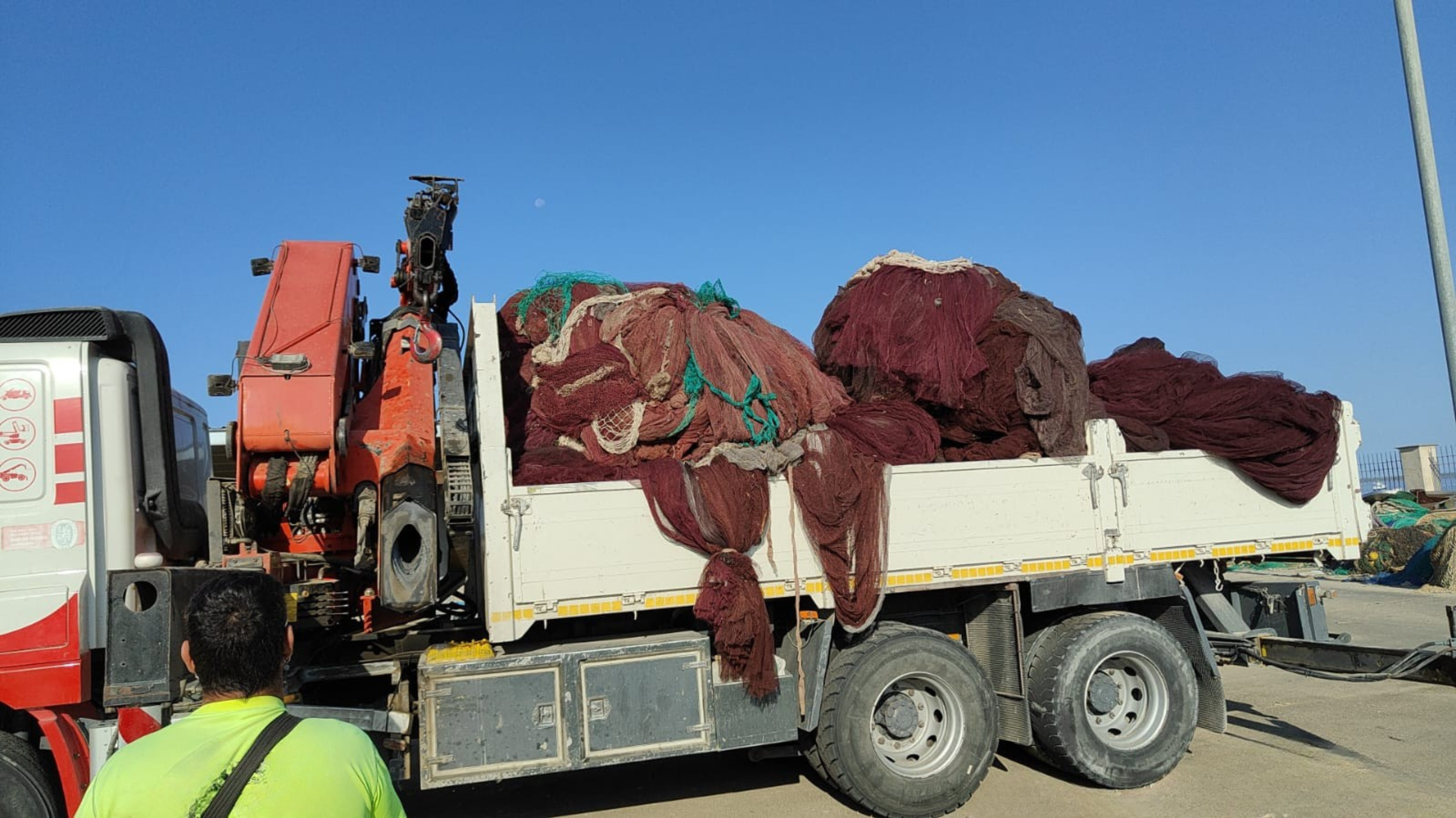
© CEPESCA
Beyond recycling, Redes de España represents regulatory and social innovation in practice. Under the project, which is developed with the support of the Biodiversity Foundation through the Pleamar programme and co-financed by the European Union (EU) through the European Maritime, Fisheries and Aquaculture Fund, a technical regulation has been designed to ensure the traceability of each recovered net, from recovery at port to its reuse as raw material. This system aims to develop into a replicable model across the EU, responding to the Single-Use Plastics Directive and promoting extended producer responsibility.
What differentiates Redes de España from other programmes is its commitment to simplifying recycling work for fishers: all that is needed is to fold and label the gear, with no need to separate its components, and at no extra cost to them. Its second differentiating feature is its inclusive approach. Specific training activities have been carried out in key fishing ports in Spain (in Sanlúcar de Barrameda, Isla Cristina, Burela, Celeiro and Almería) with the participation of guilds, fish producer organisations and social partners. Awareness-raising activities incorporate a gender perspective and work with groups at risk of exclusion, encouraging their inclusion in new marine-waste value chains.
Redes de España demonstrates that the fisheries sector is indeed part of the environmental solution, and can lead the transition towards a true circular economy aligned with the European objectives of sustainability, innovation and social cohesion.

Javier GARAT PÉREZ (Spain)
Secretary-General, Spanish Fishing Confederation (CEPESCA)
© EU/EESC