On 2 June 2026 from 14:30 to 17.30 CEST in Brussels,the Consumers and Environment category of the European Economic and Social Committee (EESC), in partnership with the European Commission's Directorate-General for Environment, organised an EU Green Week partner event.
The 8th meeting of the EU and the Canada Domestic Advisory Groups (DAGs), "DAG-to-DAG meeting", established under the EU-Canada Comprehensive Economic and Trade Agreement (CETA), took place on 1 June 2026.
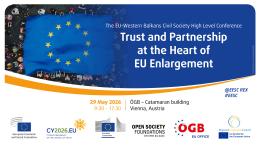
Trust and Partnership at the Heart of EU Enlargement
Event type
Conference
Location
ÖGB ,
Johann-Böhm-Platz 1 A
Vienna
Austria
On 29 May 2026, the European Economic and Social Committee (EESC) organised a High‑Level Civil Society Conference that brought together EU and Western Balkans stakeholders to discuss the role of civil society in advancing EU enlargement, strengthening democratic resilience and supporting socio‑economic convergence in the region.
The 10th meeting of the EU Domestic Advisory Group (DAG) under the EU-Singapore Free Trade Agreement (FTA), will take place on 28 May 2026 at the EESC.
Building on the successful joint meeting held in December, this meeting will be organised together with the EU DAGs for Japan and Korea. The aim is to foster synergies, exchange best practices, and discuss cross-cutting issues relevant to all three DAGs.
Members of the three DAGs will exchange with the European Commission's DG TRADE on the state of play of the implementation of the respective TSD Chapters under the FTAs. Further discussions will include TSD in the digital economy, including AI governance and new forms of work, the implementation of ILO Conventions in Singapore, Korea and Japan, as well as the follow up of the Commission's Evaluation of the impact of EU's agreements on key environmental aspects, including the climate
During the meeting, the EU DAG will also exchange views on EU-Singapore relations and recent developments in Singapore, including their priorities, with Ambassador Heng Aik Yeow, Head of the Mission of the Republic of Singapore to the European Union.
Building on the successful meeting held in December, which gathered also the EU DAGs for Korea and Singapore, the format of the meeting will be the same this time. The aim is to foster synergies, exchange best practices, and discuss cross-cutting issues relevant to all three DAGs.
This public hearing will gather policymakers and civil society stakeholders to discuss on how public banks can better support EU industrial policy, innovation, the scale-up of EU businesses, and, ultimately, economic growth.
The 37th meeting of the EEA Consultative Committee takes place in Vaduz, bringing together EESC and EFTA representatives to discuss key developments within the EEA. The meeting focuses on the future of the EEA Agreement, current policy challenges, and priorities such as jobs, skills and labour mobility.
This public hearing will aim to present and discuss the European Commission's Action Plan against Cyberbullying, bringing together key institutional actors, civil society organisations, social partners and experts to exchange views on effective prevention and response measures. The discussion will contribute to the preparation of the EESC Opinion SOC/869.