
European Economic
and Social Committee
Modernising cohesion policy for a stronger, more resilient EU
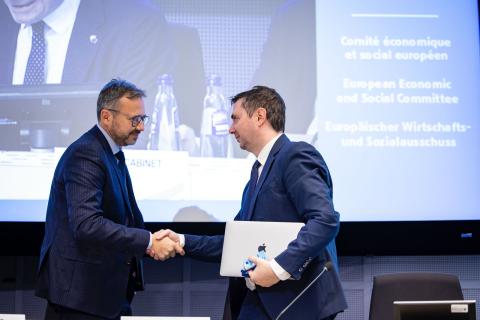
Cohesion policy has long been a pillar of European integration, promoting economic, social and geographical unity across the EU. As the post-2027 Multiannual Financial Framework (MFF) takes shape, it is essential to modernise cohesion policy to increase efficiency, sustainability and responsiveness to new challenges. In a newly‑adopted opinion, the European Economic and Social Committee (EESC) stresses the need for a results‑oriented approach to ensure cohesion policy continues to deliver tangible benefits while reducing inequalities and promoting sustainable competitiveness.
The MFF 2028+ will need a thorough overhaul to support regional development, green and digital transformation and economic competitiveness. Cohesion policy remains vital but must evolve to become more efficient and impactful. With investment needs exceeding EUR 750‑800 billion annually, maintaining robust EU funding is crucial for bridging regional disparities and driving sustainable growth.
As EESC rapporteur David Sventek states, ‘Cohesion policy must remain the EU’s key instrument for regional development. A results-oriented approach ensures that every euro spent contributes to economic and social well-being.’
To meet these challenges, the EESC calls for the EU’s fiscal capacity to be kept at a minimum of 1.8% of EU GDP and the share allocated to cohesion policy to be increased in the next MFF. This is essential to address emerging challenges, including green and digital transitions, demographic shifts and social disparities.
Key principles
To achieve a more effective cohesion policy, the EESC recommends adhering to the following principles:
- partnership and multi-level governance: cohesion policy should be managed through responsibility shared among EU, national, regional and local authorities, ensuring active participation from organised civil society;
- place-based and subject-based approaches: policies should be tailored to the specific needs of different regions, especially those facing structural challenges such as less‑developed, just transition, and vulnerable regions;
- results orientation: financial support should be conditional on measurable outcomes to enhance transparency and ensure funds deliver real socio-economic benefits;
- simplification and social conditionalities: reducing bureaucratic complexity and ensuring investments contribute to social cohesion are key to improving policy effectiveness.
Challenges, risks, and opportunities
A shift towards results-driven cohesion policy presents both opportunities and challenges. While it ensures more efficient allocation of resources and greater accountability, it also requires significant adjustments in implementation, monitoring and evaluation. To address this, the EESC advocates:
- balancing competitiveness with social investment: cohesion policy must ensure that no region is left behind while supporting economic growth;
- technical assistance and capacity‑building: strengthening the role of civil society organisations in policy implementation and oversight is crucial;
- smart oversight: result-based obligations should be integrated into audit and supervision mechanisms without creating unnecessary administrative burdens.
Moving forward
As Florian Marin, co-rapporteur, stresses, ‘We must focus on transparency, efficiency, and inclusivity. A modernised cohesion policy must prioritise measurable impacts while maintaining strong partnerships at all levels.’
The EESC firmly believes that a robust, well-funded and results-driven cohesion policy is crucial for the EU’s long-term prosperity. By reinforcing principles of partnership, simplification and impact-driven investment, the next MFF can ensure that cohesion policy continues to support regional development, foster economic resilience and reduce disparities across Europe.
Work organisation
Recommended for you
Pro odolnost EU má zásadní význam aktivní úloha organizované občanské společnosti
News
Na plenárním zasedání EHSV se diskutovalo o tom, jak roste význam organizované občanské společnosti a měst, neboť ovlivňují schopnost Evropy čelit asymetrickým otřesům a neočekávaným…
Mladí lidé coby hybatelé změn a evropské integrace zemí západního Balkánu
News
V rámci konference občanské společnosti na vysoké úrovni na téma Politika v oblasti mládeže v zemích západního Balkánu, kterou uspořádal Evropský hospodářský a sociální výbor (EHSV),…
České předsednictví chce dát Evropě nové pojetí, novou podobu a nový impuls
News
Jedním z bodů červencového plenárního zasedání Evropského hospodářského a sociálního výboru (EHSV) byla diskuse s českým ministrem zahraničních věcí Janem Lipavským o…
Vaše Evropa, váš názor (YEYS!) 2023: Mladí lidé požadují transparentnější, digitálnější a zjednodušenou EU
News
Evropský hospodářský a sociální výbor (EHSV) uspořádal ve dnech 23. a 24. března 14. ročník akce Vaše Evropa, váš názor (YEYS!). V jejím rámci se v Bruselu sešlo 105 studentů z 35 škol ze všech 27…
Spravedlivý přechod na nízkouhlíkovou společnost není možný bez účasti občanské společnosti
News
Dolní Vítkovice v Ostravě jsou bývalou průmyslovou oblastí, kde se dříve těžilo uhlí a vyráběla ocel. 11. října 2022 se zde na konferenci sešli zástupci akademické obce, místních…