
European Economic
and Social Committee
Modernising cohesion policy for a stronger, more resilient EU
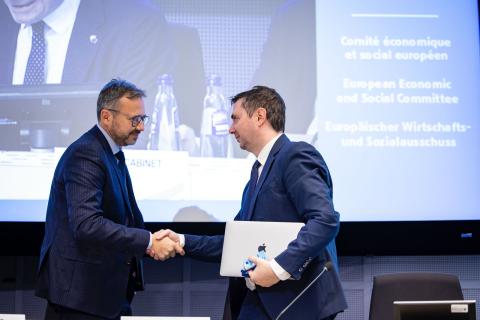
Cohesion policy has long been a pillar of European integration, promoting economic, social and geographical unity across the EU. As the post-2027 Multiannual Financial Framework (MFF) takes shape, it is essential to modernise cohesion policy to increase efficiency, sustainability and responsiveness to new challenges. In a newly‑adopted opinion, the European Economic and Social Committee (EESC) stresses the need for a results‑oriented approach to ensure cohesion policy continues to deliver tangible benefits while reducing inequalities and promoting sustainable competitiveness.
The MFF 2028+ will need a thorough overhaul to support regional development, green and digital transformation and economic competitiveness. Cohesion policy remains vital but must evolve to become more efficient and impactful. With investment needs exceeding EUR 750‑800 billion annually, maintaining robust EU funding is crucial for bridging regional disparities and driving sustainable growth.
As EESC rapporteur David Sventek states, ‘Cohesion policy must remain the EU’s key instrument for regional development. A results-oriented approach ensures that every euro spent contributes to economic and social well-being.’
To meet these challenges, the EESC calls for the EU’s fiscal capacity to be kept at a minimum of 1.8% of EU GDP and the share allocated to cohesion policy to be increased in the next MFF. This is essential to address emerging challenges, including green and digital transitions, demographic shifts and social disparities.
Key principles
To achieve a more effective cohesion policy, the EESC recommends adhering to the following principles:
- partnership and multi-level governance: cohesion policy should be managed through responsibility shared among EU, national, regional and local authorities, ensuring active participation from organised civil society;
- place-based and subject-based approaches: policies should be tailored to the specific needs of different regions, especially those facing structural challenges such as less‑developed, just transition, and vulnerable regions;
- results orientation: financial support should be conditional on measurable outcomes to enhance transparency and ensure funds deliver real socio-economic benefits;
- simplification and social conditionalities: reducing bureaucratic complexity and ensuring investments contribute to social cohesion are key to improving policy effectiveness.
Challenges, risks, and opportunities
A shift towards results-driven cohesion policy presents both opportunities and challenges. While it ensures more efficient allocation of resources and greater accountability, it also requires significant adjustments in implementation, monitoring and evaluation. To address this, the EESC advocates:
- balancing competitiveness with social investment: cohesion policy must ensure that no region is left behind while supporting economic growth;
- technical assistance and capacity‑building: strengthening the role of civil society organisations in policy implementation and oversight is crucial;
- smart oversight: result-based obligations should be integrated into audit and supervision mechanisms without creating unnecessary administrative burdens.
Moving forward
As Florian Marin, co-rapporteur, stresses, ‘We must focus on transparency, efficiency, and inclusivity. A modernised cohesion policy must prioritise measurable impacts while maintaining strong partnerships at all levels.’
The EESC firmly believes that a robust, well-funded and results-driven cohesion policy is crucial for the EU’s long-term prosperity. By reinforcing principles of partnership, simplification and impact-driven investment, the next MFF can ensure that cohesion policy continues to support regional development, foster economic resilience and reduce disparities across Europe.
Work organisation
Recommended for you
Tetyana Ogarkova: "The day of victory will come but it will not bring normality back"
Agenda
On 24 February 2022, the lives of millions of Ukrainians were turned upside down. Now, when we say the word "victory", we expect that day to be the way things used to be. A normal day, a day of peace…
Lutte contre la précarité énergétique: garantir un approvisionnement énergétique abordable devrait figurer au premier rang des priorités politiques des pays de l’UE
News
Alors que le nombre de ménages qui sont dans l’incapacité de chauffer leur logement va vraisemblablement augmenter dans l’Union, avec une inflation annuelle de l’énergie qui dépasse 40 %, il y a…
Les zones rurales ont le potentiel pour produire davantage de résultats
News
Si l’attrait de la vie à la campagne s’est accru ces toutes dernières années, de nombreuses zones rurales de l’Union restent confrontées à un certain nombre de problèmes qui dissuadent les personnes…
Pour lutter contre le sans-abrisme, il faut une approche globale et une action collective
News
Le 7 octobre dernier, le Comité économique et social européen (CESE) a tenu une conférence sur le sans-abrisme et les moyens d’éradiquer ce phénomène d’ici à 2030, en appliquant le principe du…
Un rôle actif pour la société civile organisée est essentiel à la résilience de l’Union européenne
News
Le CESE a tenu un débat en session plénière sur l’importance croissante de la société civile organisée et des villes pour mettre l’Europe en capacité de faire face aux chocs asymétriques et aux…