
European Economic
and Social Committee
Social Dialogue within the Green Transition - Press Release
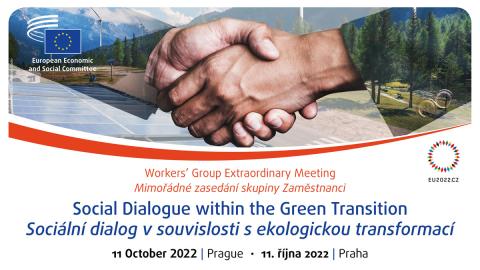
The transition towards a low-carbon economy is a fundamental priority. But the green transition will fail without social dialogue. This represented a general agreement among the discussions during the meeting, particularly if climate policies were not made also socially sustainable and did not take into account the needs and worries of working people, of citizens. Key points raised during the debates included the fact that real wages were decreasing with the soaring inflation, the complementarity of fighting climate change and protecting social rights, and the fundamental role of involving Trade Unions in the design and implementation of policies within the Green Deal.
In the words of Workers' Group president Oliver Röpke, 'we as Workers' Group made it clear from the beginning that we are committed to the green deal, but we always remarked that we need a social deal within the green deal. Collective bargaining and social dialogue have to be the starting point, and from there we must strengthen social protection mechanisms. At EU level, we must set minimum standards, such as with unemployment benefits'. In his concluding remarks he noted that 'Green transition can be an opportunity to reduce disparities among citizens, and among European regions. More upwards social convergence is needed. We have seen in this meeting that we're far from alone in this desire'
The different speakers and members, during the debates, noted the need to support regions and workers in transition, recognising the challenges of job losses, the need not just for reskilling of workers, but also for financial support. Likewise, the need to develop new institutional tools, different from SURE but inspired by it, was also commented, as many things had changed since the early days of the European Pillar of Social Rights.
The first panel of the meeting, reviewing at first the midterm of the Czech Presidency, highlighted the priority occupied by the energy crisis and the Russian invasion of Ukraine in all current EU policies, and discussed the different challenges that this poses to the fight against climate change, with Marian Jurečka and Pavlina Zaková from the Czech government, and Josef Středula and Bohumír Dufek from the Czech Trade Unions ČMKOS and ASO respectively.
Picking on the tension between the current situation and climate change, the second debate pointed out that these goals were not opposite, but rather self-reinforcing, as ensuring energy security, countering Putin's autocracy, and lowering energy prices all needed the same effort against fossil fuels. With the scene of the challenges for the energy transition set up by CASE researcher Agnieszka Kulesa, the panel moderated by EESC member Lucie Studničná counted with interventions by MEP Mikuláš Peksa, ETUC Confederal Secretary Ludovic Voet, and Workers' Group President Oliver Röpke.
Drawing on the conclusion that only extensive social dialogue and strong social policies at all levels could make the different challenges work in synergy to deliver a just transition, the final panel of the day, moderated by Workers' Group president Oliver Röpke counted with intervention of Commissioner for Jobs and Social Rights Nicolas Schmit, Deputy Minister for Legislation Dana Roučková, ČMKOS Vice-President Radka Sokolová, Chief Secretary of the employer organisation KZPS Jan Zikeš, and President of Healthcare and Social Care Union Dagmar Žitníková.
You can rewatch the morning and afternoon sessions in full (English language only) here
Work organisation
Recommended for you
Pro odolnost EU má zásadní význam aktivní úloha organizované občanské společnosti
News
Na plenárním zasedání EHSV se diskutovalo o tom, jak roste význam organizované občanské společnosti a měst, neboť ovlivňují schopnost Evropy čelit asymetrickým otřesům a neočekávaným…
Mladí lidé coby hybatelé změn a evropské integrace zemí západního Balkánu
News
V rámci konference občanské společnosti na vysoké úrovni na téma Politika v oblasti mládeže v zemích západního Balkánu, kterou uspořádal Evropský hospodářský a sociální výbor (EHSV),…
České předsednictví chce dát Evropě nové pojetí, novou podobu a nový impuls
News
Jedním z bodů červencového plenárního zasedání Evropského hospodářského a sociálního výboru (EHSV) byla diskuse s českým ministrem zahraničních věcí Janem Lipavským o…
Vaše Evropa, váš názor (YEYS!) 2023: Mladí lidé požadují transparentnější, digitálnější a zjednodušenou EU
News
Evropský hospodářský a sociální výbor (EHSV) uspořádal ve dnech 23. a 24. března 14. ročník akce Vaše Evropa, váš názor (YEYS!). V jejím rámci se v Bruselu sešlo 105 studentů z 35 škol ze všech 27…
Spravedlivý přechod na nízkouhlíkovou společnost není možný bez účasti občanské společnosti
News
Dolní Vítkovice v Ostravě jsou bývalou průmyslovou oblastí, kde se dříve těžilo uhlí a vyráběla ocel. 11. října 2022 se zde na konferenci sešli zástupci akademické obce, místních…