
European Economic
and Social Committee
Social Dialogue within the Green Transition - Press Release
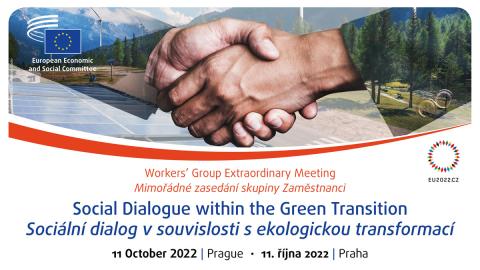
The transition towards a low-carbon economy is a fundamental priority. But the green transition will fail without social dialogue. This represented a general agreement among the discussions during the meeting, particularly if climate policies were not made also socially sustainable and did not take into account the needs and worries of working people, of citizens. Key points raised during the debates included the fact that real wages were decreasing with the soaring inflation, the complementarity of fighting climate change and protecting social rights, and the fundamental role of involving Trade Unions in the design and implementation of policies within the Green Deal.
In the words of Workers' Group president Oliver Röpke, 'we as Workers' Group made it clear from the beginning that we are committed to the green deal, but we always remarked that we need a social deal within the green deal. Collective bargaining and social dialogue have to be the starting point, and from there we must strengthen social protection mechanisms. At EU level, we must set minimum standards, such as with unemployment benefits'. In his concluding remarks he noted that 'Green transition can be an opportunity to reduce disparities among citizens, and among European regions. More upwards social convergence is needed. We have seen in this meeting that we're far from alone in this desire'
The different speakers and members, during the debates, noted the need to support regions and workers in transition, recognising the challenges of job losses, the need not just for reskilling of workers, but also for financial support. Likewise, the need to develop new institutional tools, different from SURE but inspired by it, was also commented, as many things had changed since the early days of the European Pillar of Social Rights.
The first panel of the meeting, reviewing at first the midterm of the Czech Presidency, highlighted the priority occupied by the energy crisis and the Russian invasion of Ukraine in all current EU policies, and discussed the different challenges that this poses to the fight against climate change, with Marian Jurečka and Pavlina Zaková from the Czech government, and Josef Středula and Bohumír Dufek from the Czech Trade Unions ČMKOS and ASO respectively.
Picking on the tension between the current situation and climate change, the second debate pointed out that these goals were not opposite, but rather self-reinforcing, as ensuring energy security, countering Putin's autocracy, and lowering energy prices all needed the same effort against fossil fuels. With the scene of the challenges for the energy transition set up by CASE researcher Agnieszka Kulesa, the panel moderated by EESC member Lucie Studničná counted with interventions by MEP Mikuláš Peksa, ETUC Confederal Secretary Ludovic Voet, and Workers' Group President Oliver Röpke.
Drawing on the conclusion that only extensive social dialogue and strong social policies at all levels could make the different challenges work in synergy to deliver a just transition, the final panel of the day, moderated by Workers' Group president Oliver Röpke counted with intervention of Commissioner for Jobs and Social Rights Nicolas Schmit, Deputy Minister for Legislation Dana Roučková, ČMKOS Vice-President Radka Sokolová, Chief Secretary of the employer organisation KZPS Jan Zikeš, and President of Healthcare and Social Care Union Dagmar Žitníková.
You can rewatch the morning and afternoon sessions in full (English language only) here
Work organisation
Recommended for you
Az egészségügyi ágazatbeli közszolgáltatások közös létrehozása erősíteni fogja a demokrácia részvételi jellegét az EU-ban
News
Az Európai Gazdasági és Szociális Bizottság (EGSZB) és a Debreceni Egyetem által szervezett rendezvény rávilágított, mennyire fontos az általános érdekű szolgáltatások közös létrehozása az…
YEYS! 2023: A fiatalok átláthatóbb, digitalizált és egyszerűbb EU-t szeretnének
News
Március 23-án és 24-én az Európai Gazdasági és Szociális Bizottság (EGSZB) immár 14. alkalommal adott otthont a „Your Europe, Your Say!” (A Te Európád, a Te szavad! – YEYS!) című rendezvénynek. Erre…
Az EGSZB megnyitja a jelentkezést civil társadalmi díjára, melynek témája a mentális egészség
News
Civil társadalmi szervezetek, magánszemélyek és magánvállalkozások mostantól nevezhetik nonprofit projektjeiket az európai polgárok mentális jólétének támogatásának szentelt EGSZB-díjra. Az Európai…
Az EGSZB felhívása: 2024 júniusában szavazzunk egy egységes és demokratikus Európai Unióra!
News
A demokrácia világszerte hanyatlik, a növekvő infláció és a háború fenyegető veszélye közepette a dezinformáció térnyerése és egyre nagyobb elégedetlenség tapasztalható. Nagy tehát a tétje az új…
Az Európai Gazdasági és Szociális Bizottság készen áll arra, hogy együttműködjön az EU Tanácsának magyar elnökségével
News
Az Európai Gazdasági és Szociális Bizottság (EGSZB) júliusi plenáris ülésén Oliver Röpke EGSZB-elnök vitát tartott Bóka János európai uniós ügyekért felelős miniszterrel, aki ismertette az EU Tanácsa…