European Economic
and Social Committee
European Economic
and Social Committee
The European Economic and Social Committee (EESC) is the voice of organised civil society in Europe.
Find out more about its role and structure at http://www.eesc.europa.eu/en/about
The EESC issues between 160 and 190 opinions, evaluation and information reports a year.
It also organises several annual initiatives and events with a focus on civil society and citizens’ participation such as the Civil Society Prize, the Civil Society Days, the Your Europe, Your Say youth plenary and the ECI Day.
Find the latest EESC opinions and publications at http://www.eesc.europa.eu/en/our-work/opinions-information-reports/opinions and http://www.eesc.europa.eu/en/our-work/publications-other-work/publications respectively.
The EESC is active in a wide range of areas, from social affairs to economy, energy and sustainability.
Learn more about our policy areas and policy highlights at http://www.eesc.europa.eu/en/policies
The EESC holds nine plenary sessions per year. It also organises many conferences, public hearings and high-level debates related to its work.
Find out more about our upcoming events at http://www.eesc.europa.eu/en/agenda/our-events/upcoming-events
Here you can find news and information about the EESC'swork, including its social media accounts, the EESC Info newsletter, photo galleries and videos.
Read the latest EESC news http://www.eesc.europa.eu/en/news-media/news and press releases http://www.eesc.europa.eu/en/news-media/press-releases
The EESC brings together representatives from all areas of organised civil society, who give their independent advice on EU policies and legislation. The EESC's326 Members are organised into three groups: Employers, Workers and Various Interests.
Find out more about our Members and groups at http://www.eesc.europa.eu/en/members-groups
The EESC has six sections, specialising in concrete topics of relevance to the citizens of the European Union, ranging from social to economic affairs, energy, environment, external relations or the internal market.
Find out more at http://www.eesc.europa.eu/en/sections-other-bodies
Europeiska ekonomiska och sociala kommittén (EESK) välkomnar det faktum att 2022 har utsetts till Europaåret för ungdomar, men känner att detta bör omfatta mer än rena marknadsföringsaktiviteter. Året bör bidra till EU:s ungdomsstrategi genom tydliga planer och åtaganden som syftar till att uppnå konkreta resultat för alla unga européer.
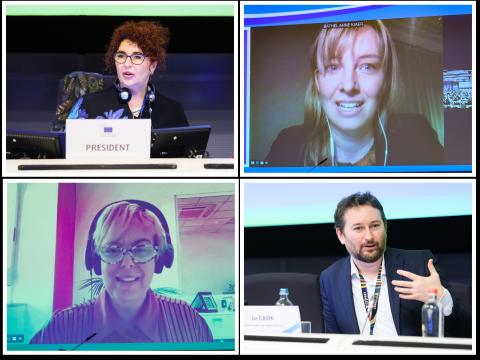
EESK debatterade Europaåret för ungdomar 2022 vid sin plenarsession i januari, med deltagande av Anne Kjær Bathel, företrädare för programmet European Young Leaders, Joe Elborn, generalsekreterare för Europeiska ungdomsforumet, och Miriam Teuma, ordförande för Europeiska styrkommittén för ungdomsfrågor.
EESK:s ordförande Christa Schweng menade att det är viktigt att ungdomar är med när dagens och morgondagens politik utformas. ”De är framtiden, så att göra dem delaktiga och investera i dem är avgörande för bygget av stabila, fredliga och hållbara samhällen och för utvecklingen av en politik som svarar mot de särskilda behov som yngre generationer har”, fortsatte hon.
EESK har unika förutsättningar för att kunna arbeta och samverka med nätverk för unga och är redo och villigt att spela en ledande roll i året för ungdomar och därigenom bygga vidare på kommitténs framgångsrika initiativ, såsom Ditt Europa din mening!, rundabordssamtalen om klimat och hållbarhet för ungdomar och EU:s klimattoppmöte för unga som anordnas tidigt på sommaren.
EESK ser fram emot att bidra till Europaåret för ungdomar 2022. Året måste ge konkreta resultat för Europas ungdomar på politikområden som påverkar deras liv. (ks)